Rathnapureeswarar Temple
Rathnapureeswarar Temple in Tiruvarur district, Tamil Nadu, is a revered Shaivite shrine among the Paadal Petra Sthalams. Dedicated to Lord Shiva, it reflects Chola-era architecture and rich devotional heritage. Rathnapureeswarar Temple is a Shaivite temple located in Tiruvarur district in Tamil Nadu. This 1000 years old temple is said to have been built by King Ratnendra Chola.

Share this Article:

Introduction

Rathnapureeswarar Temple, dedicated to Lord Shiva, is an ancient Hindu temple located in Thirunattiyathangudi in Thiruvarur district in the Indian state of Tamil Nadu. Thirunattiyathangudi is regarded as the birthplace of Kotpuli Nayanar. He is noted to be one of the 63 Nayanmars, a group of Tamil devotional saints of the 6th–8th century who were dedicated to Lord Shiva. Kotpuli Nayanar attained salvation for his pure devotion to Lord Shiva. These 63 Nayanmars were known for their unwavering bhakti or devotion and religious poetry. The temple finds its mention in the hymns sung by Sundarar in the Thevaram. The temple, earlier known as Natiyathankudi after the village where it is located, dates back to almost 1000 years and is believed to be built by King Ratnendra Chola.


Significance of Rathnapureeswarar Temple

In Rathnapureeswarar Temple. Lord Shiva is the moolavar or the presiding deity of the temple. Here he is worshipped in his manifestation as Rathnapureeswarar. Lord Shiva is also known as Manikkavannar. His consort, Parvati, is known as Mangalambikai. The murthy of idol in the temple is Swayambhu murthi. This means an idol that is believed to have originated on its own rather than being sculpted or installed by human hands. 

The Rathnapureeswarar Temple is recognized as one of the revered shrines among the 275 Paadal Petra Sthalams, a distinguished group of Shiva temples celebrated in the Tamil Shaiva tradition. These sacred sites, also known as Devara Sthalams, hold immense religious significance as they are praised in the devotional hymns composed by the Shaiva Nayanars. This is the 118th temple located on the banks of the River Cauvery that finds mention in Thevaram. 

The temple finds its place in the early medieval Thevaram, which constitutes the first seven volumes of the twelve-part Tirumurai. This canonical collection serves as a profound Shaiva narrative, blending elements of epic and Puranic traditions while also offering a hagiographical account of the early Shaiva saints. Through the devotional poetry, the Tirumurai immortalizes the spiritual legacy of these saints, thereby enhancing the sanctity and historical importance of the Rathnapureeswarar Temple.


Legend of Rathnapureeswarar Temple

An interesting legend associated with the temple states that once a Chola king, Ratnendra Chola thought of dividing diamonds present in the treasury with his brother. He was however, not able to reach a compromise. At this point, Lord Shiva is thought to have appeared before them in the form of a diamond merchant and helped them with their job. In appreciation and gratitude, Ratnendra Chola constructed the Rathnapureeswarar Temple.


Structure of Rathnapureeswarar Temple

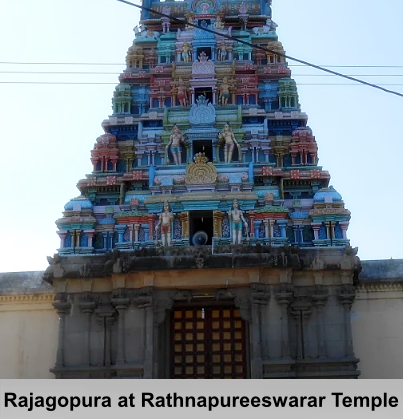
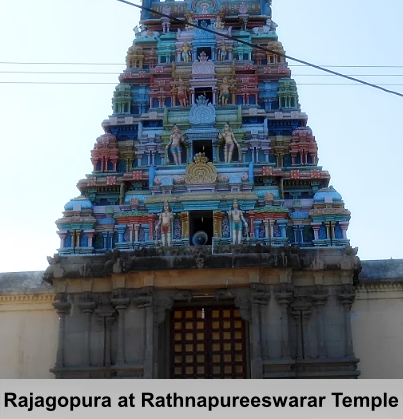
The Rathnapureeswarar Temple features several key architectural and devotional elements that are characteristic of traditional South Indian temple design. Prominently, there is a Rajagopura, Dhwaja Stambha, and the sacred figure of Nandi. The Rajagopura, or gopuram, serves as a monumental and often intricately ornamented entrance tower, a defining feature of Dravidian-style temple architecture. Here, the Rajagopura has a five-tier structure. The Dhwaja Stambha, or flagstaff, stands erected before the mukhamandapa or the front pavilion of the temple, marking an important ritual axis of the temple. Nandi, the revered bull and vahana (mount) of Lord Shiva, is also enshrined within the temple complex, symbolizing devotion and strength.

Within the prakara, or the outer circumambulatory passage surrounding the sanctum, several shrines are dedicated to prominent Shaivite saints and deities. These include Kotpuli Nayanar, Gnanasambandar, Navukkarasar, Sundarar, and Manikkavacakar, along with deities such as Vinayaka, Muruga accompanied by Valli and Deivanai, Kasi Visvanathar, Visalakshi, Gajalakshmi, and Sandikesvara. These figures hold deep religious significance and are closely associated with the worship of Lord Shiva. There is also a small temple dedicated to the Navagrahas or nine planets.

The Kosta, or the outer walls of the inner sanctum which is the garbhagriha, are adorned with sculptural representations of important deities, including Lord Vinayaka, Dakshinamurti, Lingodbhava, Brahma, and Durga. Additionally, a shrine dedicated to Goddess Parvati is situated to the left of the sanctum sanctorum of the presiding deity, further emphasizing the divine union central to Shaivite worship. Goddess Parvati is venerated in the form of Mangalambikai, depicted in a benevolent posture that symbolizes prosperity and grace. Her iconography emphasizes her role as the nurturing embodiment of the divine feminine, adorned with traditional ornaments and often accompanied by attendant figures. This representation aligns with classical Tamil temple artistry, where the goddess personifies auspiciousness (mangala).

Within the mahamandapa, shrines dedicated to the Nayanmar saint Kotpuli and Lord Nataraja further enrich the temple’s spiritual and artistic elegance. The presence of Kotpuli Nayanar reflects the integration of hagiographic traditions, while the bronze image of Nataraja captures the cosmic tandava, the dynamic dance symbolizing the cycles of creation and destruction.

In the outer precincts of the temple, directly facing the rajagopura, there is also a shrine dedicated to Lord Vinayaka, the son of Lord Shiva and Goddess Parvati, signifying his role as the remover of obstacles and the deity traditionally worshipped at the commencement of all auspicious undertakings. All the deities in the temple are wearing a Rudraksha called Makarakandiga.


Festivals at Rathnapureeswarar Temple

Rathnapureeswarar Temple celebrates the festival of Kotpuli Nayanar Guru Puja on Jeshta day in the Tamil month of Aadi, that is during the months of July and August. Kotpuli Nayanar is remembered as a devoted commander in the Chola army. During a time of famine, he had set aside grain specifically for the service of Shiva’s devotees. However, upon discovering that his relatives had consumed this reserved grain out of necessity, he regarded it as a violation of his sacred vow. In an extreme act driven by his uncompromising devotion, he punished them by taking their lives, thereby upholding what he believed to be his duty to Lord Shiva. This episode is often cited in Shaivite tradition as a powerful, though severe, illustration of absolute devotion and steadfastness in religious commitment. 

The Puja is observed on the Kettai Nakshatram where Lord Shiva and Kotpuli Nayanar are worshipped. People offer prayers, perform abhishekam, and also offer vastra as an expression of their devotion. Another important celebration at the temple is the Nadavu Utsavam, which is observed during the Tamil month of Aadi. This festival holds special significance and involves dedicated rituals performed to invoke prosperity and divine protection, reflecting the temple’s deep-rooted heritage dating back to the Chola period

Besides, the temple also celebrates other festivals associated with Lord Shiva such as Mahashivaratri and Pradosham with elaborate abhishekam ceremonies. The Tamil months of Aani (June–July) and Margazhi (December–January) are marked by heightened religious activities. During these periods, special thirumanjanam (ritual ablutions) are conducted for the presiding deity, accompanied by the devotional recitation of Thevaram hymns. These practices highlight the temple’s enduring role in the Shaivite tradition, long celebrated by revered saints such as Sundarar.


Share this Article:

More Articles in Temples of India


Khajuraho Temples
Khajuraho Temples are known the world over for their beauty and architectural construction. This group of temples is situated in the central Indian state of Madhya Pradesh.
Temples In Hampi
Temples in Hampi are the manifestations of rich religious beliefs and architectural and sculptural abundance.
Dilwara Temples
Dilwara Temples located at Mount Abu date back from the 11th to 13th century and rank among the popular tourist destinations of Rajasthan.
Chola Temples
Chola Temples of South India comprises of the three great temples that were constructed in the 11th and 12th century and is declared as a World Heritage Site.
Badami Cave Temples
The Badami Cave Temples, an exemplary production of Indian architecture, are situated in the town of Badami.
Temples in Guwahati
Known to be the temple town of Assam, the temples in Guwahati are a reflection of the Assamese style of culture and architecture.
West India Temples
West India Temples are worth a visit for their beautifully designed masterpieces on stone.
North Indian Temples
India has a rich cultural and historical heritage because of its temples and pilgrimage sites. The North Indian Temples are in plenty and cater to people of all religion.
South Indian Temples
South Indian Temples lavishly built and aesthetically designed, in true sense are the symbol of architectural brilliance.
East India Temples
East India temples are really fascinating and enthralling and visit to these places can mesmerize a person very easily.
Northeastern Temples of India
Religious fervor and spiritual passion enlaces the northeastern temples of India.
Central India Temples
Central Indian temples amidst their religious fervour reverberates the true spirit of Hinduism.
Temple Architecture During Rajput Period
Temple architecture during the Rajput period was inclined to the aspect of Bhakti. Rajput kings encouraged this art which is reflected in the grandeur style of the temples.
Architecture of Mata Vaishnodevi Temple
Architecture at Vaishnodevi has been the source of artistic enjoyment for many, reinstating the vitality of the Indian religiosity and cultural fervour.
History of Sri Sanjeevi Rayar Temple
Steeped in glorious history this is indeed a legendary temple.
Temples in Munnar
Munnar houses myriad temples that are visited by many devotes throughout the year. The temples of Munnar are especially known for their festivals that are celebrated with great grandeur.
History of Indian Temples
The history of Indian temples dates back to the ancient ages and variant dynasties that have ruled throughout the ages. Every temple of every region has a story attached to it that reflects the cultures of the specific dynasty.
Kalyaneshwari Temple
Kalyaneshwari Temple is one of the well known Shakti peeth of India. Located at a distance of 20 kms from Asansol this age old temple is known for its miracles and a number of legends that attract the devotees and tourists as well.
Kalika Temple in Udhampur
Also known as Maha Kali Temple, the Kalika Temple located at the Reasi town is a holy shrine.
Medieval Temples of India
Medieval temples of India vary from each other due to the style and architecture. The impact of the prevalent kingdom is prominent in the style of building.
Temples of Ramanathapuram District
Temples of Ramanathapuram district have special significance in the state, owing to its architectural attributes.
Architecture of Brihadeeswarar Temple
Architecture of Brihadeeswarar Temple in Thanjavur reflects the Dravidian style architecture. Lord Shiva is the primary deity of this temple.