 Indian crops are essential factors for the survival and growth of the nation. Being an agrarian country, it is natural that multitudes of crops are available in India. India produces around 193 million tonnes of a number of food grains, each year. Indian crops not only nourish the life of the Indian populace with their nutritional values, but also bring loads of revenue from abroad. Most of the Indian villages are hub of crops that are exported to various foreign countries. Ample supply of water for irrigation in India, multiplied by high tech machines and techniques have accelerated the growth of Indian crops to a large extent. Paddy, wheat, barley, maize, millets like jowar (great millet), bajra (pearl millet) and ragi (finger millet) are the major Indian crops.
Types of Indian Crops
Indian crops are of two types namely, food crops and cash crops. These crops are described below.
Indian Food Crops
Indian food crops are those agricultural outputs which are used for consumption. Some of the food crops are described below.
Rice
Rice is the basic food crop of India. This crop is grown in abundance in the western coastal strip and the eastern coastal strip of the country covering all the primary deltas, Assam plains and surrounding low hills, foothills and Terai region along the Himalayan Mountain Range, Bihar, West Bengal, northern Andhra Pradesh, eastern Uttar Pradesh, eastern Madhya Pradesh and the entire Indian state of Odisha. Rice forms one of the prominent food crops of eastern India.
Wheat
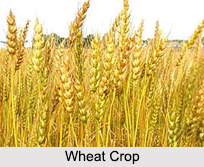
Wheat forms one of the oldest crops introduced in India and it grows well on a soil type called loamy soils of the plains of northern India covering Haryana, Punjab, western Uttar Pradesh, Bihar, Gujarat, Rajasthan, Maharashtra and Madhya Pradesh in India.
Pulses
Pulses include grams (chana), arhar or moong, lentil (masur), black gram (wad) and peas (matar). India is the largest consumer and producer of pulses. Pulses are grown all around the country, excluding areas with plentiful rainfall.
Sugarcane
Sugarcane production in India is the highest in the world. India has the largest surface area under sugarcane. The Indian state of Uttar Pradesh is a leading producer of sugarcane and the other states where it is grown are Punjab, Andhra Pradesh, Maharashtra, Bihar, Karnataka and Tamil Nadu.
Other Indian Food Crops
Other Indian food crops are maize, jowar and bajra.
 Indian Cash Crops
Indian cash crops are those agricultural products which are used for business or commercial purposes. It can thus be comprehended that they play an important role in enriching Indian economy. Some of these crops are described below.
Jute
Jute cultivation is believed to have started in India as early as 800 B.C., for manufacturing cordage, cloth and paper. Jute is called the `brown paper of wholesale trade` since it is used for packing many commodities such as cotton, rice, wool, wheat, sugar, fertilizer, pulses and cement. Jute is also used for manufacturing rugs, carpets, tarpaulins, ropes, upholstery and strings.
Tea
Tea requires hot climate, excess rainfall and sloppy soil to be cultivated in India. Tea is grown mostly in Assam. Other Indian states where tea is cultivated are Karnataka, Kerala, Himachal Pradesh, Bihar, etc.
Coffee
Coffee can be grown in wet climate and fertile sloppy land. Coffee produced in India is considered to be the finest coffee in the world grown in shade rather than direct sunlight. Coffee cultivation takes place in the states of Karnataka, Kerala and Tamil Nadu.
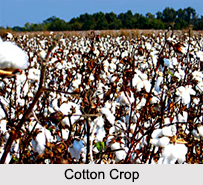
Cotton
Cotton can be grown in uniformly high temperatures varying between 21 degree Celsius and 30 degree Celsius. It can be grown in tropical and sub-tropical areas and areas having at least 210 frost free days in a year. The states of Punjab, Haryana, Gujarat, Maharashtra, Tamil Nadu and Karnataka, etc produce cotton In India.
Rubber
Rubber can be grown in hot and humid climate and in areas receiving annual rainfall of over 200 cm. It requires rainfall to be well distributed throughout the year. In India, rubber is cultivated in Kerala, Karnataka, Andaman and Nicobar Islands, etc.
Jute, cotton, cashew are the Indian cash crops that are mostly found in regions like West Bengal, Odisha, Haryana, Assam, etc.
Other Indian Cash Crops
Other Indian cash crops are silk, tobacco, oilseeds, Jute and Mesta, etc.
Indian Crops
Indian crops help in creating food security in India. The type of soil and climate in different parts of India control the type of crops produced in those regions. India has attained the status of being one of the world`s largest suppliers of crops like rice, cotton, sugar and wheat.