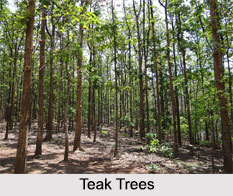
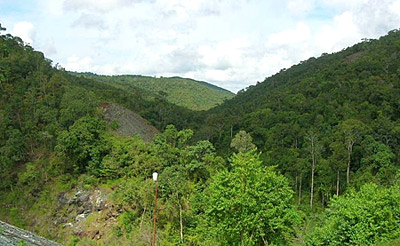
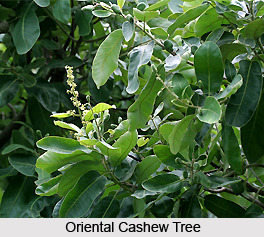
 The oriental cashew tree is also known as marking nut tree, commonly found throughout the sub-Himalayan and tropical regions of India, particularly in deciduous forests of peninsular India and in the foothills of the Himalayas to an elevation of 1000 m. The botanical name of the Oriental Cashew tree is Semecarpus anacardium. The common name of this tree varies according to the region of India. Each State has a separate name, such as in Bengali it is popular as Bhela and Bhelatuki, in Hindi it is known as Bhela, Bhelwa, Bhilawa and Bhilwan, in Sanskrit it is known a Bhallataka and Bhal-latakah and in Punjabi the Oriental Cashew tree is popularly known as Bhela, Bhi-ladar and Bhilawa.
Oriental Cashew tree is basically a small medium-sized deciduous tree, up to 15 meter tall, with rough, dark brown bark. The leaves of this tree are large, oblong and simple which are 17-60 cm long and 10-30 cm wide. The fruits are 2.5 cm long, obliquely ovoid, smooth and shiny. These fruits become black in colour after ripening.
The Oriental Cashew trees have a great value in medicinal purpose and are used for the treatment of different diseases. The fruits of these trees are pungent and hot and are useful for the treatment of the diseases like tumours and warts, acute rheumatism, asthma, neuralgia, epilepsy and many more. These fruits are considered as a toxic drug in Ayurvedic practice and is used an ingredient of numerous important Ayurvedic medicine preparations.
The extracts from the Oriental Cashew tree are effective on human tissue culture. The nut juice helps to the patients suffering from mouth and oesophageal cancer, resulting in the relief and extension of survival time. When these nuts are boiled in milk, the extracts become useful in backache treatment.
In different regions the seed oil of the Oriental Cashew tree is used for the treatment of coughs and colds. The gum or gum resin exuded from the cut bark is used to treat leprous affections and nervous debility. Roots cooked in sour rice water are used for the treatment of sterility in women. In few parts of India, the roots are also taken internally for the treatment for eczema.