Introduction
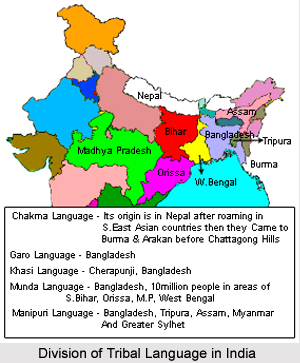 Indian subcontinent consists of an umpteen number of separate linguistic communities, at times sharing a common language and culture and again, at times standing in huge difference in dialects. It is already acknowledged that cosmopolitan and metropolitan populace possesses their indigenous sophisticated version of language and mode of communication. However, the point of interest in this context is the mode of utilisation of the language of tribes and tribal population in the country.
Tribal people make up 8.2 percent of the nation`s total population, which adds to over 84 million people, according to the 2001 Indian census. Tribal people are essentially an aboriginal community residing in India, possessing their own customs and languages. With their own mellifluous and rational style of living, Indian tribesmen are almost secluded in their universe, cut off from the rest of `civilised` society. As such, it has since long remained a point of much curiosity and research about the kind of daily life they lead, or the style of language they employ. Indeed, Indian tribal languages are perhaps the second most enamouring topic of daily discussion, with the first being accredited to tribal dance and jewellery.
Different Types of Indian Tribal Language
Indian tribal language can be defined as essentially `folk` languages, possessing no literary specifications of their own and spoken by people of ethnic groups who prefer to live in relatively isolated groups. Indian tribal languages can simply be defined as the traditional languages utilised by the tribal folk. The languages used by tribal communities in India are indeed quite complex, but still priceless relics of India`s past and nearly overshadowed glory. This is the precise reason why they are preserved orally in the form of songs, legends and other tales. Some of the leading tribal language-speaking groups comprise: Garo tribes, Chakma tribes, Naga tribes, Gond tribes, Mizo tribes, Munda tribes, Santhali tribes, Khasia tribes, Oraon tribes and the tribe of Manipur.
Some of the tribal languages prevalent in India are Abujmaria, Garo, Aariya, and Tsangla, Saurashtri etc.The Garo language is spoken by the tribal communities residing in and around Garo hills, Meghalya, Tripura, Western Assam, and Nagaland. Several dialects of this language include Megam, Chisak, Atong etc. Another tribal language is Abujmaria which is spoken by the people of Abujmar hills in Bastar District. The Hill Maria tribal community uses this language as their medium to converse with their folks. This language is of Dravidian language family. Saurashtri is another tribal language which is also termed as Patnuli. Tribal communities residing in different parts of Andhra Pradesh, parts of Karnataka, North Arcot and Chennai speak in this language. Apart from these tribal languages, there are some other tribal languages namely Gadaba spoken by the people of Koraput district of Orissa. Aariya is another tribal language spoken by the tribal communities of Madhya Pradesh and Tsangla spoken in some villages of Arunachal Pradesh.
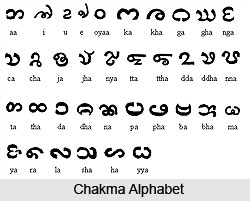
Indian tribal languages are extremely well organised and orderly, owing to a developed past and the enlightened educational interference. Garo and Chakma languages have a slight Chinese hint to their diction. There lies an elementary similarity between the Garo and Magh languages, as both tribes belong to the same origin. Munda, Santhali, Kol, Khasia, Garo and Kurukh language are interrelated languages. Munda and Kurukh are regarded as equivalent languages, due to the syntax and verbs of both are almost identical. Munda, Santhali and Kol languages are even more ancient than the Indo-Aryan languages. These tribal languages further belong to Austro-Asian, Indo-Chinese, and Chinese-Tibetan, Tibetan-Burman or Dravidian families. As these tribal groups have mostly migrated from places mentioned, they have adopted their language principally from those nations.
Indo Aryan Tribal Languages
Indo-Aryan Family: Assamese language , Baigani, Banjari, Bengali language,, Bhatri, Bhili, Bhunjia, Chakma, Chhattisgarhi, Dhanki, Dhodia, Dhundhari, Gadiali, Gamit/Gavti, Garasia/Girasia, Gojri/Gujjari, Gujarati language, Hajong, Halbi, Harauti, Hindi language, Jaunsari, Kachchi, Khotta, Kinnui, Kokni, Konkani language, Kotwalia, Kudamamali, Thar, Lambani or Lamani language, Laria, Magahi, Mahl, Marathi language, Mavchi, Mewnri, Nagpuri, Naikadi, Nimari, Oriya language, Rathi, Sarhodi, Shina, Tharu, Wagri, Warli.
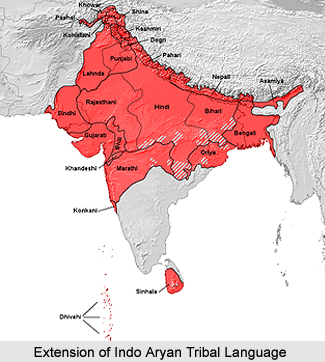 Indo Aryan tribal language speakers are distributed and scattered over a huge geographical territory of the country. The speakers of this family of tribal language comprise over a total population of almost 491 million people. The northern, eastern, western and central portions of India are full with people who speak the Indo Aryan languages. There are almost 574 mother tongues in the Indo Aryan family of tribal languages. Some of the languages are supposed to have great literary traditions and activities. In the family of Indo Aryan tribal languages there is actually no dearth of philological literature.
Types of Indo Aryan Language
There are three main languages in the Indo Aryan family of languages and these are Bhili language, Khandeshi language and Halabi. These three languages have been categorized as tribal languages. They are mainly spread over several districts of states like Gujarat, Madhya Pradesh, Rajasthan and Maharashtra. In the Bhili language group there are almost 36 dialects that are spoken by the people. Some of the important mother tongues of this group are Boari, Bhilali, Barel, Chodhri, Dhodia, Garasi, Kokna or Kokni/ Kukna, Gamti, Pardhi, Mawchi, Wagdi and more.
Khandeshi group of language in the Indo Aryan family of tribal languages comprises almost five main mother tongues. This language is spoken by a total of almost 1.2 million persons. The third main language of this group of tribal language that is the Halbi or Halabi is spoken by over 5 lakh people in the states of Maharashtra and Madhya Pradesh. Thus, around 26 per cent of the total population of the country are the speakers of these major tribal languages belonging to the Indo Aryan family of languages.
Distribution of Indo Aryan Language
Research shows that in India, a total of 83 groups of tribal languages are identified. Out of which 3 belong to the Indo Aryan family. Kanauji is an Indo Aryan language that is spoken in several parts of Uttar Pradesh and its major dialect is Tirhari. Another prominent Indo Aryan tribal language is sometimes called `Gypsy` language and is spoken by near about 60,000 people in areas of Madhya Pradesh, Andhra Pradesh, Rajasthan and Uttar Pradesh. Its main dialect is kuchbandhi.
Kawari and Katkari languages belonging to the Indo Aryan tribal language family are spoken by people of areas of Madhya Pradesh, Gujarat and Maharashtra. In fact, in Raipur district of Madhya Pradesh, number of people speaking this Indo Aryan tribal language is around 33 thousand. Khandesi is another Indo Aryan tribal language and its main dialects are Kunbi, Ahirani, Rangari, etc. It is spoken by the tribes of some parts of Gujarat and Maharashtra. Tribes of the state of Jammu and Kashmir speak Kishtwari, belonging to the Indo Aryan group of tribal languages. Koch is spoken by tribes of Tripura and Assam and in Cooch Behar district of the state of West Bengal. Konkani and Goanese are two very popular Indo Aryan tribal languages that are spoken in coastal areas of Maharashtra and Goa.
Hence, it is proved by the fact that the major regions where the Indo Aryan tribal languages include states of eastern, central and western India.
Tibeto Burman Tribal Languages
Tibeto-Burman Family: Adi Ashing, Adi Bokar, Adi Bori, Adi Gallong, Adi Komkar, Adi Milang, Adi Minyong, Adi Padam, Adi Karko, Pailibo, Adi Pangi, Adi Pasi, Adi Ramo, Adi Shimong, Adi Tangam, Aimol, Anal, Angami, Ao, Apatani, Balti, Bangni/Dafla, Bawm, Bhotia, Biate, Bodo, Bugun, Chakhesang, Champa, Chang, Chiru, Chote, Chung, Dalu, Deori, Dokpa/Droskat, Duhlian-Twang, Gangte, Garo, Halam, Hmar, Hrusso/Aka, Hualngo, Kabui, Kachari, Kagati, Kak barak, Khamba, Khampa, Khiamngan, Koch, Koireng, Konyak, Kuki, Ladakhi, Lahauli, Lai Hawlh, Lakher/Mara, Lalung, Lamgang, Lepcha, Lisu, Lotha, Lushai/Mizo, Mag/Mogh, Mao, Maram, Maring, Memba, Mikir, Miri, Mishing, Mishmi, Monpa, Monsang, Moyon, Na, Naga, Sherdukpen, Nishi, Nocte, Paite, Pang, Phom, Pochury, Ralte, Rengma, Riang, Sajalong/Miju, Sangtam, Sema, Sherpa, Singpho, Sulung, Tagin, Tangsa, Thado, Tangkhul, Tibetan, Toto, Vaiphei, Wancho, Yim-chungre, Zakhring/Meyer, Zemi, Zou.
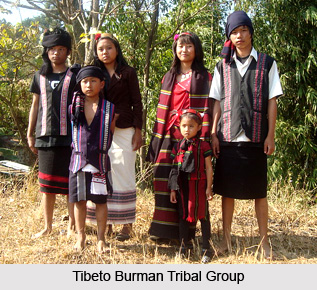 Tibeto Burman Tribal languages usually comprise eight major groups of languages. Nine languages of the Bodo sub-family of the Tibeto Burman language family constitute the largest group of tribal languages in the country. These major nine languages of this sub-family are Bodo, Garo, Tripuri, Mikir, Rabha, Dimasa, Lalung, Deori and Koch. These languages are spoken by over half of the tribal population spread in the Brahmaputra valley, N. Cachar Hills in Assam, Meghalaya and Tripura. And languages that are belonging to other sub-groups of the Tibeto Burman tribal language family are spoken by smaller number of populations. Like for instance, twenty four languages of Naga group forms 19 per cent in the states of Nagaland, Arunachal Pradesh and North Manipur Hills; twenty five languages of Kuki-Chin group forms 15 per cent in the states of Mizoram, Manipur and Tripura. Here the prominent languages are Lushai/Mizo, Thado. The Tibeto Burman tribal language family has been divided into three separate branches and these are Tibeto Himalayan, Assam Burmese and North Assam. Further, Tibetan and Himalayan groups are two of the major groups of this family.
Moreover, Tibeto Burman tribal language family also includes 55 languages of NEFA group of Arunachal Pradesh and Northern Assam that form a total of 12 per cent; nine languages of Bhotia group forming two per cent, and 14 languages of Himalayan group forming two per cent. These tribal languages belonging to this particular family are spoken by tribal people extending to the central and western sub-Himalayan range (including Sikkim, West Bengal, Uttar Pradesh and Himachal Pradesh. Bodo group of languages belonging to the Tibeto Burman language family are spread over a vast area in Assam plains and extending up to the foothills of Arunachal Pradesh and Bhutan. At one time their use extended till South-East Bengal (now in Bangladesh). There is another variety of Bodo and Garo, known as Barish, that was used as a contact language among the tribal communities in Assam plains.
Among the tribal communities that belong to the Bodo ancestry, Garo speakers form the majority in four districts of the state of Meghalaya and Tripuri speakers along with their allied communities (Reang, Noatia, Jamatia) are concentrated in Tripura itself. With the continued exodus of Bengali population from East Pakistan since 1947 the share of Tripuri speaking population in Tripura is now shrunk from 41 percent to almost 23 per cent. Two other prominent tribal communities of the North-East, those belonging to the Naga group and to the Kuki-Chin group (Lushai/Mizo), have after a long-drawn agitation, succeeded in acquiring a degree of autonomy in the federal set up. But the most numerous tribe speaking Bodo, along with Mikir, and other allied languages like Rabha, Dimasa, Lalung, etc. in the same sub-family of the Tibeto Burman tribal language family constitute only five to six per cent of the total population in the entire state of Assam.
Many of the languages belonging to the Tibeto Burman tribal language family have been affected by the Indo Aryan languages and are restricted to the valleys only. However, Tibeto Burman tribal languages are spoken by huge tribal population of the country extending from Ladakh to north eastern region of the country. The mother tongues of this language group are spoken by a huge number of people and that is near about a million people of the country. The Tibeto Burman tribal language family is actually a sub family of the Sino Tibetan family of tribal languages.
Dravidian Tribal Languages
Dravidian Family: Dhurwa, Gadaba tribe , Gondi, Kadar tribe, Kannada, Kodagu, Kolami, Koraga, Kota, Koya/Koi, Kui, Kurukh, Kuvi, Malayalam, Malta, Maria, Naiki, Parji, Pengo, Tamil, Telugu langauge, Toda, Tulu, Virnvn, Yerukula.
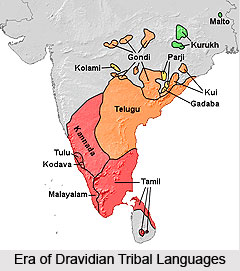 The group of Dravidian tribal languages are spoken by near about 158 million people. They account for a total of 24 per cent of the total population of the country. In the Dravidian language group there are basically four prominent literary languages and these are Telugu, Malayalam, Kannada and Tamil. Along with these major languages, two more languages that are Coorgi or Kodagu and Tulu are not counted as the Dravidian tribal languages. It is because of the fact that these languages have been merged into Kannada language.
In the Dravidian tribal languages family, 147 mother tongues have been included. The most important among them are Kolami, Kui, Konda, Koya, Gondi, Oraon/Kurukh, Parji and more. Little information is available regarding the Dravidian tribal languages. Kadar is one of the popular Dravidian languages and it is quite similar to the Malayalam language. This Dravidian language is mainly spoken by some scheduled tribe communities in areas of Kerala like Palghat, Trichur and Ernakulam and also in some parts of Andhra Pradesh and also in areas of Coimbatore district in Tamil Nadu.
Kaikadi is another major Dravidian tribal language that is spoken by the Kaikadi tribes in several parts of Karnataka and Maharashtra. Kamar, another tribal language belonging to the Dravidian family is spoken by the tribal communities of areas of Rewa district of the state of Madhya Pradesh and in Raipur district of the state of Chattisgarh. Another Dravidian tribal language is Kanikkaran that is spoken in Ernakulam, Thiruvananthapuram and Kozikhode districts of Kerala and Tirunelveli district of the state of Tamil Nadu. Khirwar Dravidian tribal language is mainly spoken by the Khirwar tribal group of Sarguja district of the state of Madhya Pradesh. Dravidian tribal language family also includes Kolami language, which is spoken by the tribes of Adilabad district of the state of Andhra Pradesh. It is also spoken by the tribes of Nanded district and Chandrapur district of Maharashtra. Its main dialects are Asifabad, Naiki and Utnur.
Konda-Dora is a Dravidian language and it is spoken in several areas of Orissa and Andhra Pradesh. Koraga is spoken in parts of Kerala. Kota is another hugely spoken Dravidian language. It is mainly spoken in parts of Tamil Nadu. Koya is spoken in several parts of Madhya Pradesh, Orissa, Maharashtra and Andhra Pradesh. Its main dialects are Podia, Malakanagiri Koya, Chintoor Koya, etc.
Thus, it can be said that the Dravidian tribal languages are mainly spoken in parts of Andhra Pradesh, Tamil Nadu, Kerala, Maharashtra and Orissa.
Other Tribal Languages
Austro-Asiatic Family: Asuri, Bhumij tribe, Birhor tribe, Birjia tribe, Bondo, Diday, Gutob, Ho, Juang, Kharia, Khasi, Kherwari, Korku, Korwa, Kurmi, Lodha, Mundari, Nicobarese, Santali, Saora/Savara, Shompen, Thar.
Andamanese Family: Andamanese Tribe, Jarawa tribe, Onge, Santinelese.
Chinese Family: Khampti
Unclassified Family: Manchat
However, the list of Indian tribal languages is pretty huge and gargantuan in the outset, owing to the overwhelming number of tribes residing throughout the country.