Indianetzone.com - Web Portal on Indian Culture & LifestyleArt & Culture  •  Health  •  Movies & Entertainment  •   Society  •  Reference  •   Sports  •  Travel  

  Home >> Travel >> States of India >> Jharkhand , Indian State
Forum
Forum on States of India
Discuss Now
Free E-magazine
Subscribe to Free E-Magazine on Indian Culture & Lifestyle.
Learn More
Interesting Readings
  - Panch Badri , Badrinath
  - Madhya Pradesh , Indian State
  - Karnataka , Indian State
  - Haryana , Indian State
  - Chhattisgarh , Indian State
  - Arunachal Pradesh , Indian State
  - Andhra Pradesh , Indian State
  - Himachal Pradesh , Indian State
  - Uttarakhand , Indian State
  - Uttar Pradesh , Indian State
  - Jammu & Kashmir , Indian State
  - Mizoram , Indian State
  - Meghalaya , Indian State
  - Nagaland , Indian State
  - Sikkim , Indian State
  - Tripura , Indian State
  - Manipur , Indian State
  - Assam , Indian State
  - Jharkhand , Indian State
  - West Bengal , Indian State
  - Tamil Nadu , Indian State
  - Bihar , Indian State
  - Punjab , Indian State
  - Rajasthan , Indian State
  - Gujarat , Indian State
  - Kerala , Indian State
  - Orissa , Indian State
Jimtrade.com : India Business to Business Directory
Business Directory of Indian Suppliers Manufacturers and Products from India.
India`s leading Yellow pages directory.
Jharkhand , Indian State

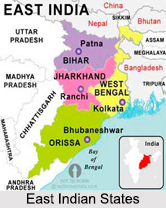
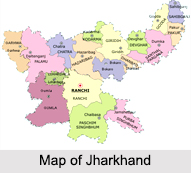
Jharkhand is a state in northeastern India, bordered by Bihar,West Bengal, Orissa, Chhattisgarh and Uttar Pradesh ststes. It occupies 28833 sq mi its capital being Ranchi. It was carved out of the southern part of Bihar state on November 15 2000. Jharkhand shares its border with the states of Bihar to the north, Uttar Pradesh and Chhattisgarh to the west, Orissa to the south, and West Bengal to the east. The industrial city of Ranchi is its Capital. Some of the other major cities and industrial centres are Jamshedpur, Bokaro Steel City, Sindri, Jharkhand, Giridih, Gumla, Deoghar, Hazaribagh and Dhanbad once a part of West Bengal. Jharkhand is also popularly known as Vananchal (vana plus anchal, meaning land of woods). Jharkhand is famed for its mineral wealth and forestry products.

History of Jharkhand
For a greater part of Vedic age, Jharkhand remained buried. During the age of Mahajanpadas around 500 BC, India saw the emergence of 16 large states that controlled the entire Indian subcontinent.

Geography of Jharkhand
Most of the state lies on the Chota Nagpur Plateau, which is the source of the Koel River, Damodar River, Brahmani River, Kharkai River, and Subarnarekha rivers, whose upper watersheds lie within Jharkhand. Much of the state is still covered by forest. Forest preserves support populations of Tiger and Asian Elephant. Soil content of Jharkhand state mainly consist of soil formed from disintegration of rocks and stones. Weather remains cool in most areas of Jharkhand, especially Ranchi, Gumla, Netarhat, Dhanbad etc. Jharkhand has a rich variety of Flora and Fauna. The National Parks and the Zoological Gardens located in the state of Jharkhand present a panorama of this variety.

Economy
Agriculture: Principal food grains crops are paddy, wheat, maize and pulses.

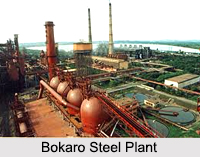
Industry and Minerals: Jharkhand has the country`s two biggest steel plants at Bokaro in the public sector and Tata Iron and Steel Company (TISCO) in Jamshedpur in the private sector. Other important industries are Tata Engineering and Locomotive Company, Sriram Bearing, Usha Martin, Indian Tube Company, etc. The state is abundantly rich in minerals-copper, coal, iron, manganese, mica, chromite, bauxite, etc., and has the potential of becoming one of the most prosperous states of India.

Power: The installed capacity of power in Jharkhand is 2,590 MW. This includes 420 MW (Tenughat Thermal Power Station), 840 MW (Patratu Thermal Power Station), 130 MW (Sikkidri Hydel) and 1,200 MW (DVC, Thermal/Hydel). The prospects of capacity addition in both the thermal and hydel sectors of various power stations are 4,736 MW. This includes 686 MW hydel generations. To provide electricity to all villages and rural areas, the State Government has made a provision of Rs.30 crore during 2001-02.

Government and Politics in Jharkhand
The state is headed by a Governor, who is appointed by the President of India. However, the real executive power rests with the Chief Minister and the cabinet. The political party or the coalition of political parties having majority in the Legislative Assembly forms the Government. The administrative head of the State is called Chief Secretary, under whose jurisdiction a hierarchy of officials drawn from the Indian Administrative Service / State Civil Services function. The Judiciary is headed by a Chief Justice and Jharkhand has a separate High Courts of India, located in Ranchi. Jharkand is one of the thirteen states in which the Naxalite rebels have considerable influence.

Transport in Jharkhand
Demographics: Jharkhand has a population of 26.90 million, consisting of 13.86 million males and 13.04 million females. The Sex ratio is 941 females to 1000 males. The population consists of 28% tribals, 12% Scheduled Castes and Tribes and 60% others. There are 274 persons for each square kilometer of land. However, the density of Population varies considerably from as low as 148 per square kilometer in Gumla district to as high as 1167 per square kilometer in Dhanbad district.

Jharkhand has remained a home to a number of tribal communities since time immemorial. In fact, in some of the districts of Jharkhand, the tribal population predominates, the non tribal one. Jharkhand has 32 primitive tribal groups. These are the Asur, Baiga, Banjara, Bathudi, Bedia, Binjhia, Birhor, Birjia, Chero, Chick-Baraik, Gond, Gorait, Ho, Karmali, Kharwar, Khond, Kisan, Kora, Korwa, Lohra, Mahli, Mal-Paharia, Munda people, Oraon, Parhaiya, Santal, Sauria- Paharia, Savar, Bhumij, Kol and Kanwar.

The geographical area now comprising Jharkhand was previously part of Bihar. The area has witnessed migration of people from the adjoining areas of Bihar and West Bengal for last several decades. Industrial and mining centres like Jamshedpur, Dhanbad and Ranchi have attracted people from all parts of India. Hinduis, Jainism, Buddhism, Islam and Christianity are the main religions present in the state. The tribal communities of Jharkhand have their own spiritual beliefs, commonly called Sarna. During the colonization process the tribal religious beliefs were looked down upon as pagan and inferior. Through overt and covert conversions and other influences at assimilation, the Christian missionaries have contributed much for the demolition of many of the tribal Sarna beliefs.

Education in Jharkhand
The literacy rate in Jharkhand in 2001 was 59.13% and female literacy rate is still lower at 49.38%. Jharkhand has a network of government and privately run schools, although standards of teaching vary considerably from place to place, as also from school to school.

Schools: The medium of instruction in schools is English with Hindi/Sanskrit as second language. After 10 years of schooling, students can join 2 years of Intermediate course (or +2 courses) in Arts, Science and Commerce. This is followed by 3 years of degree courses (graduation)or 4 years of Engineering degree.

Universities: A number of non-technical colleges are located in bigger cities as well as in small towns. The Industrial Training Institutes (ITIs) in particular, offer popular 3 year diploma courses. Jharkhand has 3 Universities namely Ranchi University, Sidhhu Kanhu University, Dumka and Vinoba Bhave.

Birla Institute of TechnologyBirla Institute of Technology, Ranchi, National Institute of Technology, Jamshedpur, and the Indian School Of Mines are famous engineering colleges. National Institute of Foundry and Forge Technology and B.I.T SINDRI are among one of the oldest engineering colleges in eastern india established in 1949. There are three medical colleges in Jharkhand namely Rajendra Institute of Medical Sciences at Ranchi, Medical College Jamshedpur and Patliputra Medical College And Hospital at Dhanbad. The famous B-school Xavier Labour Relations Institute is at Jamshedpur. It`s PMIR programme is regarded best in the entire Asia-Pacific region.

Media in Jharkhand: Hindi newspapers like the Ranchi Express and the Prabhat Khabar are the main newspapers, published from the state capital, Ranchi and are available in almost all parts of the state. All important Indian newspapers, in Hindi, English and Bengali are  Ranchi Expressalso available in bigger cities by the afternoon and after a day`s delay in smaller towns. Most of the national magazines in Hindi, English and Bengali are regularly available in bigger cities and at other places supply may be arranged through newspaper vendors. All India Radio is the only Radio station in Jharkhand and covers the entire state. Doordarshan, the national television broadcaster, is also available in almost all parts of the state. Bigger cities of Jaharkhand is served by all television channels available in India and channels are received through cable. In some interior regions, channels are received via satellite dishes.

Landline telephone connectivity is provided by Bharat Sanchar Nigam Limited (BSNL), Tata Teleservices (TATA INDICOM) and Reliance Infocomm and covers almost all parts of the state. Cellular service, covering all major centres of the state, is provided by BSNL, Aircel, Reliance Telecom and Airtel (GSM Service) and also by Tata Indicom and Reliance Infocomm (CDMA Service). Internet connectivity is available in most of the district headquarters.

Mahendra Singh DhoniSports
Jharkhand has earned itself an important place in the sports arena - thanks to the dashing wicketkeeper batsman Mahendra Singh Dhoni. Jharkhand is the host for upcoming National Games.


More on Jharkhand
Cities of Jharkhand
Costumes of Jharkhand
Culture of Jharkhand
Festivals of Jharkhand
Temples of Jharkhand


Recently updated articles in States of India
Home | Sitemap | Contact Us