Introduction
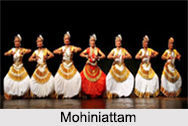 Mohiniattam is one of the major classical dance styles of India. There is a considerable amount of disagreement among scholars regarding the origin of this traditional dance form of Kerala. It has only been in recent decades that Mohiniattam has risen in popularity and acceptability. Mohiniattam though born out of the fusion of Kathakali and Bharatnatyam, has developed its own identity.
Etymology of Mohiniattam
It is said in the word Mohiniattam, `Mohini` means a maiden who charms the onlooker and `attam` means dance. The Mohiniattam dances describe episodes from the epics and legends through graceful steps, rhythmic movements of her arms and facial expressions.
Origin of Mohiniattam
The first reference to Mohiniattam is found in Vyavaharamala composed by Mazhamangalam Naryanam Namboodiri, assigned to the 16th century A.D. Most of them agree that it was during Maharaja Swathi Thirunal`s rule in the 16th century that Mohiniattam achieved its refined form. Mohiniattam is mentioned in some 18th century texts, but the practical aspect of the style was revived in the 19th century, Swathi Tirunal, the enlightened ruler of Travancore in Southern Kerala promoted its study. He composed many of the musical arrangements and vocal accompaniments, which are hymns in praise of Lord Vishnu, and provide the musical backdrop for the Mohiniattam dancers` performance.
History of Mohiniattam
Mohiniattam evolved from the state of Kerala which also has an association with the old tradition of Lasya style of dancing. The temple sculptures of the state are the earliest manifestations of Mohiniattam or other dance forms similar to it. Mohiniattam poses are also palpable from the various feminine sculptures that adorn the 11th century Vishnu temple at Trikodithanam, and the Kidangur Subramanya Temple.
The Lasya theme was incorporated by Malayalam bards and playwrights, a fact evident from the text-based records starting from the 12th century. The 16th century book titled "Vyavaharamala" written by scholar, poet, author and astrologer Mazhamangalam Narayanan Namboodiri is the first known book that mentions the term Mohiniattam in connection with a payment due to a Mohiniattam dancer. While discussing about various performing art forms of Kerala, renowned poet Kunchan Nambiar in his 17th century book "Gosha Yatra" mentioned about Mohiniattam. By that time this dance form had emerged as one of the classical art forms of the state.
Under the patronage of the princely states, the dance form of Mohiniattam developed between the period of 18th and 19th centuries but as the British colonialism spread, there was a stark decline in various classical dance forms. Eventually social and economic conditions associated with Devadasis of South India and the nautch girls of North India added with contempt and despicable attitude from the Christian missionaries and British officials, who held them as harlots, disgraced such systems. Furthermore, the Christian missionaries launched anti-dance movement in 1892 to stop such practice. They caricatured the facial expressions and sensuous gestures emoted during temples dances, which thus stigmatized all Indian classical dance forms including Mohiniattam that saw its decline in the princely states of Cochin and Travancore.
Type and Theme of Mohiniattam
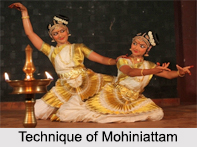 Mohiniattam is also known as the `Dance of the Celestial Female Magicians`. It is essentially a solo dance, performed by female dancers. However, the basis of this dance also signifies the transformation of Lord Vishnu into a female form and showcases the concept of Ardhanarishvara, which is the combination of the male and female as one. Like many other dance forms, this was also restricted to the Devadasis. The theme of Mohiniattam is love and devotion to God. Delicate themes of love are performed with suggestive abhinaya, subtle gestures, rhythmic footwork and lilting music. Mohiniattam signifies the dance of enchanters that causes destruction of the wicked and brings delight and pleasure to the good. Unlike other classical dance forms, Mohiniattam draws upon secular and social themes rather than religious mythology, the age-old stirring tales from the Ramayana, the Mahabharata and the Indian Puranas.
Style and Technique of Mohiniattam
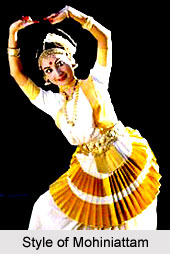 The distinctive style of Mohiniattam is the complete absence of heavy stamping and rhythmical tension, where the footwork is gentle, soft and sliding. The movements are never abrupt, they are dignified, easy and natural, but the vertical line of the body is never broken. Hence, among the styles detailed by Bharata Muni in the ancient Indian treatise on dance, the Natyashastra, Mohiniattam resembles the Kaisiki type meaning graceful. The dance is romantic in nature and is characterized by graceful movements, wide swinging steps and swaying of the upper body from side to side.
Mohiniattam is renowned for its grace, flow, simple looking footwork and rotating rhythmic movement. The eyes play an important role in emphasizing the direction of the movement. The basic dance steps are the Adavus, which are of four kinds: Taganam, Jaganam, Dhaganam and Sammisram. These names are derived from the nomenclature called Vaittari. Mohiniattam like much other form follows the Hastha Lakshandeepika, which is a classical text, the basis for the expressive gestures of the hands and arms in Mohiniattam. This Indian classical dance has flavours of Bharatnatyam and Kathakali in it.
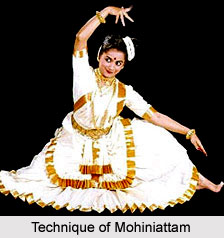 The technique of Mohiniattam emphasizes lasya and sringara or romance is the prominent rasa. Rasa means the dominant emotion. Basically, it is the Nayika (heroine) a devotee pining for the Deva or Nayaka (hero), Chari (special type of movement) and Nritta Mudra (hand movement without any special meaning) are special to Mohiniattam. The hasta mudras used in this dance are Asamyukta (single hand), Samyuktra (both hands) and in Misra (either way) positions. The bobbing gait forward - backward or side ways and the graceful swaying of the trunk or head are special to this style. The basic sitting posture with the feet apart is reminiscent of Kathakali.
Performance of Mohiniattam
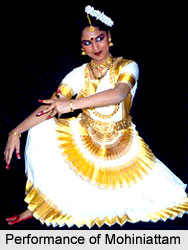 The story of Mohini is central to the performance of this dance. Mohiniattam performances depict love and devotion to god. The dancers mostly depict the verses from Meghdoot and Geeta Govinda in their dances. Geeta Gobinda was preferred the most because the spectators used to get saturated in the overflow of spiritual ecstasy. Hence, the spiritual essence of the ethereal love of Lord Krishna and Sri Radha not only coloured Mohiniattam but also glorified it. The hero of most performances is Lord Vishnu or Lord Krishna.
1. Cholkettu: The opening dance, Cholkettu, sets the tone of the performance. It is performed in praise of Shiva and Parvati and is very similar to Alarippu and Sabdam of Bharatnatyam. Cholkkattu means stylized rhythm, beginning and ending with passages of appeal. The dancer stands with hands raised over the head in welcome. To begin with, there is a verse in praise of Lord Shiva as Nataraja. It is followed by a hymn of 14 lines that outlines the story of Lord Rama. This is sung in a rhythmically stressed manner, and the dancer interprets the story through expressions and gestures. When the song is over, the dancer continues to dance, offering passages of sheer dance. The entire composition lasts no more than ten minutes.
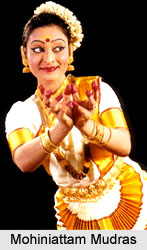 2. Varnam: The next number is a Varnam, which contains alternate sequences of expressional and abstract dance. The theme is invariably love, hidden by making the object of love, a God. There are only five Varnams in the tradition, and all of them are credited to Swati Tirunal. Jatiswaram is performed next. It is composed of sequences of pure, decorative dance in variegated rhythmic pattern set to adjust with melodic lines rendered through musical note.
3. Padam: The Padam is also on the theme of love, and is a purely expressional piece. The Padams in Mohiniattam are nearly all the compositions of Swati Tirunal.
4. Tillana: The last item is the Tillana, an abstract dance combined with garlands of sound syllables. But while in Bharatnatyam the Jatis are recited separately, here they are incorporated into the main melody of the Varnam. Padams, Kirtis, Thillana, Javalis and Shlokas are the varying items in Mohiniattam as well.
There is a tremendous amount of force that a Mohiniattam dancer brings out in her performance without which the performance would be lacking in its lustre but this tremendous energy is released in a very controlled and graceful manner which can be achieved only with discipline, hard work and (bhakti) or devotion to the art form. But at the end of it all the transformation is tremendous. The joyful dancing eyes and the waving of the eyebrows of the dancer all create a great mischievous atmosphere .The sweet smelling of the flowers, the gentle, swaying movement of the upper body in perfect harmony with the music and the bewitching personality of a Mohiniattam dancer all take us to the highest aesthetic order "the atmosphere of enchantment".
Costumes of the Mohiniattam Dancers
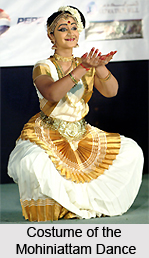 Mohiniattam or Mohiniyattam is an Indian classical dance form that evolved in the state of Kerala, India, and is counted among the two popular dance arts of the state, the other being Kathakali. Although its roots date back to the age-old Sanskrit Hindu text on performing arts called "Natya Shastra", similar to other Indian classical dance forms, Mohiniattam adheres to the Lasya type that showcases a more graceful, gentle and feminine form of dancing. The costume is usually consisted of a choli and a white, or off-white Kasavu saree of Kerala with a gold or red border.
Dresses of Mohiniattam Dancers : One of the distinctive features of the Mohiniattam is the simplicity of the costumes. There is a typical costume for Mohiniattam, which is a mixture of white and gold. They usually consist of a choli and a white, cream or off-white colored sari with a gold or red-bordered Kasavu saree of Kerala worn in such a manner that a pleated fan is formed like an apron in front of the waist. White is a favourite colour of the people basically because of the hot and humid climate. Mohiniattam maintains realistic make-up and simple dressing which is very much a characteristic of women from Kerala.
Ornaments of Mohiniattam Dancers : The beauty of Indian classical dance also lies in its appropriate and relevant costume and jewelry. The dancer usually wears gold ornaments, which symbolizes purity, truth and immortality - all these are attributed to the dance of the celestial maidens. Gold jewellery including necklaces, bangles, waistbands and anklets adorn the body of the dancer and their tinkling makes music as she dances. The dancer also wears a pair of large round ear studs known as Toda, which is circular like a coin and has dangling earrings which is known as "jhumka". The necklace choker is the traditional Nagapadam in the shape of a snake"s hood, and the powanmala - a chain made of gold coins or kasimala. The forehead is covered with an ornament called the Nethichutti and the nose is adorned by Mukkuthi or nose ring. The bangles are known as Kappu. Musical anklets called ghunghru made of leather straps with small metallic bells attached to it are wrapped around the ankles. These produce rhythmic sound while the dancer showcases excellent footwork.
Makeup and Hairstyle of Mohiniattam Dancers : The dancer"s hair is gathered in a bun that is worn at the side of the head and decorated with jasmine flowers and with a simple ornament tied on the bun. The face is done up with an exaggerated eye make up to help her express her emotions. The eyes reflect immediately the mental state of the situation or character the dancer is representing and a description of Mohiniattam cannot be complete without the mention of the nayan abhinaya or the use of the eyes, eyebrows and eyelids. The tilaka or the red mark on the forehead represents matrimony faithfulness of the Hindu women.
Music in Mohiniattam
The main musical instrument used in Mohiniattam is Edakka. Even the instruments such as violin, veena and mridangam provide musical accompaniment to the dancers. The vocal music for Mohiniattam is Carnatic Music. The lyrics composed by Maharaja Swathi Thirunal and Irayimman Thampi are in Manipravala, which is a mixture of Sanskrit, Tamil and Malayalam. The music also accentuates these movements by being extremely lyrical, sensuous and concentrating more on bhava than trying to articulate the swara patterns. This mode of singing is called Sopanam.
Mohiniattam Dancers
Mohiniattam Dancers : The first renowned Mohiniattam dancer was Kalyaniamma. She also taught in Shantiniketan. The other notable teachers in Kerala Kala Mandalam were Krishna Paniker and Madhavi Amma. It was from these Gurus that new generations of Mohiniattam dancers were born.