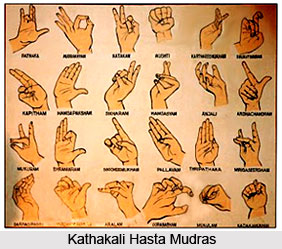
 The Hasta Mudras in Kathakali or the codified finger movements in Kathakali are full of definite symbolical significance and meaning and are effective substitutes for spoken language. Imitative, technical and suggestive they are cent per cent symbolical and denote objects, actions and even inflection. The system of finger poses is based on the Natyashastra by Bharata Muni. Hasta Lakshana Deepika and Abhinaya Darpana are two standard works on Mudras. The Mudras which constitute the alphabet of a language of more than seven hundred words aim at indirect suggestion rather than direct exposition. Each pose has a different name. Greater significance has been attached to indirect suggestion.
There are 24 basic Mudras and about 300 main continuations. It is believed that the Mudras have their origin in the Tantric rites of the old. This wonderful gesture language has in it all the potentialities of a universal medium of effectively expressing thoughts. The mudras permit endless permutations and combinations, providing ample scope to the talented artists endowed with originality to express his rare and full volumed genius.
Hast-Mudras are shown with one hand and both hands as befitting the occasion. Showing a basic Mudra with one hand is called Asamyukta pose while showing the same root Mudra with both hands is called Samyukta Pose. The display of one root mudra with one hand and simultaneously another root mudra with other hand is known as Misra. The twenty-four basic mudras are Pataka, Mudrakhya, Kataka, Mushti Kartarimukha, Sukatunda Kappitthaka, Hamsa-paksha, Sikhara, Hamsasyam, Anjali, Ardhachandra, Mukura, Bhramara, Suchimukha, Pallava, Tripataka, Mrigasirsha, Sarpasira Vardhamanaka, Arala, Urnanabha, Mukula and Katamugha.
This article is a stub. You can enrich by adding more information to it. Send your Write Up to content@indianetzone.com