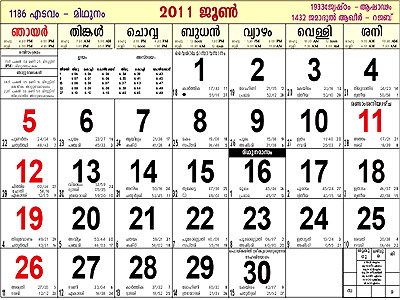
 The origin of the calendar has been dated as 825 CE. Various theories have been attributed to the origin of calendar. According to some it was founded by the ruler of Venad Udaya Marthanda verma or by Adi Sankara. It is also believed that it is a derivation of the Saptarshi Era. It is commonly agreed among the scholars that it was started with the reopening of the natural disaster that destroyed city of Kollam.
It is also possible that in the honour of philosopher Shankara`s death, a new calendar was adopted. The Malayalam months are named after the Zodiac signs.
The origin of the calendar has been dated as 825 CE. Various theories have been attributed to the origin of calendar. According to some it was founded by the ruler of Venad Udaya Marthanda verma or by Adi Sankara. It is also believed that it is a derivation of the Saptarshi Era. It is commonly agreed among the scholars that it was started with the reopening of the natural disaster that destroyed city of Kollam.
It is also possible that in the honour of philosopher Shankara`s death, a new calendar was adopted. The Malayalam months are named after the Zodiac signs.
Formerly the New Year in the Malabar region was on the 1st of Kanni and that in the Travancore region was on the 1st of Chingam. When the Government of Kerala adopted Kolla Varsham, the 1st of Chingam was accepted as the Malayalam New Year. Medom is the first month according to the astronomical calendar.
The departure of the Perumal coincides with the beginning of a new era considered as Kollam era. The era began on the day denoted by the Chronogram a-cha-rya-va-ga-bhe-dya which corresponds to September 17,825 A. D. The mampalli plate of the year 149 is the earliest document which refers to this era. It is believed that the era commemorates the building of a palace or Kovilakam which later became a town. The era commences on the 1st of Chingam in the south and on the first of Kanni, a full month later, in north Kerala.
The chronogram a-cha-rya-va-ga-bhe-dya, corresponds to the first day of the Kollam era which means that Acharya`s word or law is unalterable. Acharya is referred to Shankaracharya and the chronogram gives the date of the promulgation of his ordinances to the people of Kerala. The irregular customs of the Namboodiris are supposed to have been laid down by Sankara at Kurakkeni Kollam on the 1st of Chingam and at Pantalayini Kollam on the first of Kanni. These two Kollams were the capitals of the southern and the northern Kolattiris.
Some scholars associate the Kollam era with Onam, the national festival of Kerala. The days prior to Onam are referred as Pukku chingam or the part of the months which end a year and to the days after Onam as Pukku Chingam or the part of the month which became part of the New Year. The theory gives a reasonable answer to the different dates for the beginning of the era in the north and south Kerala. Onam hardly falls of the first of Chingam and it is not convenient to start an era in the middle of a month. The northerners began the New Year on the first of Kanni after Onam, and the southerners on the first of Chingam before Onam. However, even this is not a sustainable theory.
The chronogram according to which the era started on the first Kanni and not on the first Chingam faintly suggests a northern origin of the era. Both Pantalayini Kollam and Quilon could claim to have given the name to the era.