 The princely state of Jammu and Kashmir was established after the defeat of the Sikhs in the First Anglo-Sikh War in 1846, which coincided with British rule in India. Different people holding the title of "Maharaja" and belonging to the royal Dogra Dynasty had ruled this state at that time. Given below are the Maharajas of Jammu and Kashmir.
Gulab Singh
Gulab Singh, the founder of the Dogra Dynasty was the first Maharaja of Jammu and Kashmir (1846-1857). Post the Anglo-Sikh Wars, Lahore court was defeated. Subsequently, it had to give Jammu to Gulab Singh as per the Treaty of Lahore. According to the treaty, the control of the rivers Sutlej and Beas and part of the Indus was given to the British. All the hilly regions between River Beas and Indus (including Kashmir) were also to be added to the land controlled by Gulab Singh for 7,500,000 Nanakshahee Rupees in a separate sale by the Britishers.
Ranbir Singh
 Ranbir Singh, the Maharaja of Jammu and Kashmir (1857-1885) was the son of Maharaja Gulab Singh. He was a great scholar of classical Persian and had learned Swedish and English languages. Maharaja Ranbir Singh had established a Translation Bureau called "Daarul Tarjumah" in which the "Tibb-e-Unaani" was translated from Arabic and Latin into Persian and Dogri. During his tenure, the trans-Himalayan territories were annexed and added to Jammu and Kashmir.
Pratap Singh
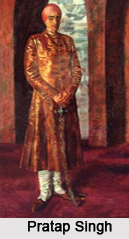
Pratap Singh, the Maharaja of Jammu and Kashmir (1885-1925) was the successor of Ranbir Singh. During his tenure, the Jhelum Valley Cart Road from Kohala to Baramulla was completed and was extended to Srinagar. The first land settlement was carried out by the State Government, which resulted in the rights of the agriculturists being clearly defined. Establishment of Department of Agriculture, cooperative societies, a degree college, modern hospital, modern water works, etc were other signs of improvement taking place in the state during the reign of Pratap Singh.
Hari Singh
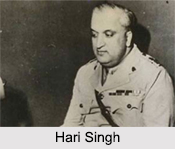
Hari Singh, the last ruling Maharaja of Jammu and Kashmir (1925-1961) was the successor of Pratap Singh. He is credited with the introduction of laws prohibiting child marriage, opening places of worship for the low castes, etc. Hari Singh faced a tough situation of deciding whether to join his Muslim majority state with India or Pakistan. He had signed an Instrument of Accession to the Dominion of India on 26th of October, 1947. The whole of the princely state came under the Dominion of India, giving impetus to the first Indo-Pakistan War.