Introduction

A princely state, also known as a native state, was a nominally sovereign territory under the British Raj that was not directly administered by the British government. Instead, it was ruled by an indigenous monarch who governed under a system of indirect rule, bound by subsidiary alliances and the suzerainty of the British Crown. At the time of British withdrawal from India, there were 565 officially recognized princely states across the Indian subcontinent, and the Princely State of Patdi was one among them.


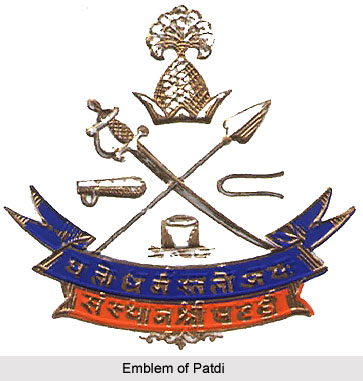
The Princely State of Patdi, also known as Patri, was amongst the major native states during the rule of the British Empire in India. During the early 19th century, the region was appointed as one of the princely states of India under the indirect rule of the British administration. The territory covered a total area of 165 sq miles and comprised of a total population of 20,346 in the year 1941. At present, Patdi is situated 90 km towards the west of Ahmedabad in the state of Gujarat. Presently, the population of the region is around 20,000. The erstwhile state of Patdi was located in the northeast of Kathiawar. The territory was bounded by Dasada in the east, north and northwest. The region of Bajana bounded the southeast. The British enclave (Province of Bombay) and a part of Jhinjhuvada province bounded the southwest of this princely state.


History of Princely State of Patdi

Patdi was an estate within the Eastern Kathiawar district governed by British Raj. The title of ‘Desai’ was granted to the Kadva Patidar rulers by Emperor Jahangir. Historically, this region fell under the jurisdiction of the Jhalawar State.

The Desai dynasty of Kadwa (or Katva) Patidars was the ruling family of the princely state of Patdi. The family settled in the area in the 15th century. The region of Patdi was obtained by Bhav Singh of Viramgam in the year 1741. The Princely State of Patdi included around 24 villages and 16 villages of them covering an area of 135.6 sq miles, were in the district of Ahmedabad. The princely state of Patdi was incorporated as a part of the Baroda Agency, which was a sub division of Western India States Agency. It was also a part of the Eastern Kathiawar Agency. The territory of Patdi later became a part of the Indian state of Gujarat. The native ruler of the princely state of Patdi, who held the title and style of Desai, exercised significant civil and criminal jurisdiction. Most of the revenue of the state was obtained from the villages during the rule of the British Empire in India. The state of Patdi was ranked 41st in order of precedence amongst the states of Western India.


Political Position of the Princely State of Patdi

Patdi state was one of the original constituent members of the Chamber of Princes, a number of smaller states indirectly represented by 12 princes who were elected periodically by them. According to the Attachment Scheme of 1943, the state of Patdi was attached to the princely state of Baroda. The native ruler of the state held the title of Desai.

Major  political developments during colonial rule included Patdi’s incorporation into the Eastern Kathiawar Agency and later the Baroda Agency as a semi-jurisdictional state. The British Political Agent stationed at Rajkot supervised external relations and ensured adherence to imperial policies. The state participated in regional alliances through tribute arrangements, notably paying fixed revenues to the Gaekwad of Baroda, with the system mediated by British authorities to stabilize Kathiawar’s fragmented polities. No major conflicts involving Patdi are documented, although the agency-wide suppression of banditry (baharvatiya) between the 1820s and 1860s indirectly strengthened the security of its borders. By 1943, amid broader efforts to streamline administration in smaller princely states, Patdi was attached to Baroda under the Attachment Scheme, which increased administrative oversight without formally altering its nominal sovereignty. 


Economy of the Princely State of Patdi

Patdi has historically been known for its salt production. Situated on the edge of the Little Rann of Kutch, a salt marsh in the Thar Desert, its primary industry has long been the extraction and processing of salt and related products. The town has served as an important salt supply and transportation center in India, a role it continues to fulfill today. Agriculture constitutes another pillar of the local economy, with cotton processing units playing a significant role in managing the district’s substantial output, alongside the cultivation of arid-adapted crops such as Pearl Millet (bajra) and pulses.


Accession with Union of India

Patdi retained its princely status until 15 August 1947, when it acceded to the Dominion of India through the Instrument of Accession, integrating peacefully into the United State of Saurashtra and later the Bombay State (subsequently Gujarat in 1960). After independence of India in 1947, Patdi became and continues to be a municipality-administered town located in the Dasada Taluka of Surendranagar District in the state of Gujarat. It serves as the administrative headquarters of Dasada Taluka. The town lies on the edge of the Little Rann of Kutchh and features an inner fort that is protected by deep water and surrounded by suburban settlements. 

The town is also known for Surajmalji High School, one of its notable educational institutions. The primary economic activity in Patdi is salt production and related industries. From ancient times, the town has played a significant role in providing a channel for salt transportation across India and is still continuing the legacy. Patdi functions as an important commercial center for the surrounding villages, offering a reliable market for consumer goods. It also hosts a farmers’ market and cotton processing units, supporting the local agricultural economy. 

Geographically, the town is situated about 90 kilometers west of Ahmedabad in Ahmedabad district. The nearest airport is Ahmedabad International Airport, located approximately 90 kilometers away. The closest railway station with adequate train connectivity is Viramgam, which is about 30 kilometers from the town. 

Due to its proximity to the neighboring desert region, the climate in Patdi is generally dry, although it does not differ significantly from the climate experienced in other parts of Gujarat.


Rulers of Princely State of Patdi

The chronology of the native rulers of the princely state of Princely State of Patdi are as follows-

  • Desai Shri Bhanjibhai
  • Desai Shri Udekaranji
  • Desai Shri Bhavsinhji
  • Desai Shri Nathubhai
  • Desai Shri Vakhatsinhji Nathubhai (1796- 1809)
  • Desai Shri Harisinhji
  • Desai Shri Arbhamji Harisinhji
  • Desai Shri Kubersinhji Vakhatsinhji
  • Desai Shri Jorawarsinhji
  • Himmatshimji Jorawarsimhji
  • Desai Shri Surajmalji Jorawarsinhji (1884- 1913)
  • Desai Shri Daulatsinhji Surajmalji (1913- 1928)
  • Desai Shri Raghuvirsinhji Daulatsinhji (1928- 1940)
  • Darbar Shri Naransinhji Chandrasinhji (1940- 1941)
  • Darbar Shri Pratapsinhji Naransinhji (1941- 1978)
  • Darbar Shri Kishansinhji Pratapsinhji (1978- 2002)
  • Esai Shri Karnisinhji Kishansinhji

Later, state managers were assigned to govern the affairs of the estate. They are:

  • Magganlal Ranchhoddas Patel
  • Bhanusimhji
  • H.K. Doshi