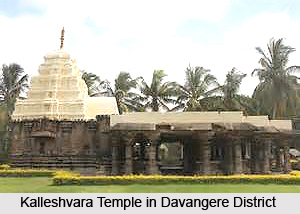
 Kalleshvara Temple, Bagali is also known as `Kalleshwara Temple` and it is located in the district of Davangere, in the southern Indian state of Karnataka. The temple had been erected during the middle portion of the 10th century, during the regime of Western Chalukya rulers and the temple has witnessed the reign of two Kannada dynasties. During this point of time, King Tailapa II around 987 AD.
History of Kalleshvara Temple
A man named Diggimayya is credited for establishing the initial consecration of the Kalleshvara Temple. However, the current temple tower might have been constructed much later. 36 ancient Kannada inscriptions have been discovered in the temple premises belonging to the 10th and 11th centuries, which are referred to as `danashasana`. Presently, Kalleshvara Temple is maintained by the Archaeological Survey of India. The temple vestibule and closed hall are said to have been built during the time of Rashtrakuta rule, during the 10th century.
Architecture of Kalleshvara Temple
A main shrine dedicated to Lord Shiva which faces towards the east, a closed hall or `mahamantapa` which can be entered from the eastern and southern part of the temple and a vestibule or `antarala` are existent inside the temple. A gigantic hall or `sabhamandapa` exists in front of the spacious hall, which consists of beautifully ornamented pillars with an embellished ceiling. A `mukhamandapa` or hall is also present close to the shrine of Sun God or Lord Surya which points towards the east-west direction, along with a shrine dedicated to Narasimha, an incarnation of Lord Vishnu, which is believed to have been erected during the regime of the Western Chalukyas. Eight tiny shrines surround the main shrine. 24 pillars of the total 50 pillars are based on a platform called `jagati` which is also equipped with a balcony seat or `kakhasana`. The doorways comprising the lintel and doorjamb faces towards the idol of `Nandi`, companion of Lord Shiva and the southern doorway is quite ornate. Chalukyan sculptures of Sarasvati, Kartikeya, Lord Shiva, Umamaheshvara (which portrays Shiva with Parvati, His consort), Lord Surya, `Mahishashurmardini` (an incarnation of Goddess Durga) and `Anantasayana Vishnu` (form of Lord Vishnu reclining on a snake) are also existent.