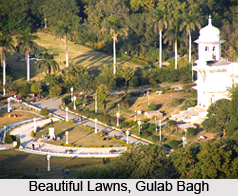
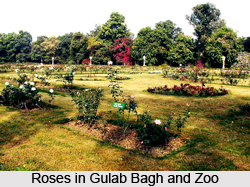
 Gulab Bagh and Zoo is also referred to as `Sajjan Niwas Garden` and is located near Pichola Lake in the city of Udaipur in the state of Rajasthan, occupying an area measuring about 100 acres of land. This garden is renowned for possessing numerous variations of beautiful roses, and due to the presence of innumerable kinds of roses, this garden has been named the `Gulab Bagh`. It had been built in the year 1878. Visitors can easily access Gulab Bagh and Zoo by means of auto rickshaws, taxis and other forms of regional conveyance. Gulab Bagh occupies an area measuring 66.5 acres of land.
History of Gulab Bagh and Zoo
The creation of Gulab Bagh was initiated by Maharana Sajjan Singh during the year 1878 and is said to be the fourth oldest zoo in the entire nation. T.H. Story, a reputed horticulturist from Madras was invited to this region in 1882 under the royal orders of Sajjan Singh Maharana for preparing a garden which would be filled with plants possessing medicinal properties. The appointed horticulturist had rendered his services till the year 1920. A lotus pond and innumerable trees involving Tamarind, Pomegranate, Bananas, Lemon, Guava, Mango, Citron, Dhanverjia, Dawood, Jasmine, Lichi, Sapota, Wood Apple, Arjun, Kargi Lime, Meetha Neem, Karonda, Bullock`s Heart or `Ramphal`, Mulberry, Jackfruit, Anola, Grandi Flora and others were planted in the garden.
 The scientific and biological names of the trees were recorded in English and Hindi during 1882. A tiny pond was present inside the garden prior to its destruction which was done to create a water works project. Initially, Water Lily of Victoria species was planted. Previously Gulab Bagh was referred to as `Bada Bagh` but today this name is no longer used.
During 2nd November, 1890, the foundation stone of the Victoria Museum which is now known as Saraswati Bhawan Library was established by Maharana Sajjan Singh. Lord Landsdown had inaugurated this museum who was the earliest curator was Mr. Gauri Shankar Ojha who had been appointed for this post in 1890. Several stone manuscripts and unique objects belonging to the period beginning from the 3rd century BC to the 17th century AD are existent. Maharana Fateh Singh had arranged for several vegetable and flower exhibitions in the Gulab Bagh and Zoo in the year 1888. This emperor also organized regular fights between wild boars, tigers and lions for the purpose of entertainment. Hoolock Gibbons, Zebras, Black Leopard, Ostriches, Rhinoceros, etc. were some of the animals introduced into the zoo of Gulab Bagh which were later shifted to the other zoos of India post the Indian Independence.