Curry

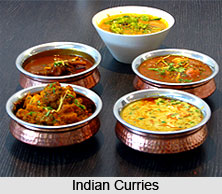
A curry in India is a spicy stew-like dish, something that is wholly based on sauce prepared with vegetables and spices.

About Curry

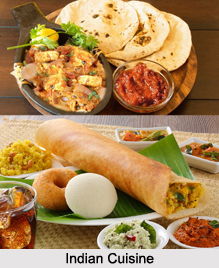
Curry, Indian CuisineCurry is an incorporation of complex combinations of spices or herbs, usually including fresh or dried hot chillies. The decisive identity of India with the world starts with the flavours of the ubiquitous curry. It has successfully arrested the fascination of the globe all through. It is one delicacy that is prepared with different variations by different chefs.

The origin of the word `Curry` comes from the Tamil word `Kari`, which is a blend of spices and sauces, chiefly coconut. Curry may contain meat, poultry, fish, or shellfish, either alone or in combination with vegetables. Many are instead entirely vegetarian, especially among those who hold ethical or religious values against eating meat or seafood. However, it has spread all over the country with varieties sprouting up in every Indian province.

In original traditional cuisines, the precise selection of spices for each dish is a matter of regional cultural tradition and religious practice. Such dishes are called by specific names that refer to their ingredients, spicing, and cooking methods.

Traditionally, spices are used both whole and ground; cooked or raw; and they may be added at different times during the cooking process to produce different results. The main spices found in most curry powders are turmeric, coriander, and cumin; a wide range of additional spices may be included depending on the geographic region. Curries may be either "wet" or "dry". Wet curries contain significant amounts of sauce or gravy based on yoghurt, coconut milk, dal or stock. Dry curries are cooked with very little liquid which is allowed to evaporate, leaving the other ingredients coated with the spice mixture.


It is quite a distinctive image that Indian curries from different Indian cuisines vary in its taste, aroma, cooking pattern and serving style. Such a wide array of exotic flavours and scrumptious recipes makes Indian curry stand out from even the different provinces within, and spreading into the world. Curry, Indian Cuisine The evolvement of curry in India has now led to a fantastic amalgamation of international cuisines, with the term being just not restricted to Indianised versions. It is usual to distinguish broadly between regional styles of Indian cuisine, recognizing that within those categories are innumerable sub-styles and variations. The distinction is commonly made with reference to the staple starch: wheat in the form of unleavened breads in the north; rice in the east; rice and millet in the south.
Indian Curry in Different Cuisines

Indian Curry in Different Cuisines, Indian CuisineIndian curry is not just a term that can be clubbed into a specified summation of dishes. India reflects its culinary arts through unity in diversity and secularity, with every kind of man residing within, in the process making Indian food acknowledged to the world. Curry is a staple dish used perhaps in every Indian household, both vegetarian and non-vegetarian, with spices and masalas heightening its aroma and exotic essence to the fullest. The different regions in India, with its cultural variety stand out for their distinctness in every sphere of living. Cooking quite seemingly reflects the Indian style of living and weather of that particular place. For instance, Gujarati cuisine hugely differs with Manipuri cuisine, making use of different ingredients. On the other hand, Kashmiri cuisine will never be the same with South Indian delicacies. The spices used for the method of preparation make Indian cuisine stand out from every other culinary in the world. Curry in Bengali cuisine, with its rich and chilli spices, vastly differs from Punjabi curry, heaviness personified. It becomes thus pretty obvious that Indian curry in different cuisines reflects its own passion to cook meticulously and to prepare the best.
Curry of Bengal

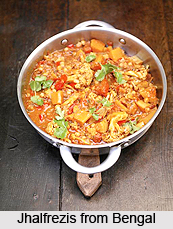
Bengali cuisine comprehends an over-excess of curries which are the most unknown to the outside world. They are legendary for their extreme tang and zing. Veritable Bengali recipes for curries are difficult to find outside `Bangla` kitchens, although certain dishes are admired, for example, the jhalfrezis and the prawn malai curry. Seafood and fresh fish are a chosen favourite with Bengalis and an incredible a-la-carte of curries has been invented up to accompany them. Mustard seeds and mustard oil are added to many recipes, so are poppy seeds and these flavours are highly distinguishing to the Bengali curries.

Curry of Punjab

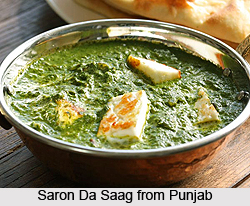
Indian Curry in Different Cuisines, Indian Cuisine In Punjabi cuisine when curries are concerned, are non-vegetarian or completely vegetarian. One of the main features of Punjabi curry is its diverseness in range of dishes. Home cooked and restaurant Punjabi curry can deviate significantly, with restaurants using large amounts of `ghee`, together with liberal amounts of butter and cream, with home cooked curry concentrating mainly on wheat masala flavourings. There are certain curry dishes which are exclusive to Punjab, such as Mah Di Dal and Saron Da Saag (Sarson Ka Saag). The food is custom-made for the Punjabi lifestyle, in which most of the rural folk burn off lot of calories while working in the fields. The main masala in a Punjabi curry comprise of onion, garlic and ginger. Tandoori food is a Punjabi speciality especially for non-vegetarian dishes. Many of the hugely admired elements of Anglo-Indian cuisine, like Tandoor, Naan, Pakoras and vegetable dishes with paneer - have arrived from the Punjab.

Curry of Kashmir

Kashmiri cuisine is one of the remarkable facets in Indian curry. Kashmiri curry has developed over hundreds of years. The first striking influence was the food of the Kashmiri Buddhists and Pandits, the Hindus who lived in the valley during the middle ages. The cuisine was then influenced by the cultures which arrived with the invasion by Timur from the area of present-day Uzbekistan. Subsequently, it has been profoundly influenced by central Asian, Persian, Afghan and Punjabi cultures. Kashmiri cuisine is in fact distinctly differentiated in Hindu and Muslim mode of cooking. A typical Kashmiri Hindu curry makes use of a lot of yogurt and turmeric, but avoids onion and garlic. Kashmiri curry does not consist of many minced meat dishes, unlike the Kashmiri Muslim cuisine. Kashmiri Muslim curry truly personifies richness and usage of masalas. With its host of dishes available in non-vegetarian platter, the basic use of thick curry and tanginess makes it stand out in Indian curry world.

Curry of Uttar Pradesh

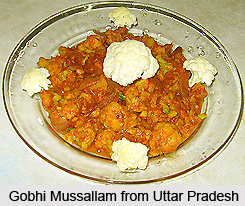
Indian Curry in Different Cuisines, Indian Cuisine Curry from Uttar Pradesh consists of both vegetarian and non-vegetarian dishes. A typical Uttar Pradesh curry has been enormously influenced by Mughal cooking techniques. Cuisine of Uttar Pradesh bears similarities to those of Kashmir and Punjab, and the state is known for its Nawabi foods (of Lucknow and surroundings) and use of mutton, paneer and rich spices, including cardamom and saffron. The rather famous curry preparations include umpteen mutton recipes, Murg Mussallam, Dum Bhindi, Gobhi Mussallam, Kofta and Rizala.

Curry of Rajasthan

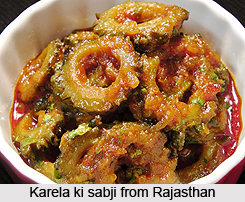
Rajasthani cuisine was heavily influenced by the war-like existence of the Rajputs and the availability of ingredients in this extremely parched region. Food that could persist for several days and could be eaten without giving a heat was preferred. Insufficiency of water and fresh green vegetables had left a considerable impact on Rajasthani cooking. As such curries were also made to suit the weather, which primarily are made from dried and fiery vegetables like chillies, making a curry pretty hot and zesty to eat. Some of the famous Rajasthani vegetarian curry dishes comprises of Kicha ki sabji, Moranga ki sabji, Guwar fali ki saag, Beans ki sabji, Gajar ki sabji, Karela ki sabji, Raabdi, Vadi, Ker-saangri ki sabji, Khaddi, Makki ki raab, Makki ki saag, Kikoda ki sabji, Matar ki sabji, Aloo matar ki sabji. Laal maans is a well known dish from Rajasthani curry platter.

Curry of Gujarat

Gujarati cuisine is primarily vegetarian, due to the decisive influence of Hinduism and Jainism. An emblematic Gujarati Thali consists of Rotli (a flat bread made from wheat flour), daal or kadhi, rice, and sabzi/shaak (a dish made up of different combinations of vegetables and spices, which may be stir fried, spicy or sweet). Gujarati curry can vary vastly in flavour and heat, depending on a given family"s tastes as well as the region of Gujarat they are from. North Gujarat, Kathiawad, Kutch and South Gujarat are the four major regions of Gujarat that all represent their own style to Gujarati food. Many Gujarati curry dishes are uniquely sweet, salty and spicy at the same time.

Curry of Andhra Pradesh

The primary dish under Andhra Pradesh cuisine includes "Koora" (in Telugu), eaten with hot rice and ghee. It could be made either from vegetable, or a combination of vegetables and meat. The rich dish could also be prepared wet (koora, pulusu or gojju) or dry (vaepudu). There are numerous types of recipes with various combinations of spices. The version of curry here is also deviated as is with other Indian regions. Richness and mild curries both reside side by side in Andhra cuisine, with vegetarian options going the mild way. Pickles are always included in Andhra Pradesh cuisine, with non-vegetarian items also topping the list in curry items. Biryani is an influence from Muslim rule over India, with side dishes enriches in thick curry recipes.

Curry of Karnataka

The curries of Karnataka characteristically comprehend a lot more dal (lentils) compared to curries of other parts of India. Some distinctive soup dishes include Saaru, Gojju, Thovve, Huli, Majjige Huli which bears resemblance to the "kadi" made in the north and Sagu or Kootu which is eaten mixed with hot rice.

Curry of Kerala

Indian Curry in Different Cuisines, Indian Cuisine Malayali curries of Kerala distinguishably contain shredded coconut paste or coconut milk, curry leaves and numerous spices. Mustard seeds are used in almost every dish, together with onions, curry leaves, sliced red chillies fried in hot oil. Most of the non-vegetarian curry dishes are heavily spiced. Kerala is known for its time-honoured Sadya, a vegetarian meal served with boiled rice and a host of side-dishes, such as Parippu (Green gram), Papadum, little ghee, Sambar, Rasam, Aviyal, Kaalan, Khichadi, pachadi, Injipuli, Koottukari, pickles (mango, lime), Thoran, one to four types of Payasam, Boli, Olan, Pulissery, moru (buttermilk), Upperi, Banana chips, etc. The sadya is customarily served on a banana leaf.
Curry of Tamil

Tamil cuisine"s unique flavour and aroma is accomplished by a blend and mishmash of spices, including curry leaves, tamarind, coriander, ginger, garlic, chilli, pepper, cinnamon, cloves, cardamom, cumin, fennel or anise seeds, fenugreek seeds, nutmeg, coconut, turmeric root or powder and rosewater. Lentils, vegetables and dairy products are essential side courses and are regularly served with rice. Traditionally, vegetarian curries prevail upon the menu, with a host of non-vegetarian dishes, including freshwater fish and seafood, cooked with traditional Tamil spices and seasoning.

Recently updated articles in Food in India

Mehboob Alam Khan
Mehboob Alam Khan Thumbnail

Mehboob Alam Khan

Mehboob Alam Khan is a renowned culinary historian, chef, and educator dedicated to preserving Hyderabad's rich gastronomic heritage. Celebrated for r...

Assamese Cuisine
Assamese Cuisine Thumbnail

Assamese Cuisine

Assamese Cuisine is a mixture of different indigenous styles with regional variations and considerable external influences. Assamese use simple and fl...

Tamarind
Tamarind Thumbnail

Tamarind

Tamarind Pulp is the thick pulp of ripe fruit of Tamarind which is commonly used as condiment.

Food in Mauryan Period
Food in Mauryan Period Thumbnail

Food in Mauryan Period

Food in Mauryan Period largely includes the food and drinks during 300BC to 75 AD which has been extensively discussed in Arthashastra, rock edicts of...

Shilarna Vaze
Shilarna Vaze Thumbnail

Shilarna Vaze

Shilarna Vaze, also known as Chef Chinu, is a celebrated chef, entrepreneur, and sustainability advocate. Co-founder of Gaia Gourmet, she blends globa...