Home > Indian History > History of India > Chauhan Dynasty
Chauhan Dynasty
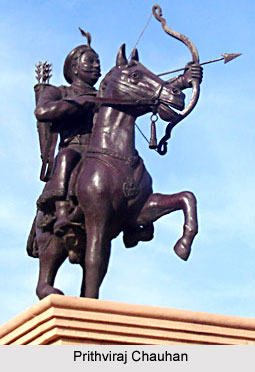
The Chauhan dynasty is a prominent Rajput lineage that rose to power in Rajasthan from the seventh century onward. Known for its warrior tradition and regional influence, the dynasty produced notable rulers such as Prithviraj Chauhan and played a significant role in medieval North Indian politics.

Share this Article:

Introduction

The Chauhan dynasty is associated with several ruling Rajput families that emerged in the present-day Indian state of Rajasthan from the seventh century onward. Descendants of the Chauhan Rajputs went on to govern multiple princely states across Western and Northern India, maintaining political authority and regional influence until the pre-independence era.


Origin of Chauhan Dynasty

The term “Chauhan” is the vernacular form of the Sanskrit word “Chahamana.” Several Chauhan inscriptions refer to a legendary hero named “Chahamana” as their ancestor, although none specify the period in which he lived. The earliest known ruler of the dynasty was Vasudeva. According to the Prabandha-Kosha, a 14th-century Sanskrit collection of prabandhas compiled by the Jain scholar Rajashekhara Suri, Vasudeva is believed to have ascended the throne in 551 CE (608 Vikram Samvat).

Sevadi inscription: The earliest surviving inscription describing the origins of the Chauhans is the Sevadi inscription dated to 1119 CE, attributed to Ratnapala, a ruler of the Naddula Chahamana dynasty. This inscription states that the ancestor of the Chahamanas was born from the eye of Indra, reflecting the dynasty’s mythological lineage.

Bijolia rock inscription: The 1170 CE Bijolia rock inscription of Someshvara, a Shakambhari Chahamana king, records that his ancestor Samantaraja was born at Ahichchhatrapura in the gotra of the sage Vatsa.

Sundha Hill inscription: The 1262 CE Sundha Hill inscription of Chachiga-deva, a Jalor Chahamana ruler, describes the dynasty’s ancestor Chahamana as “a source of joy” to the Vatsa lineage.

Mount Abu inscription: The 1320 CE Mount Abu inscription from the Achaleshwaram Temple, attributed to the Deora Chauhan ruler Lumbha, further states that the sage Vatsa created the Chahamanas as a new warrior lineage after the solar and lunar dynasties had ceased to exist.

Ajmer inscription: In contrast, the Ajmer inscription of Vigraharaja IV of the Shakambhari Chahamana dynasty (c. 1150–1164 CE) asserts that Chahamana belonged to the solar dynasty, tracing descent from Ikshavaku and Rama. This claim is echoed in the 12th-century Prithviraja Vijaya mahakavya, composed by Prithviraja III’s court poet Jayanaka, which also attributes a solar dynasty origin to the ruling house. According to this text, Chahamana descended to earth from Arkamandala, the orbit of the sun.

The earliest extant recension of the Prithviraj Raso by Chand Bardai, dated to the 15th or 16th century, recounts that the first Chauhan king, Manikya Rai, was born from a sacrifice performed by Brahma. A similar tradition appears in the 16th-century Surjana-Charita, composed by the Bengali poet Chandra Shekhara under the patronage of the Ranthambore ruler Rao Surjana. This text states that Brahma created the first Chahamana from the disc of the Sun during a sacrificial ceremony at Pushkara.


Theory of Agnivanshi Origin

Despite other theories, the most popular myth regarding the origin of the Chauhan dynasty is that the Chauhans are one of the four Agnikula clans, deriving their origin from a sacrificial fire-pit at Mount Abu to fight against the Asuras or demons. According to few historians the agnikula clans were originally Gurjaras and Chauhan was prominent clan of the Gurjars.


This legend is believed to have been formulated by the 10th-century Paramara court poet Padmagupta, whose Nava-sahasanka-charita initially mentioned only the Paramaras as fire-born. The later inclusion of the Chauhans in the Agnivanshi myth can be traced to subsequent recensions of the Prithviraj Raso. In this expanded version of the legend, the sage Vashistha and other revered sages commenced a grand sacrificial ceremony on Mount Abu, which was disrupted by unruly daityas (demons). To eliminate these intruders, Vashistha created the progenitors of three Rajput dynasties from the sacrificial fire pit. The Parihar (Pratiharas), the Chaluk (Chaulukyas or Solankis), and the Parmar (Paramaras). However, these warriors were unable to defeat the demons. The sages then prayed once more, resulting in the emergence of a fourth warrior, Chahuvana (Chauhan), who ultimately vanquished the demons.

A slight variation of this legend appears in the writings of Surya Malla Mishrana, the court poet of Bundi. In his account, four heroes are created by different gods at the request of the sage Vashistha. According to the bardic tradition of the Khichi clan of the Chauhans, the Parwar (Paramara) emerged from the essence of Shiva, the Solankhi (Solanki) or Chaluk Rao (Chaulukya) from the essence of Brahma, and the Pariyar (Parihar) from the essence of Devi. The Chahuvan (Chauhan), in contrast, was born from Agni, the God of fire.


History of Chauhan Dynasty

The Chauhans were historically a powerful and influential group in the region that is now known as Rajasthan. For nearly four centuries from the 7th century CE, their stronghold at Sambhar posed a significant challenge to the power base of the Guhilots in the south-western part of the region, as well as to other allied Agnivanshi clans. Although the Chauhans suffered a major setback in 1192 with the defeat of their leader, Prithviraj Chauhan, at the Second Battle of Tarain, this event did not mark the end of their political presence.

Following the invasion of Qutbu l-Din Aibak in 1197, the Chauhan kingdom fragmented into the Satyapura and Devda branches. Throughout the 13th and 14th centuries, the Chauhan Rajputs continued to engage in prolonged conflict with the Delhi Sultanate, vying for control over strategically important regions such as Delhi, Punjab, and Gujarat.

The Chauhan dynasty dominated Delhi, Ajmer and Ranthambhor. They were also prominent at Godwar in the southwest of Rajputana, and at Hadoti in the east. This clan originated near Amber, which is now Jaipur in Rajasthan. The Chauhans of Gurjar clans are the Mainpuri in Uttar Pradesh and the Neemrana in Alwar district of Rajasthan.


Chauhan dynasty had established themselves in various places in the Northern India and in the Western state of Gujarat in India. The Chauhans by winning various battles liberated themselves from the dominance of the Pratiharas in the early eleventh century. The kingdom of Chauhans became the leading state and a powerful kingdom in Northern India under Prithviraj Chauhan who was also called Rai Pithora. In 1192 Muhammad Ghori defeated Prithviraj at the Second Battle of Tarain and with this the Chauhan kingdom felt a major setback.

However till 1365 Chauhans remained in Ajmer as the feudatories of Mohammed of Ghori and the Sultans of Delhi. In 1365 Ajmer was captured by the rulers of Mewar. During this time, Govinda, who was the grandson of Prithviraj III, established themselves as the rulers of Ranthambhor from the thirteenth to the fifteenth century. Afterwards Ranthambhore was also captured by the rulers of Mewar. The Hadas, another branch of the Chauhans moved in the Hadoti region in the twelfth century. In 1241 The Hadas captured Bundi and ruled there until the twentieth century. Hada Rajputs won Kota and ruled there till the merger of state in independent India. The last Chauhan king ruled in Mainpuri, a district in Uttar Pradesh of India.

Prithviraj’s defeat and capture at Tarain ushered in Muslim rule in North India by the Delhi Sultanate. The Chauhans of Ajmer remained in exile due to Muhammad of Ghori and his successors, until when Ajmer was captured by the Sisodias rulers of Mewar, and it was then returned to the Chauhans.

The Chauhan Rajputs come from region around the lakes of Sambhar and Pushkar in Rajasthan, near Amber and Mewar Jaipur. Uttar Pradesh, UttarakhandHimachal Pradesh and Neemrana in Alwar District of Rajasthan were other seats of Rajputs. There is a great village of the Chauhan clan by the name of Gura Sonigara near Pali in Rajasthan.

The Chauhan rulers of Ajmer are Ajay Pal, Prithviraj I, Jagdeva, Vigraharaja I, Apara Gangeya, Prithviraj II, and Someshwara. The Chauhan rulers of Mainpuri are Pratap Rudra, Veer Singh, Dhaarak Dev, Pooran Chand Dev, Karan Dev, Ghaatam Dev and Maharaja Tej Singh Chauhan.

The religion of the Chauhans varies from region to region. In India the majority of the Chauhans are Hindus but in Punjab they are the Sikhs. In Pakistan majority of the Chauhans are predominantly Muslims. The failure of the Chauhans ushered in the Muslim rule in North India in the form of the Slave dynasty, the first dynasty of the Delhi Sultanate.


Cultural and Religious Integration of Chauhan Dynasty

The history of the Chauhans reflects a synthesis of Vedic and local traditions, integrating diverse beliefs and practices within their society. The prominence of fire and sun worship, along with rituals involving weapons and animal reverence, indicates a blending of Aryan customs with regional warrior traditions. This cultural amalgamation is widely viewed as an effort to consolidate authority and forge a distinct Rajput identity during times of external invasion and internal conflict.

The Bijoliya inscription offers valuable insight into the presence of both Jain and Shaiva pilgrimage sites along the Kutila River, highlighting the religious diversity and tolerance that characterizes Chauhan rule. It illustrates the dynasty’s patronage of multiple faiths, particularly Jainism and Shaivism, which held significant influence in the region.

Additionally, the inscription records the granting of dohli (land grants) to temples, showing the support of the Chauhan rulers towards religious institutions. Such grants were commonly used to secure legitimacy and backing from religious authorities, while also encouraging the development of pilgrimage centers and strengthening local economies.


Share this Article:

More Articles in History of India


History of Uttar Pradesh
The state was the heart of Mahabharata war and the history of Uttar Pradesh is very much the history of India. The place finds its mentions in Hindu epics Ramayana and Mahabharata.
History Of Archaeology In India
History of archaeology in India contributes a lot to define the past history and the social life of India.
Mughal Architecture during Babur
Mughal architecture during Babur marked the foundation of a new architectural era in India, blending Timurid, Persian, and local influences. His reign emphasized garden design, notably the Charbagh layout, and modest yet elegant structures. As the first Mughal emperor in India who introduced this architecture during 16th century Babur’s creations reflected symmetry, functionality, and a deep appreciation for nature.
Princely State of Patdi
The Princely State of Patdi was one of the many princely states under the British Raj, ruled by local Kadva Patidar leaders under indirect British control. Known for its strategic location near the Little Rann of Kutch, Patdi played an important role in salt production and regional trade. Princely State of Patdi or Patri was incorporated as a part of the Baroda Agency, which was a sub division of Western India States Agency.
Architecture during Sayyid and Lodi Dynasty
Architectures during the Sayyid and Lodi dynasty were mainly the tombs and monuments for the dead rulers. It were carefully designed and meticulously constructed.
Brahmanical Sources of Ancient History
Brahmanical Sources of ancient history are contained in the Vedas and they constitute one of the most important literary sources of information about ancient India.
Female Education In British India
The over brimming enthusiasm among zealous Hindu reformers welcomed female education in British India.
Revenue System of Mauryan Empire
Revenue system of Mauryan Empire can be divided into eight categories. The principal revenue of the state was the land revenue, taxes from traders, artisans and professional taxes were also collected.
Mughal Architecture During Jahangir
Mughal architecture during Jahangir`s period was relative dull in comparison to that of Akbar dynasty.
Princely State of Satlasna
Princely State of Satlasna was amongst the former native states of India that was appointed as one of the Indian princely states during the early 19th century.
Coins of Chola Empire
Coins of Chola Empire were issued in gold, silver and copper and carried the Chola emblem.
Social Life during the Pala Period
Religious toleration and simple living were the characteristics of social life during the Pala period.
Coins of the Chalukya Dynasty
Coins of the Chalukya Dynasty was reintroduced in the South India after a brief break of coinage less period of nearly three century. Chalukyas issued coins only in gold and they exhibit a brilliant artistic skill of the engraver.
Costumes of Indus Valley Civilisation
Costumes of Indus valley Civilization have been considered as the basis for Indian clothes. Sophisticated ornaments and make up were used during that age.
Development of Science under Gupta Empire
Development of Science under Gupta Empire was progressive and it had attained considerable perfection. Mathematics, astronomy, medicine, chemistry, physics and metallurgy were the most prominent of the sciences at that time.
Culture under Delhi Sultanate
Culture under Delhi Sultanate had enduring aspects to it. It included the society, the religious condition, literature and art and architecture of that period.
Princely State of Hapa
Princely State of Hapa was incorporated as a part of the Baroda Agency, which was under the administrative control of the Western India States Agency.
Economy Under Chola Dynasty
Economy under Chola dynasty was strong and well developed. The economic life of the people of the Chola Kingdom was well balanced with their social life.
Coins of Khilji Dynasty
Coins of Khilji Dynasty had an influential feature that was followed by the other dynasties.
Religion During Mauryan Dynasty
Religion during Mauryan dynasty became a considerable episode in Indian history with an esteemed lineage of rulers.