 The costumes of Indus valley civilization have been revealed from unearthed figurines. The dress on the clay figurine can be considered as the normal attire of the female of the time. The waist is bare and a very scanty skirt is worn. The skirt is held by a girdle that is made of beads or of bands of woven material secured by a pin or fastening of some kind. One figure wears a cloak which is wrapped around the upper part of the body. Head-dresses are used which are made of stiffened cotton cloth. A tight collar that gives an appearance of greater length to the neck is worn by a few of the figurines.
The male figures are generally seen to be nude. Probably a rob with or without embroidery was worn over the left shoulder and under the right arm. The figure of a man at Harappa might be wearing a close-clinging dhoti. Footwear as such was not found. Cotton as a fabric was used but no evidence was available as far as use of linen and wool are considered.
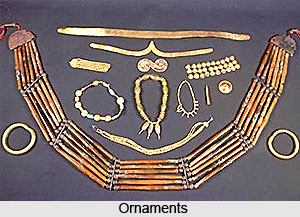
Ornaments Used in Indus Valley Civilisation
People seem to have been fond of jewellery and hair-dressing. Jewellery made of stones; gold and silver have been unearthed. Men had varied styles of hair-dressing. For instance, one wears his hair parted in the middle and the short locks at the back of the head are which are kept tidy by a woven fillet. Some show the hair woven into a bun after the hair being plaited. Some other figurines show the hair coiled in a ring on the top of the head and in similar rings concealing the ears. Beards were trimmed in various styles.
Metal ornaments were made of gold, electrum, silver, copper and bronze. Stones like lapis lazuli, turquoise, jadeite, carnelian, agate, onyx, Amazon stone, heliotrope, plasma, tachylite, chalcedony, nepheline-sodalite, shell, pottery, faience, vitreous paste; quartz, serpentine and haematite were used. The ornaments used are girdles, necklace, bracelets, pectorals, beads, cones, ear rings, nose-rings, finger-rings, anklets, bangles and hair-pins.