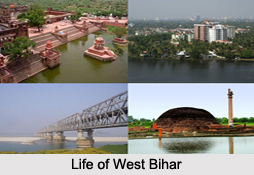
History of Rajputs reveal that the first Rajput kingdoms date back to the seventh century and it was during the ninth and eleventh centuries that they rose to fame. The four Agnivanshi clans, namely the Pariharas (of the Pratihara), Solankis (of the Chalukya dynasty), Paramara, and Chahamanas of the Chauhans rose to prominence by establishing territories and creating kingdoms.
Chattis Rajput Kuls : The Chattis Rajkul is a list of kings of the thirty six different Indian states. Chattis Rajkul clans include clans from Suryavansha, Chandravansha, Agnivansha and Nagvansha. Suryavanshi`s are descendants of Surya, the sun god, Chandravansha being that of moon and Agnivansha meaning those born from the sacrificial fire pit. This is again divided into Guhilots, Yadu vansh, Tomar vansh, Rathore, Parmar, Chauhan, Gurjar, Solanki many more to be mentioned.
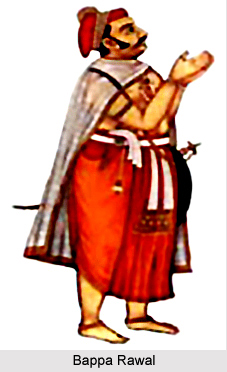
Beginning of Rajput Kingdoms : The first Rajput Empire in medieval history is Harsha`s empire who ruled over the whole of north India for forty seven years. After his death his empire broke into numerous Rajput Kingdoms. Bappa Rawal of the Gahlot dynasty established his rule in the eighth century in Chittor.
The Kachwahas dynasty from
Bihar founded Gwalior and Narwar in One of their descendants, Dulah Rai established his rule in Dhundhar in the 11th century. The royal Pratiharas established their rule over Malwa the eighth and ninth centuries. One branch of the clan established a state in Mandore in the Marwar region in sixth and seventh centuries. Around ninth century the Pratiharas of
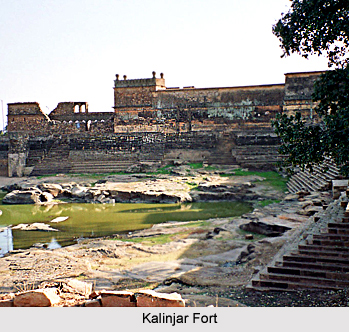
Ujjain conquered Kannauj, and from this city they ruled much of northern India for a century. They went into decline after invasions of Rashtrakutas in early tenth century. The Chandela clan ruled Bundelkhand and occupied the fortress of Kalinjar; and later built the temples at Khajuraho. Intermarriage among the Rajput clans interlinked the various regions of India and Pakistan, facilitating trade and scholarship. The early eleventh century saw the reign of the Pratihara king Bhoja of Malwa. During this time art, literature and archaeology flourished.
Rajputs under Muslim Rule : For geographical reasons, Rajput-ruled states suffered the burden of attack from the Mongol, Turk, and Afghans who constantly invaded India. In the 11th century, Mahmud of Ghazni conquered the Hindu Shahi kingdom in the
Punjab which weakened the Pratihara kingdom. In the mean time the Gahadvala dynasty established a state centred around
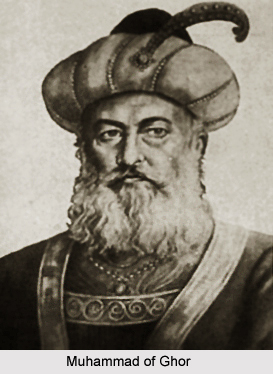
Kannauj, ruling for about a hundred years. They were defeated by Muhammad of Ghor, who sacked the city in twelfth century.
Meanwhile, a nearby state was ruled successively by the Tomara and Chauhan clans. Prithiviraj III, ruler of
Delhi, defeated Muhammad of Ghor at the First Battle of Tarain. Muhammad defeated Prithviraj at the Second Battle of Tarain (1192 CE). In this battle, rampant inner conflict among Rajput kingdoms made the invaders to easily attack.
The
Delhi Sultanate was established by Qutb-ud-din Aibak, Muhammad of Ghor`s successor, in the early thirteenth century. Sultan
Ala-ud-din Khilji conquered in subsequent centuries Gujarat, Malwa, Ranthambhore, Chittorgarh, Jalore, and Bhinmal. All were conquered after long sieges and fierce resistance from their Rajput defenders.
Ala ud din Khilji delegated the administration of the newly conquered areas to his principal Rajput collaborator, Maldeo Songara, ruler of Jalore. Maldeo Songara was soon displaced by his son-in-law Hammir, who re-established the state of Mewar which emerged as a leading Rajput state, after Rana Kumbha enlarged his kingdom at the cost of the sultanates of Malwa and Gujarat.
The Delhi sultanate was extinguished when
Babur defeated Ibrahim Lodi at the First Battle of Panipat. Rana Sanga, ruler of
Mewar, fought with Babur but was defeated. Rana Sanga died soon; Mewar came under the rule of his widow, Rani Karmavati. This was menaced by Bahadur Shah, ruler of Gujarat.
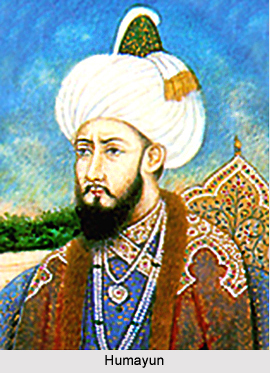
Babur`s son
Humayun was a ruler who was forced to spend long periods in exile. His son Akbar, however, consolidated his inheritance and expanded what had been the Delhi sultanate into a wide empire. Part of the reason for his success was his inclusion of native Rajput chiefs into the ruling class of his empire. The Rajput chiefs cemented the alliance with marriages, with numerous Rajput noblewomen being wed to Mughal grandees. The Kachwahas were the first to extend matrimonial alliances with Akbar; they pioneered a trend that soon turned pervasive and played no small role in extending Rajput influence across the Indian sub-continent. Indeed, two successive Mughal emperors,
Jahangir and
Shah Jahan, were born to Rajput mothers.
Rajput chiefs served as
Mughal officers and administrators across the Mughal Empire. In this period, the aristocratic image of the Rajputs can be said to have shaped up. However, it was not until the reign of Akbar fifteen years later that the structure of relations between the Mughal Empire and the Rajput states began to take definitive shape. Later, Babur`s grandson Akbar attacked Chittor. After a struggle, Mewar`s chief citadel of Chittor finally fell to
Akbar.
After Rana Pratap`s death, his son Rana Amar Singh continued the struggle for 18 years. He finally entered into a peace treaty with the Mughals but with certain exceptions. The treaty was signed by Rana Amar Singh and Prince Khurram Shihab-ud-din Muhammad Singh regained control of his state as a representative of the Mughals. The last Rajput dynasty to enter into an alliance with the Mughals was the Sisodias of Mewars.
Rajputs in Medieval India : 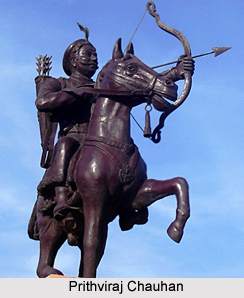 Prithviraj Chauhan
 was the last Rajput ruler of Delhi. The Chauhans, led by the grandson of Prithviraj, Govinda, later established a small state around Ranthambore. The Rever Maharaja Ranavghansinh ruled Taranga in the eleventh century. The Tomaras later established themselves at Gwalior, and their ruler Man Singh had built a fortress. Muhammad`s armies brought down the Gahadvala kingdom. Some surviving members of the dynasty had taken refuge to the western desert, formed the Rathore clan, and found the state of Marwar. The Kachwaha clan came to rule Dhundhar, their capital being Amber. The Katoch clan, the Chauhans of Chamba and certain clans of Uttarakhand and Nepal had emigrated to Himalayas.
Rajputs in British Empire ; The trend of political relations between Rajput states and the central power of the Mughal emperors was the pioneer for similar relations between them and the British rule. The eighteen states in the Rajputana region, out of which fifteen were ruled by Rajputs, entered into alliance with the
British East India Company and became princely states under the British Rule. The British also took control of Ajmer, which became the province of Ajmer-Merwara. A large number of other Rajput states in central and western India made similar pacts. Most of them were placed under the Central India Agency`s authority and the various agencies of state of Kathiawar.
Rajputs after Independence : The Maharajas were given undue recognition and an annual amount was endowed to them. Many entered into affairs of state and served as elected representatives. However, later on the Maharajas were de - recognized and the system of annual endowment was also abolished.
The Mair Rajputs today are found in the states of
Punjab,
Haryana,
Himachal Pradesh,
Jammu and Kashmir, and
Rajasthan. The capital city of India, Delhi also contains a number of Mair Rajputs. Many Mairs are goldsmiths today because that is recognized as their traditional occupation. Sikh
Rajputs are the followers of
Sikhism belonging to the Rajput social group. Many Punjabi Rajput families are also enrolled in the Guru`s Army, or Khalsa Panth, and baptized as Khalsa Sikhs.
Today the kingdoms have been transformed into famous hotels and tourist destinations, though the Maharajas fulfill some of the ceremonial duties. Rajput men and women are still much involved with elaborate ceremonies, especially weddings, for these are the rituals of Rajput identity. There are modern Rajputs who are followers of the Swaminarayan sect, of
Ramanuja, or of Vallabhacharya. These groups are all vegetarians, but other Hindu Rajputs, the majority, are Shaivites.

 Rajputs are one of the major Hindu Kshatriya groups in India. After the death of Harsha, northern India disintegrated completely. This period was marked by the ascendancy of the Kshatriya clan, Rajputs.
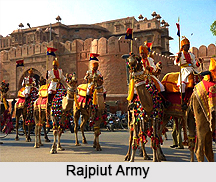 Rajputs allowed intermarriage among the different Rajput clans that interlinked different regions of India and this made the trade and scholarship easier to flow from one part of the country to another. Though the majority of Rajputs practice Hinduism but they also practiced Shaivism, Vaishnavism, Shaktism and occasionally
 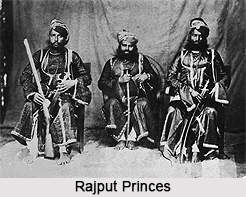 Rajputs are a community that hailed basically from northern India and Gujarat. The main centres of the Rajputs were Rajasthan, Uttar Pradesh and Madhya Pradesh but their clans have had a long and significant presence in other states. In Madhya Pradesh Rajputs are the major Hindu caste and their dominance exists in Bihar, Uttarakhand, Himachal Pradesh and Gujarat as well. Rajputs of India encompass many different tribes and they were praised for their valour and chivalry in battle.
 The dhoti is also worn, though styles differ from region to region. The tevata style is most commonly worn in the
 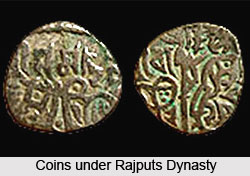 Delhi coinage under Rajputs was made up of silver-copper alloy. The production capacity of Delhi remained stable and the rate of production was also maintained fairly constant throughout the period. The quality of execution of the coins, especially from 1160 AD onwards, was superior in comparison with the billon coinage of the Gurjara-Pratiharas, but inferior to the Shahi coinage. The coins were popularly called Dehliwalas after their place of origin, and enjoyed wide currency in their own time. While virtually all of the hoards recovered date from the Ghurid or early Sultanate period show a post-conquest circulation pattern, the unusually high rate of attrition in circulation attests to both frequency of use and dispersal into neighbouring kingdoms in the pre-conquest period. From the pattern of hoard finds and historical inference, this emigration appears to have been largely towards the northwest of Delhi, or into the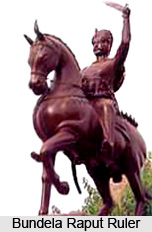
 The Bundela chief Rudra Pratap (ruled 1501-1531) founded the state of Orchha. The Bundelas seized the city of Chanderi in 1586. Rulers like Madhukar, Virsingh Dev, Ram Sab and Jujhar Singh then subsequently ruled the region. When the Mughal Emperor Shah Jahan killed Jujhar Singh in 1636, Orchha was for a short time annexed to the Mughal Empire, although it was later restored to the Bundelas.
 In 1729 Baji Rao sent a Maratha army to help Chhatar Sal against the Mughals. Chhatar Sal`s ruled the states of Panna, Ajaigarh, Charkhari, Chhatarpur, and Jaso. Chhatarpur went to the Ponwar Rajputs in 1785. In 1680 Devi Singh Bundela became governor of the Chanderi, and the city remained in the hands of his family until Jean Baptiste Filose captured it in 1811 on behalf of the Maratha ruler Daulat Rao Sindhia of Gwalior. After 1802, the Bundela rulers entered into treaties of subsidiary alliance with the British, and princely states were formed. The Bundelas ruled Orchha, Datia, Panna, Ajaigarh, Charkhari, and Jaso until 1950. Precisely, the Bundela rulers of Orchha are Raja Rudra Pratap, Raja Bharatichand, Raja Madhukarshah, Raja Virsingh Dev, Raja Jujhar Singh, Raja Devi Singh, Raja Pahar Singh, Raja Sujan Singh I, Raja Indramani Singh, Raja Jashwant Singh, Raja Bhagwat Singh, Raja Udwat Singh, Raja Prithvi Singh, Raja Sanwant Singh, Raja Hati Singh, Raja Man Singh, Raja Bharti Singh, Raja Vikramajit, Raja Dharam Pal, Raja Vikramajit, Raja Tej Singh, Raja Sajjan Singh, Maharaja Hamir Singh, Maharaja Pratap Singh and Maharaja Vir Singh.