Home > Travel > States of India > Bundi District
Bundi District
The Bundi District, famous for monuments and forts, lies in the state of Rajasthan.

Share this Article:

About Bundi District

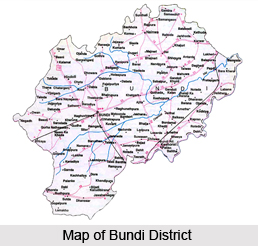
Bundi District, RajasthanBundi District is a district located in the southeastern part of the state of Rajasthan in the western part of India. The town of Bundi is the district headquarters. The total area of the district is 5,550 sq km. It has a population of 9,610,269 (as per the 2001 census). It is surrounded on the north by the Tonk District, on the west by the Bhilwara District and on the southwest by the Chittorgarh District. The river Chambal forms the southern and eastern boundaries. Bundi is in general dry in nature with the exception of the monsoon or winter rains. The annual rainfall is 76 cm. Hindi and Rajasthani are the two languages spoken in this district.

Bundi District is very famous for its intricate carvings and murals. It has a collection of monuments including impressive medieval forts, palaces, havelis, and temples with beautiful stone idols, and carved pillars. The important tourist destinations are Garh Palace, Kshar Bagh, Chhattar Mahal, Sukh Mahal, Taragarh Fort, Dugari, Indargarh, Keshavraipatan and Talwas. The step-wells including Nawal Sagar and Raniji-ki-Baori are also worth visiting.

The Bundi district of Rajasthan has been an imperative tourist destination for both the foreign and domestic tourists. The place presents a unique tradition with baoris , palaces and forts , lakes and the beautiful natural surroundings. Many fairs and festivals are organized every year. The rainy season is very unique for the Kajli Teej Festival. The weather is usually pleasant except for a patch of the hot summer. During the monsoons in Bundi a local festival called Kajli Teej is uniquely celebrated here. A local fair is also held on this occasion displaying lot of local handicraft items including Katar , paintings and bangles and the like.


History of Bundi

Rajasthan is full of tales of how the Rajputs were always engaged in wars within their tribes. The settlement of Bundi is a living example where the Rajputs of different clans were regularly fighting with themselves for power. The history of Bundi dates back to 1193 when Chauhan nobles sought shelter in Mewar and became the allies of the Rana. The other young warriors moved towards the Chambal valley and overpowered the tribes, thus establishing their own kingdom of Hadoti in 1342. These incidents occurred after the fall of Prithviraj Chauhan. One of the descendants of the ruler of Hadoti, Asthtipal, was Rao Deva Hada. It was he who founded the Bundi as the capital state of the Hadoti kingdom.

The rulers of Bundi fought fierce battles on behalf of the Mughals sacrificing royal princes and heads of Hada clan. Bundi could not gain political stability before the 17th century. During this time Emperor Shahjahan awarded Rao Chhatar Sal the governorship of the imperial city of Delhi, a rare privilege for his services and loyalty.

Besides winning battles for the Mughal Empire they were continually at war with the Maharanas of Mewar and later the kingdom of Amber who repeatedly tried to annex Bundi`s territories. The adjoining state of Kota was held as a fief by the younger Bundi Prince until about 1580, when the 14-year-old Bundi Prince, Madho Singh, gallantly fighting on behalf of the Mughal Emperor Jahangir, was awarded permanent possession of the area. However by 1818 AD Bundi was under the British Raj.

The history of Bundi is similar to several Rajputana kingdoms that have witnessed clamor and turmoil. Yet Bundi stands out amongst the ancient states of Rajputana as a dynasty that had good terms with the Mughal Empire.


Princely State of Bundi

Princely State of BundiThe Princely State of Bundi was one of the 17 Gun Salute states of India during the rule of the British Empire in India. During the early 19th century, the region was appointed as one of the princely states of India under the indirect rule of the British administration. It was incorporated as a part of the Rajputana Agency and Eastern States Agency, which administered the relations of the state with the British authorities. Bundi state covered a total area of 2,220 sq miles and comprised of a population of 249,374 in the year 1941. The princely state of Bundi was located in the eastern Rajputana and was bounded by Jaipur in the north; by a Tonk enclave in the northeast; by Kotah in the east; and by Udaipur in the south and the west. The territory is traversed from southwest to northeast by a double row of hills which divide the land into 2 approximately equal and mutually inaccessible regions.

The Princely State of Bundi was honoured as one of the salute states of India with a gun salute of 17 guns. The courts of the state exercised full civil and criminal jurisdiction and followed ancient Hindu laws and customs. The native ruler of the state who held the title of Maharao Raja had full powers of administration. Bundi state was segregated into 12 tahsils. There were a number of jagirs, but were not necessarily hereditary. The princely state of Bundi continued to mint its native currency of Chehra Shahi silver rupee. The coat of arms of Bundi state was a shield that depicted Garuda, who is the mount of Vishnu, bordered by winged griffins. The shield is surrounde by bulls signifying righteousness or dharma; it was crowned by a warrior rising from flames, potrraying the creation legend of the ruling Chauhan dynasty, as the clan was allegedly created from fire.

History of Princely State of Bundi
The Hara or Hada sept of the Chauhan Rajputs was the ruling family of the Bundi state. The state was established by Rao Deva, also known as Deoraj, who seized the territory from the indigenous Minas in 1241. During the rule of Sarjan Hara, the state received privileged treatment from Mughal Emperor Akbar. The native rulers of the princely state of Bundi were loyal to the Mughal dynasty untill the 18th century. Later in the year 1734, the Maratha forces captured the land and gained power over Bundi with the help of a claimant to the royal throne. On 10 February 1818, the princely state of Bundi accepted the suzerainty of the British East India Company. The native ruler Bishan Singh signed a subsidiary alliance with the British authorities and received support and protection from the British forces. Later during the First World War, Bundi state supported the British Government of India.

In 1947, after the withdrawal of the British and the partition of India, the British authorities abandoned their suzerainty over the various princely states of India, which were left to decide whether to accede to the newly formed Dominion of India or the Dominion of Pakistan. The last ruler of the princely state of Bundi acceded his state to Republic of India, also known as the Union of India. The internal affairs of Bundi eventually came under the control of Delhi.

Rulers of Princely State of Bundi
* Rao Deva (1343- 1343)
* Rao Napuji
* Rao Hamuli (1384-1400)
* Rao Birsingh (1400- 1415)
* Rao Biru (1415- 1470)
* Rao Bandu (1470- 1491)
* Rao Narayan Das (1491- 1527)
* Rao Suraj Mal (1527- 1531)
* Rao Surtan Singh (1531- 1544)
* Rao Raja Surjan Singh (1544- 1585)
* Rao Raja Bhoj Singh (1585- 1608)
* Rao Raja Ratan Singh (1608- 1632)
* Rao Raja Chhattar Sal Singh (1632- 1658)
* Rao Raja Bhao Singh (1658- 1682)
* Rao Raja Anirudh Singh (1682- 1696)
* Rao Raja Budh Singh (1696- 1735)
* Rao Raja Dalel Singh (1735- 1749)
* Rao Raja Umaid Singh (1749- 1770) and (1773- 1804)
* Rao Raja Ajit Singh (1770- 1773)
* Rao Raja Bishen Singh (1804- 1821)
* Maharao Raja Ram Singh Sahib Bahadur (1821- 1889)
* Colonel His Highness Maharao Raja Shri Sir Raghubir Singh Sahib Bahadur (1889- 1927)
* Major His Highness Maharao Raja Shri Sir Iishwari Singh Bahadur (1927- 1945)
* Colonel His Highness Maharao Raja Shri Bahadur Singh Bahadur (1945- 1977)
* His Highness Maharao Raja Ranjit Singh (1977- 2010)

Monuments of Bundi

Monuments of Bundi, Monuments of RajasthanThe monuments of Bundi are well known for their Rajput architecture. Most of these edifices are either palaces or forts. For instance the Taragarh Fort is one of the prime attractions for the tourists. As far as Bundi is concerned, this delightful town is completely unspoilt, being situated well off the usual tourist route. It is the chief town of the old state of Bundi. To the north lie the former states of Jaipur and Tonk, to the cast and south, Kota, and to the west, Udaipur. The history of Bundi state is that of its ruling family, the Hara Chauhan clan of Rajputs, who were held in high esteem in the princely hierarchy.
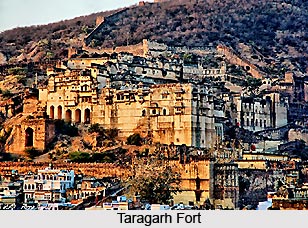
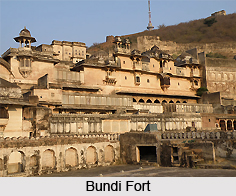
The town lies on the side of a steep hill. The palace dominates the foreground, with its pinnacled terraces and pavilions rising one above the other. Taragarh Fort is located in Bundi in Rajasthan. Also known as the Star Fort, it was built in 1342. As far as its architecture is concerned, Taragarh Fort is square in plan with large corner bastions. In the middle of the west wall is a fine gateway and in the middle of the east wall, a postern. The ramparts are crenellated, with high parapets. The main gate to the west is flanked by octagonal towers defended by a strong barbican. The approach is difficult, always commanded by the towers above. The main entrance has vaulted guardrooms. The fort is dominated by a huge masonry tower, the Bhim Burj, which provided a gun platform for cannon. The Sabirna-Dha-Ka-Kund is a square, stepped water tank with great depth. Built in 1654, it is a marvellous exercise in three-dimensional geometry.

With increasing security the Hara Rajputs constructed outside the Taragarh Fort as well. The City Palace was begun in 1580 by Balwant Singh. It is a distinguished piece of Rajput architecture, running from the women`s quarters half-way up the hill. The Chatar Mahal palace was built in 1660 by Chatar Sal, a loyal servant of Emperor Shah Jahan. It is the largest and most impressive of the jumble of palaces that cascade down the hillside. Built in a green serpentine rock, it is an exercise in Rajput architecture unadulterated by Mughal influences. Characteristic motifs such as lotus-flower spandrels and elephant symbols recur throughout, amid a profusion of arcuated roofs, kiosks and pavilions. A steep carriageway provides access. The first gate is Hazari Pol or Gate of the Thousand, where the garrison lived. The palace quarters are entered via the Hathi Pol (1607-1631), an enormous stone gateway spanned by ornamental elephants and decorated in red, yellow, blue, white and silver. Within the porch is an old water clock, supervised by an elderly retainer. In the Diwan-i-Am or Hall of Public Audience there is a canopied balcony where the ruler made his appearance.

The Chitra Mahal, an open courtyard with a gallery running around a garden of fountains, has a fine collection of Rajput miniatures in the local Bundi style depicting scenes from Raslila, the Radha-Krishna story. The colour scheme in blue, green, white and turquoise is exquisite. The murals on the walls of the cloister of the Chitra Shall {mid-18th century) are some of the finest in Rajput art. It is alleged that the area beneath the fort and palace is honeycombed with subterranean passages leading to the Chatar Mahal. Deep in these underground caverns the state treasure is supposed to be stored. Each ruler was permitted a single visit, but when the last surviving guide died in the 1940s, the secret of its precise location was lost, a tantalizing enigma buried in the haunted ruins of Bundi`s past.

Sukh Niwas is a summer palace on the Jait Sagar tank with a beautiful formal garden, the scene of festival processions. The square, artificial lake of Nawal Sagar is visible from the fort, in the centre of which is a half-submerged temple to the Anjan god of water, Varuna. The surface of the lake reflects the entire city and palace, providing a further dimension to its attractions.

To the west of the Nawal Sagar Lake is the Phool Sagar or Flower Palace, a relatively modern complex commenced by Maharaja Bahadur Singh in 1945 AD around a large artificial lake. It is still unfinished. The cenotaphs of the ruling family are at Khshar Bagh.


Places of interest around Bundi

Places of interest around Bundi, RajasthanThe kingdom of Bundi is surrounded by picturesque places. While some of these sites are of religious importance the others are for their citadels and even magnificent resorts. Local transportations and cars on hire are available for the making a trip to the places of interest around Bundi.
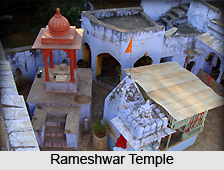
Rameshwar Temple is located 20 kilometers away from Bundi. It is dedicated to Lord Shiva. It is a picturesque site having a waterfall with a tank below. It lies quite close to the Ratna Sagar Lake. The beauty of this place is indescribable. A small fort and the Dhuleshwar Mahadev Temple and a picturesque waterfall nearby to it are the added attractions. This region is also famous for its craftsmanship, especially, pottery.

Gararda is a village that is located 32 kilometers away from Bundi. Exquisite rock paintings have been found on rocks flanking the river. It is believed that these paintings depicting animals, hunting scenes, armies, human figures, episodes from daily life and dancing postures are 15,000 years old.
35 km northeast of Bundi, Dugari, is home to migratory birds in the lovely lake, Kanak Sagar. Here the walls depict the raas-lila of Radha-Krishna.

77 kilometers away from Bundi the tourists will come across Indragarh. It was founded by Indrasal Singh Hada in the 17th century. The temples of Goddess Kali and Kamleshwar are worth checking out. The walls of the palace within the fort are ornamented with typical Bundi style paintings.

Places of interest around Bundi, Rajasthan Bijolia is located at a distance of 50 kilometers from Bundi. This town has a fortress and ruins of 11th century temples. The 13th century Undeshwara Temple and its sanctorum have a half submerged Shiva ling. This is the most remarkable local attraction here. The entire temple has been built in the Hindu architectural style. it has pagoda covered with bands of beautifully carved stone motifs. Nearby is an old Ganesh temple with a very fine image. There are also ruins of some other old temples dating back between 11th to 13th centuries.
Umaid Bagh Resort was the royal rest house Shreeji Umaid Singh ji, ruler of the Bundi state in the 18th century. Presently this magnificent building has been converted to a heritage hotel. The striking feature of this resort is that it is surrounded by water from three sides. The exotic bird life including migratory and Indian birds and the outdoor activities like trekking and jeep safari in an adjoining countryside make the stay memorable.

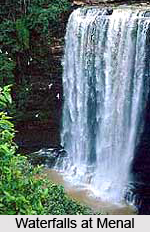
Menal is well known for its waterfalls. The waterfall thus formed particularly in the monsoon attracts a lot of people from the nearby towns. It is located 20 kilometers ahead of Bijolia on the Bundi-Chittorgarh road. This place houses many ancient temples that date back to the Gupta period. The old temple complex has an imposing Shiva temple entered through a gateway carved with images of Bhairava and Ganesh. The temples walls are carved with idols of Lord Shiva and Parvati in various forms, animals, dancers and musicians.

Another palace ruin belonging to the 20th century is said to be the mountain retreat of the legendary Rajput Prithviraj Chauhan. Other noteworthy sites are Hajashwar Temple and Mahakaleshwar Temple.


Travel information on Bundi

Travel information on Bundi, RajasthanThe district of Bundi is located at a distance of 35 kilometers from Kota. It lies in the north west of Kota. There is an antiquity about the place that adds to its charm. The availability of several modes of transportations and adequate accommodation units has given a boost to the tourism in Bundi. Hence people from all over the world, nowadays, drop in at Bundi while on Rajasthan tour. The travel information on Bundi will be of great help to interested tourists.

Arrival Information: The nearest international airport of Bundi is at Jaipur that is located 210 kilometers away. Kota is the convenient railhead on Delhi-Mumbai rail route. Bundi Railway Station is about 5 km from city centre. Chittorgarh and Bundi are also connected through railways. By road too this district is available. Jaipur, Kota, Ajmer and Chittorgarh are connected to Bundi. Regular bus services ply from Jaipur to Kota with a halt at Bundi.

Local Transport: Auto rickshaws are one of the popular ways to travel within the city. Cycles and motorbikes can also be hired at Bundi to explore this picturesque town.

Accommodation: There are several hotels where the tourists can lodge in. in case one is looking forward to a luxurious holiday then the heritage hotels will be perfect for the occasion. Economy and budget hotels are also located in Bundi. The amenities and services offered at these accommodation units will definitely impress the travelers. After all Rajput hospitality is famous worldwide.

Sightseeing: Forts, temples, palaces and ancient ruins are scattered throughout the city and also beyond its boundaries.

Shopping: Traveling remains incomplete without shopping. And when it is Rajasthan there has to be something special that can be carried back home as a gift. Bundi is popular for its traditional miniature paintings. There are shops outside the Garh Palace and the Nahar ka Chotta locality inside the town for purchasing these art pieces.


Share this Article:

Related Articles

More Articles in States of India


East Indian States
East Indian States comprises of Bihar, Jharkhand, West Bengal, Odisha and also the Union Territory of Andaman and Nicobar Islands. It defines the cultural heritage, rich historical background and the linguistic unity.
Erode District
Erode District is one of the districts in the state of Tamil Nadu. The district of Erode is having a land-locked area with no sea coast.
Purnia District in Bihar
Purnia District is located in Bihar and extends from River Ganga to Nepal. The district has a rich Hindu history and glorious past.
South Delhi District
South Delhi District is the third largest district of Delhi as far as its area is concerned. South Delhi District is known for its economic, historical, cultural and social significance.
North Indian States
North Indian States formed the cultural and religious unity in spite of having many foreign invasion and the political disturbances from the early era till the British gained supremacy in Indian sub continent.
Kendujhar District
Kendujhar District, spread over an area of 8,240 sq kms, is as varied as the whole of Orissa with waterfalls roaring gorges, mountains and minerals. The manifold expressions of nature in Kendujhar District are considered as unique.
Hooghly district
Hooghly District along the bank of the river Hooghly is one of the principal trading ports of West Bengal.
Districts of South Tamil Nadu
Districts of South Tamil Nadu consist of many tourism destinations like archaeological sites and the history of Pandyas and Cholas. Considering their proximity to the sea, many districts also boast of serene beaches and coastal beauty.
Flora of Arunachal Pradesh
Flora of Arunachal Pradesh includes infinite species and is a subject of great interests for the botanists.
Districts of South Gujarat
Districts of South Gujarat are the epicenter of Jain pilgrimages and the early Hindu kingdoms.
North West States of India
North West States of India consist of three states, which are Rajasthan, Punjab and Haryana. All of them are culturally and traditionally diverse and they have been ruled by different dynasties in historical time.
Geography Of Chittoor District
Geography of Chittoor district is spread along the topography of the land which is divided into two natural divisions; Chittoor has a dry and healthy climate.
Districts of North Rajasthan
District of Northern part of Rajasthan is dotted with ancient forts and medieval villages.
Districts of North Odisha
District of North Odisha has Bengal boundary and shares the same culture. These are reachable if one pays a weekend visit to Digha.
Districts of West Bihar
Districts of West Bihar is comprised of medieval monuments that were built by the different governors of Mughal era.
Districts of South Haryana
Districts of South Haryana consists of many cities of industrial excellence. These districts are dotted with popular tourism destinations.
Medieval History of Assam
Medieval history of Assam narrates the advent and rule of a number of kingdoms in the region. The prominent dynasties of the kingdom left an everlasting imprint on the socio cultural heritage of India.
Geography of Meghalaya
The suitable climate, highland plateaus, rivers and the flora and fauna together forms the geography of Meghalaya.
Districts of Rayalaseema
Districts of Rayalaseema in Andhra Pradesh state has urban population and rural settlements as well.
Districts of South Punjab
Districts of Southern part of Punjab depict medieval history of Punjab and the rise of Sikhs.