 We can trace the origin of the Mughals in the Persian dynasty of Chengiz Khan. Historical sources report the word "Mughal" or "Moguls" as a derivative of the Persian word "Mongol".The Central Asian nomads of Turkestan who boasted of their descent from Chengiz Khan, were called by this name. They were Islamic in religion , following the footsteps of their forefathers.
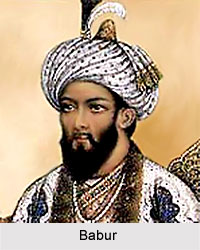
Zahiruddin Muhammad Babur ,born on February 14, 1483 was the founder of the Mughal Empire. This Timurite Prince of Turkestan was the grandson of the renowned Central Asian Conqueror , Tamerlane. While maternally he was related to Chengiz Khan. With this genetic influence, the born conquerer, Babur of Ferghana first extended his sway to the strategic Khyber area and Kabul of Afghanistan in 1504 . This significant takeover paved his way to India.
Muslim invasion was no new phenomenon in India.As early as the seventh century Muslim forces had started intruding into the domain of India. In fact, since the early 1300`s the Rajputana of the south-eastern part of India became subordinate to the dominant Delhi Sultanate of a Turkish invader , Qutubuddin Aibak .
Babur had his eye on the Delhi Sultunate. He crossed the mountains and entered into Hindusthan. He utilized the opportunity of internal rivalry within the Sultunate of Ibrahim Lodhi. He enthusiastically accepted the tempting invitation from Daulat Khan Lodhi, the governor of Punjab and Alam Khan, the uncle of Ibrahim Lodhi. Tactfully, he attacked India in 1526. With a veteran , efficient army of only 12,000 Babur braved an enormous Lodhi battalion. Babur was farsighted. He employed firearms, guncarts, superior cavalry, mobile artillery-advanced war-mechanism with which the Sultan,s soldiers were not familiar. Babur left the Lodhi army shattered in the First Battle of Panipat in 1526.Hence, Western historians often regard this battle as the first "Gunpowder" victory.
Next was the victory at the Battle Of Khanua (1527) which rewarded Babur, the desired supremacy over the north of India. Maharana Sangram Singh 1, or popularly known as Rana Sanga of Mewar gave a clarion call to the major Rajput clans of India. They together formed a formidable confederacy. Actually the Rana had an imperial design of expansion in his mind. Meanwhile , the reluctance of Hasan Khan Meo, a member of the Meo-Rajput community and the Muslim vassal of Mewat, near Delhi. A Lodhi abider was Hasan. So he rejected Babur`s alluring offer of a prestigious and profitable position in Mughal administrative hirerarchy. He allied with Rana Sanga of Mewar. Opposition compelled Babur to participate in war in March 1527 close to Khanua . Again the use of advanced weapons benefitted the Mughals. Rajputs faced a decisive defeat.
The third military success was in the Battle of Gogra in 1529. Babur routed the joined forces of Afghans and the Sultan of Bengal. However, unfortunately he could not enjoy long the fruits of his triumph. He died in 1530 at Agra. He had sown the seeds of what would grow into one of the biggest imperial achievement, the great Mughal Empire in the future to come.