Chandragupta II is also referred as Vikramaditya or Chandragupta Vikramaditya. During his reign, the Gupta Empire reached its peak. A ruler of excellent administrative abilities, foresightedness and military prowess, he was also a great patron of art, culture, literature and music. Chandragupta II the second great ruler of the Gupta dynasty was one of the ablest rulers of India.
Life of Chandragupta II
Chandragupta was the son of Samudragupta and Datta Devi. According to the Allahabad pillar inscription, Chandragupta II was married to a Naga princess Kuberanaga. Before Chandragupta II, his elder brother Ramagupta ascended the throne after death of Samudragupta. At Shringararupakam, Ramagupta was badly defeated by a Saka chieftain. To secure the people, he agreed to surrender his queen Druvadevi to the Sakas. Chandragupta II objected this and, Chandragupta II in disguise of queen Druvadevi entered enemy"s camp and killed the Saka king to restore the huge empire, queen and the dynasty. Later, Chandragupta II killed his brother and married to his widow, Druvadevi.
Rule of Chandragupta II
Chandragupta pursued an aggressive expansionist policy. He ruled from 375 to 415 A.D. Chandragupta II inherited a large kingdom but extended his empire by winning battles and also by a policy of matrimonial alliances. He defeated the Sakas to annex Gujarat and Saurashtra and made Ujjain his second capital. To strengthen his southern territories he married his daughter Prabhavati to the Vakataka king Rudrasena II. He himself married the Naga princess Kubera Naga and developed strong relationship with the Naga clan. His empire extended from the Gujarat in the north to Malwa in the central.
 After the death of his son-in-law Rudrasena II, the Vakataka realm came under the Gupta Empire and therefore this period in history is called the Vakataka-Gupta age. This gave Chandragupta the opportunity to defeat the Western Kshatrapas completely. After this his empire began from the mouth of the Ganges to the mouth of the Indus River, which is now the region from North Pakistan down to the mouth of the Narmada River. Pataliputra continued to be the capital of the empire but Ujjain became a kind of second capital.
Administration of Chandragupta II
During the reign of Chandragupta, Fa-Hien, a Chinese pilgrim visited India. From his description it is known that capital punishment was absent during the reign of Vikramaditya. Poll-tax, land tax and caste system did not prevail during his reign. During the reign of Chandragupta II gold and silver coins were produced in the Shaka tradition.
Navratnas of Chandragupta II
Culturally, the reign of Chandragupta II is marked as "Golden Age" because of the presence of circle of poets in his court who were called "Navratna" or the nine gems. The various fields of these nine gems prove that Chandragupta gave patronage to arts and literature. The Navratnas of Chandragupta II are as follows:
•Amarsimha
•Dhanvantri
•Harisena
•Kalidasa
•Kahapanaka
•Sanku
•Varahamihira
•Vararuchi
•Vetalbhatta
There is an iron pillar near Delhi`s Qutub Minar, which dates back to 4th century. This pillar bears an inscription, which states that it was erected as a mark of respect for the Hindu God Lord Vishnu and in the memory of Chandragupta II.
Inscriptions of Chandragupta II
Chandragupta"s inscriptions are enlisted below:
•Mathura pillar inscription, dated to the year 61 of the Gupta era.
•Mathura pillar inscription, undated
•Udayagiri cave inscription, dated to the year 82 of the Gupta era.
•Udayagiri cave inscription, undated.
•Gadhwa stone inscription, dated to the year 88 of the Gupta era.
•Sanchi stone inscription, dated to the year 93 of the Gupta era.
•Mehrauli iron pillar inscription, undated.
Coinage of Chandragupta II
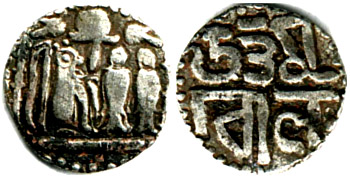
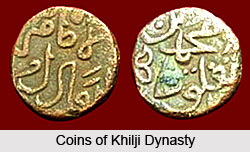
Chandragupta II continued issuing the coins, which his father Samudragupta introduced. Later, Chandragupta II also introduced several types of coins, which are Lion-slayer type, Couch-and-flower type, Rider type. Along with that Chandragupta was the first king to introduce silver coins. Some of his coins are detailed in brief below:
Lion-Slayer Type: These coins depict Chandragupta slaying a lion, and bear the legend simha-vikrama.
Couch-and-Flower Type: These coins depict Chandragupta seated on a couch, and holding a flower in his right hand.
Rider type: These coins depict the king riding a fully-caparisoned horse.