Dams in Andhra Pradesh serve the purposes of irrigation, thermal power and drinking water to all the districts of the state. The colossal dams not only supply water for irrigation and are the source of hydro electricity but are also regarded as the popular tourist spots.Nagarjuna Sagar Dam, Srisailam Project, Srisailam Dam, Nizam Sagar Joorala project, Telugu Ganga, Nijam Sagar Reservoir and Osman Sagar are some of the prime dams in Andhra Pradesh, primarily serving irrigational purposes. The dams, barrages and projects are carried out in Andhra Pradesh particularly on rivers like Penner, Musi, Tungabhadra, Godavari and Krishna. The Shriram Sagar Reservoir, Dowleswaram Barrage, Inchampalli multi-purpose irrigation project, Dummaguden Dam are constructed across the Godavari River in Andhra Pradesh. Tatipudi Reservoir Project was constructed across River Gosthani in Vizianagaram District of Andhra Pradesh. Yellampalli project or the Sripada Sagar project stands on
Godavari River in Karimnagar district of Andhra Pradesh.
The Ramagundam dam is a thermal project built in Andhra Pradesh. Singur Dam was constructed in Andhra Pradesh in 1989. Sunkesula Barrage is constructed on the Tungabhadra River in Andhra Pradesh. Nagarjuna Sagar Tail Pond Project is constructed at downstream of Nagarjuna Sagar Dam, across River Krishna in Andhra Pradesh. The Pulichintala Project is also build over the
Krishna River at Pulichintala Village in Andhra Pradesh. Prakasam Barrage was build across the River Krishna in 1855. Lower Manair Reservoir is situated in the Indian state of Andhra Pradesh, since 1985. Gandipalem Reservoir and Somasila Dam are built on the River Penner in Andhra Pradesh. The Dindi Reservoir is constructed in Andhra Pradesh for the purpose of irrigational water. Himayat Sagar Reservoir is constructed across the
Musi River in Andhra Pradesh.
The Nizam Sagar Dam is one of the major dams in Andhra Pradesh which is located at a distance of 144 kilometers to the northwest of
Hyderabad. This reservoir was built on the River Manjira, which is a tributary of the
Godavari River. The Nizam Sagar dam was erected in between the Banjapalle and the Achampet villages of the district of Nizamabad in the Indian state of Andhra Pradesh. The entire surrounding of the Nizam Sagar Dam is very much famous for its scenic beauty and which is why people visit this place to enjoy the natural environment of peace and tranquility. The most striking thing about it is that there is a motorable road of 14 ft in width over the dam measuring three kilometers long. The surroundings of the Nizam Sagar Dam is well-known as one of the major tourist destinations in Andhra Pradesh where one can avail budget as well as luxury accommodation close to the area. Neighboring the Nizam Sagar reservoir is the Jawahar Navodaya Vidyalay. Huge volume of water from this reservoir and also from the river is released to the twin cities of Secunderabad and Hyderabad. One will get to see a very beautiful garden next to the Nizam Sagar Dam. At the time of monsoon a large number of tourists from the nearby states of Maharashtra, Karnataka and several other districts of Karimnagar, Medak and Hyderabad and various other places visit the Nizam Sagar Dam area. There is also the availability of boating in the Nizam Sagar reservoir.
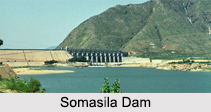
Somasila Dam in Andhra Pradesh stands on the Pennar River. This is also among the most prominent attractions for tourists in the state. The Somasila Dam is constructed over the river Pennar River in a small town by the name of Somasila in the district of Nellore in Andhra Pradesh. The place is famous for Somasila Water Project constructed across the River Penner and the Lord Shiva temple. The Lord Shiva temple is associated with a very old history and it is situated close to the dam. The Somasila Water Project was constructed during the period of the then Chief Minister of Andhra Pradesh,
N.T. Rama Rao. This project has become very vital as far as agriculture in the state is concerned. It supplies water to several agricultural fields of different villages in Andhra Pradesh. One of the villages is Penna Baddevolu which is situated downstream of the River Penner.
Water of the K-C canal from the Rajolibanda dam was reopened as a vent in the Sunkesula barrage that mainly took care of the drinking water problem of the Mahabubnagar region in the state of Andhra Pradesh in India. A delegation of Telangana Rashtra Samithi (TRS) MLAs and senior leaders along with the support of the then Chief Minister
Dr. Y.S. Rajasekhara Reddy implemented the government order for the construction of the Rajolibanda dam.
The idea of building Prakasam Barrage across River Krishna dates back to 1798. However, the construction planning was revised and redesigned by captain Buckle in 1839, and latter again in 1841 by Captain Best and Captain Lake. After the support of Major Cotton, the board of Directors of
British East India Company approved the plan of Prakasam Barrage on 5th January 1850. The construction of Prakasam Barrage was started in 1852 and completed in 1855. Later the State Government builds a new regulator cum-round bridge that was named after Sri Tanguturi Prakasam, the first Chief Minister of Andhra Pradesh. The barrage started to work officially since 1957 and it helps irrigating over 12 lakhs of acres. The Prakasam Barrage provides a panoramic view of the river. The magnificent structure of this barrage extends to a distance of 1223.5 meters over the
Krishna River. The Prakasam Barrage also acts as one of the major road bridges in Andhra Pradesh spanning over a beautiful lake. There are three canals which are linked to this barrage running through Vijayawada. The project of Prakasam Barrage was one of the first major irrigation projects of the southern parts of India which became completely successful in its mission. The richness in the field of agriculture for the state of Andhra Pradesh is due to the Prakasam Barrage since the barrage is irrigating a large patch of agricultural lands every year. Sightseeing is one of the major attractions at this place with the barrage offering a pleasant view along with the beaming lake. The pleasant breeze blowing all the time along with the calm waters make it a suitable destination for tourists in
Vijayawada.
The Dindi Reservoir is constructed between the area of Brahminepalle and Dindi on Krishna River. The geographical condition of the region is flat with a very lesser number of canals and large areas of cultivated lands. Apart from the Dindi Reservoir, there are many more canals in the region. The Dindi Reservoir is situated in close proximity to the Nagarjuna Sagar Srisailam Tiger Reserve. Another Dam in the state is the Lower Manair Dam which is located at Karimnagar district in Andhra Pradesh. The construction work of the Lower Manair Dam was initiated in the year 1974 and the same was fully completed in the year 1985. During monsoon, water in the reservoir increases in large volumes.
Tatipudi Reservoir Project was built from the period 1963 to 1968. This project is constructed across the Gosthani River in the state of Andhra Pradesh. The Tatipudi Reservoir Project in Andhra Pradesh provides water for the irrigation of a total of 15,378 acres land in the
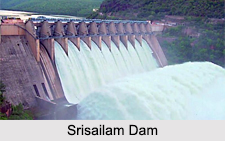
Vizianagaram district. It also forms the major source of drinking water for the people of the city of Visakhapatnam. This Project uses 3.325 TMC of the water and the storage capacity of reservoir is about 3 TMC. The approximate price of the project was Rs.1.820 crores. The Srisailam Dam is situated across the River Krishna at Srisailam in the district of Kurnool. This is one of the major dam projects of the state of Andhra Pradesh. It is also one of the 12 largest hydroelectric projects in India. The Srisailam Dam is constructed in a deep gorge in the Nallamala hills and it is placed 300 meters above sea level. This dam is 512 meter in length and 240.79 meter in height. It is having twelve radial crest gates. The Srisailam Dam provides water for irrigation to about 800 Sq Kilometers of land in the districts of Kurnool and Cuddapah. This dam of Andhra Pradesh is the prominent source of water in the Rayalaseema region which is having shortage of water throughout the year. In order to go to the main dam the tourists need to take special permission from the concerned authority. The town of Srisailam is situated at a distance of about 232 kilometers to the south of the city of Hyderabad. There are several places of interest close to the Srisailam Dam like the Bhramaramba Mallikarjunaswamy temple situated on the hilly regions of Nallamala Forest. One can also find the Sikhareswara Swamy temple and the Sri Ganapathi temple which are in close proximity to this dam. The railway station close to this dam is Nandyal situated on the Guntur-Hubli broad gauge line. This railway station is at a distance of about 158 kilometers from the Srisailam Dam.
The Government of Andhra Pradesh has come up with a scheme for the construction of Joorala Project. The site of the project is located at a distance of about 10 kilometers from Kuravapur. The people living in the surrounding area of the project in Andhra Pradesh will be highly benefited by it. The Kurvapur Kshetra River is merging with water of the Joorala Project and the construction work of the Joorala Project is still under progress. Another dam in the state of Andhra Pradesh in India is the Singur Dam. The construction of the Singur dam was completed by the Government of India in the year 1989 in Andhra Pradesh. With the support of World Bank, the Sanitation project and Hyderabad Water Supply was in charge of the dam and its smooth functioning. The huge reservoir constructed by the Singur Dam forms the primary source of electric power, water for irrigation and drinking water in the nearby areas. Due to the construction work of the Singur Dam, a large number of residents of that surrounding area had to relocate their dwellings resulting in the lost of their livelihoods. Afterwards, the Hyderabad Sanitation Project and Water Supply extended a helping hand towards displaced persons and helped them in resettling. The project, in all, helped in resettling at about 3,600 households and identified 4,600 families which require immediate support for the reestablishment of their economic productivity.
The Dowleswaram Barrage in the state of Andhra Pradesh is constructed on the last stretch of the River Godavari. It is an irrigation structure. The Godavari River empties its entire water into the
Bay of Bengal after flowing a few miles from the Dowleswaram Barrage. Sir Arthur Thomas Cotton, a British irrigation engineer, constructed the Dowleswaram Barrage which helped in boosting the economy of the state in large scale. The village Dowleshwaram is at a distance of eight kilometers to the downstream of Rajamundry. Rajamundry is a large town situated on the left bank of Godavari River. The upstream, where the River is divided into two streams or distributaries called the Gautami to the left and the Vasistha to the right, forms the dividing line between the West Godavari and the East Godavari districts. The height of the Dowleswaram Barrage is 15 feet and its construction was completed in the year 1850. Adjoining two mid stream islands, the barrage is constructed in four sections. From east to west; Dowleshwaram is on the left, Ryali, Bobbarlanka and Vijjheswaram to the right, segregated by the islands in between. The two sections in the middle are smaller. The primary canals are there in the central part of the island for the central delta and one each on both the flanks, near Nidadavole and at Dowleshwaram. There is another canal branching off at Nidadavole called the Eluru canal towards the right following a contour flowing till Vijayawada, where a barrage was constructed by one of the junior colleagues of Sir Cotton, Capt. Orr, on the Krishna River. The Krishna Barrage was constructed exactly at the same place where the earlier barrage was present in the 1960s. In the year 1980, the Government of Andhra Pradesh undertook extensive renovation work of the barrage and a road was constructed on the top of it for motor vehicles.
The Gandipalem Reservoir is also known as the Gandipalem state reservoir which is situated in Andhra Pradesh. The Gandipalem Reservoir was constructed with the aim of saving the lives of a large number of people of different villages in Udaygiri Mandal from famine in the summer season. Another major objective behind the construction of the Reservoir was to provide water for the irrigation of about 600 square kilometers of land which are located far away from Pennar River. The major source of water for the Gandipalem reservoir is the Manneru River. This river is a tributary to the River Pennar. The length of the Manneru River is 130 kilometer which starts near the village Pillipalli of Kanigiri taluk of the district of Prakasam. Dokkalavagu, Pillaperu, Uppuvagu and Upputeru are the main tributaries of the Manneru River. Another reservoir in Andhra Pradesh is the Musi Reservoir. It is within the district of Nalgonda and is constructed across the Musi River.
The
Osman Sagar is an artificial lake in the city of Hyderabad. It is famously called Gandipet and the lake is about 46 square kilometers and possesses a reservoir covering an area of 29 square kilometers. Osman Sagar Dam was built in the year 1920 by damming the River Musi, for supplying drinking water to the people of Hyderabad and also checking the devastation caused by flood to the city. During the rule of
Mir Osman Ali Khan, the seventh Nizam of Hyderabad, the city witnessed a flood of devastating nature which subsequently led to the construction of this dam and the name also came from it. The Sagar Mahal, a princely guesthouse was erected close to the Dam as the last Nizam`s summer resort. This guesthouse is regarded as a heritage building overlooking a picturesque lake. This guest house is situated on the banks of the River Musi and it is in close proximity to the Osman Sagar Dam. This dam chiefly serves the purpose of drinking water for people living in the city of Hyderabad. The Osman Sagar Dam is one of the best tourist destinations in Hyderabad. At the time of rainy season, when the reservoir is filled with crystal clear water and the blowing of sweet breezes, tourists in large numbers visit this place. Another suitable tourist destination close to the Osman Sagar Dam is the Lake Himayat Sagar. The Srisailam Project is situated in the Rayalaseema Region across the River Krishna in the state of Andhra Pradesh. The Srisailam Project possesses a live storage capacity of 250 thousand million cubic feet. The Srisailam Project reservoir was firstly planned for the generation of hydropower but the same was afterwards changed to a multi-purpose facility station for irrigation and water supply. The left bank generates 6*150 MW of power and the right bank generates 7*110 MW of power. The project is situated in Rayalaseema Region of Andhra Pradesh. More than 102 villages in Mahaboobnagar and Kurnool districts were displaced as a result of the construction of Srisailam Hydro Electric Project at Srisailam.
The Ramagundam dam is situated in Karimnagar in the state of Andhra Pradesh. The approved capacity of the Ramagundam dam is 2600 MW. The sources of water for this dam are the Sri Ram Sagar Dam build across the River Godavari and a canal from the Pochampad Reservoir. The states benefiting from the Ramagundam dam are Tamil Nadu,
Puducherry, Kerala,
Goa, Karnataka and
Andhra Pradesh. Andhra Pradesh Power Generation Corporation Limited took up the lead for the construction of the Dummaguden Dam across the Godavari River in the state of Andhra Pradesh. The Dummaguden Dam is owned and controlled by the Government of Andhra Pradesh-Commercial Enterprises. The Dummaguden Dam is at the Pamulapally village of the Bhadrachalam area in the district of Khammam. The Government invested at about Rs.1, 700/- crores for the construction of this hydel-based dam. Sunkesula Barrage is a structure of Tungabhadra Barrage Head Works close to the Sunkesula Village in the district of Kurnool in Andhra Pradesh. TBC, I & CAD DEPARTMENT, Government of Andhra Pradesh is the owner and in control of the Sunkesula Barrage project. Rs.303.92/- millions is the contract value of the project and 1020.00 MT of steel is used for the construction of this barrage. The Pulichintala Project was planned to be built on the Krishna River at the village Pulichintala of the district of Guntur in the state of Andhra Pradesh. The estimated cost of the Pulichintala Project was Rs.565.87 crores in order to stabilize and create an IP of 13, 08,849 acres in the Krishna, Prakasam, Guntur and West Godavari districts.
Himayat Sagar reservoir is situated in the city of Hyderabad, the capital city of the state of Andhra Pradesh. It is placed twenty kilometers away from Hyderabad. The Himayat Sagar reservoir is constructed over the River Musi and the construction work was completed in the year 1927. The Himayat Sagar reservoir serves the purpose of drinking water for the people of Hyderabad and Secunderabad. The reservoir was built over the River Esi which is a tributary of the River Musi with the aim of providing drinking to the people of Hyderabad and also saving the city from severe floods. The reservoir was constructed during the rule of the last Hyderabad Nizam, Nizam VII and therefore the name of the dam was given after the name of his youngest son Himayat Ali Khan. Shriram Sagar Reservoir in the Indian state of Andhra Pradesh generates 27 MW power and provides water to irrigate 18 lakh hectors of land. The Shriram Sagar Reservoir was constructed on the Godavari River. It is also the first reservoir in the state of Andhra Pradesh which was built on the River Godavari. There is a legend behind the place which is associated with the Hindu Epic
Ramayana. It is said that
Lord Rama visited this place. It is for this reason the project was given the name, Sri Rama Sagar Project. The Basara Saraswathi temple situated at a close proximity to this reservoir is visited by a large number of pilgrims.
Dams in Andhra Pradesh act as the major source of water for irrigation and also help in regulating excess water which goes on to check the excess flood. Apart from serving as the major sources of irrigation, the Andhra Pradesh dams also serve as the most favourable tourist destinations. Some of the dams are situated close to temples which are visited by a large number of devotees who also visit the dams. Tourists also go for swimming in some of the reservoirs. The blowing of cool breezes and the greenery all around make some of the dams in Andhra Pradesh the most renowned tourist destinations.