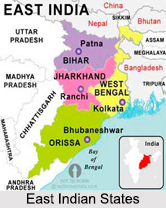
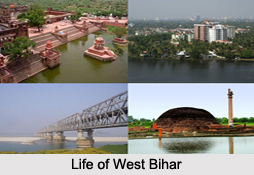
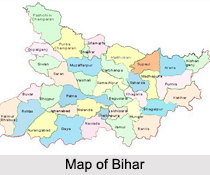
 Bihar, the third state in India, according to population is located near West Bengal in the east and Uttar Pradesh in the west which provides it with a transitional position in respect of climate, economy and culture. This eastern Indian state shares the culture, tourism and history with Jharkhand and West Bengal. The name `Bihar` is derived from `Vihara`, meaning monastery. Bihar has been a great religious center for Hindus, Jains and most importantly, the Buddhists. It was at Bodhgaya in Bihar, that Lord Buddha sat under the Bodhi tree, and attained enlightenment. A descendant of the same tree still flourishes in Bodhgaya today. Nalanda University, which was a world-renowned Buddhist University in the 5th century AD, is also located in Bihar. Rajgir, a pilgrimage place for Buddhists and Pawapuri, where Lord Mahavira breathed his last, are near Nalanda. Bihar is one of India least urbanized states.
History of Bihar
The history of Bihar began with the rule of Magadhan Empire. At that time, Pataliputra (now Patna) emerged as the capital city. The importance of Pataliputra in early India is remarkable till the foreign invasion. Bihar remained an important place of power, culture and education during the next one thousand years. The Vikramshila and Nalanda were among the oldest and best centers of education in ancient India but were destroyed by Islamic invaders in the medieval period. Later, after the decline of Bengal Sultanate, Bihar was made a province of British India in 1936. It became a state after the Indian Independence in 1947.
Geography of Bihar
Bihar emerged as the ancient state in India for its vast stretch of very fertile flat land. It has several rivers namely Ganga River, Son River, Bagmati River, Kosi River, Budhi Gandak River, and Falgu River to name a few. The climate of Bihar is also monitored by the winds near Himalayas. The vast stretch of Bihar lies in 24 degree 20 minutes and10 seconds North to 27 degree 31 minutes and 15 seconds North latitude and between 83 degree 19 minutes 50 seconds East to 88 degree 17 minutes and 40seconds East longitude.
Demography of Bihar
According to the Population Census in the year 2011, Bihar has the total population of about 104,099,452. The sex ratio of Bihar was about 919 females per 1000 males. Most of the people residing in Bihar are usually Hindus (82.69 percent). Muslims (16.87 percent) and Christians (0.12 percent) are the minors. Hindi is the official language. Angika language, Bhojpuri language, Maithili language, Bengali and Magadhi language are also popular here. Urdu is the second official language of State government.
 Culture of Bihar
Bihari people have a rich cultural tradition. People of Bihar celebrate the major festivals like Chhath Puja, Diwali, Teej Festival and Chitragupta Puja. Shravani Mela is organised every year in the Hindu month of Shravan that is the lunar month of July-August. Bihar is also nourished with the tribal dances and tribal music. They are sung mainly in group settings without the help of many musical instruments, though Dholak, Bansuri, and occasionally Tabla and Harmonium are used. Bihar also has a tradition of lively Holi songs known as `Phagua`, filled with fun rhythms. There are several folk dance forms that can keep one enthralled, such as Dhobi Nach, Manjhi, Gond Nach, Jitiya Nach, More Morni, Dom-Domin, Bhuia Baba, Rah Baba, Kathghorwa Nach, Jat Jatin, Launda Nach, Bamar Nach, Jharni, Jhijhia, Natua Nach, Bidapad Nach and Sohrai Nach. The cuisine of Bihar is dominated by rice, dal, roti, tarkari and pickle.
Education in Bihar
Bihar earned the fame in ancient studies and learning. In modern Bihar, the Nalanda Open University was established in 1917 and among the oldest university in India. Bihar has 11 colleges, which include the Science College, B.N.College, Patna Women`s College, Patna College and Patna Medical College and Hospital and Magadh Mahila College.
Administration of Bihar
Bihar is constitutionally administered by Governor, who is appointed by the President of India. The Chief Minister of Bihar and the Council of Ministers are responsible to maintain the law and order of Bihar. Bihar is administered with 9 administrative divisions and 37 districts.
Economy of Bihar
Bihar is completely dependent on agriculture and natural gases. The crops like rice, paddy, wheat, jute, maize and oil seeds are grown. Sugarcane, potato, cauliflower, cabbage, tomato, radish, carrot, beat etc. are some of the vegetables grown in Bihar. Bihar has a number of major public sector projects like the Oil refinery of Indian Oil Corporation and economy manufacturing plant of Hindustan Fertilizer Corporation Ltd (HPCL) at Barauni, Pyrites, Phosphates and Chemicals Ltd (PPCL) at Amjhor; Cotton spinning mills at Siwan District, Pandaul District, Bhagalpur District, Mokamah District, and Gaya District, 13 sugar mills in private sector and 15 in public section located in South and North Bihar.
Tourism in Bihar
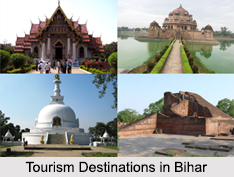
Bihar is dotted with many tourism destinations like Vaishali, Barabar Caves, Rameshwar Kund, Gridhakuta Hill, Mandar Hill, Archaeological Sites in Nalanda, Rajgir, Sasaram, Vikramshila Monastery, Pawapuri and many others.