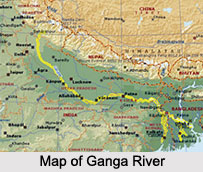
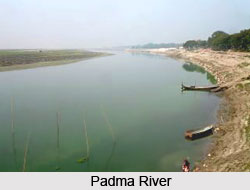
 Padma is a major trans-boundary river between Bangladesh and India. It is the main distributary of the Ganges that originates in the Himalayas. Padma River enters Bangladesh from India near the place called Chapai Nababganj. The river meets the Jamuna near Aricha and retains its name. However, finally the river meets the Meghna River near Chandpur and takes up the name `Meghna` before emptying into the Bay of Bengal. Rajshahi, a major city in western Bangladesh, lies on the north bank of the Padma River.
Etymology of Padma River
The word Padma means "Lotus". According to the Hindu mythology, Padma is the byname for the Goddess Lakshmi. Lower part of the course of Ganges River has been named as Padma.
Mythological Significance of Padma River
Padma River is mentioned in Hindu Mythology including the Vedas, the Ramayana, the Puranas and the Mahabharata. In all myths, the river is referred to as a goddess though the origin differs. In Valmiki`s Ramayana, Ganga is described as the daughter of Lord Himalaya and Menaka who were taken to the heaven by the deities. They started to live in heaven from then, inside Karmandala, a spurt shaped vessel. In Vishnu Purana, Ganga is known to evolve from the toe of Lord Vishnu`s left foot. She flowed across a considerable distance and the pole star caught her in the middle of tumble and kept her on his head round the clock.
Most myths believe on the fact how Ganga came down to earth. By a special favor of Lord Shiva, King Sagara had sixty thousand sons, all of who were burnt into ashes as they disturbed the Mighty Kapila in his meditation. King Sagara, being informed by the heavenly wanderer Narada, sent his grandson Ansuman to Kapila to ask for his mercy. Kapila granted that but only the mighty waters of the Ganga could rescue the souls of the sixty thousand sons of King Sagara. Ansuman`s grandson Bhagiratha approached Ganga and convinced her to come down. To balance such great force of impact of Ganga falling to earth from heaven, Lord Shiva used his disheveled hair.
Course of Padma River
Padma River is originated in the Gangotri Glacier of the Himalaya, and runs to the Bay of Bengal through India, entering Bangladesh at Shibganj in the district of Chapai Nababganj. Just west of Shibganj, the distributary Bhagirathi River emerges and flows southwards from the Hooghly. After the point where the Bhagirathi divides, the Ganges is known as the Padma.
Further downstream in Goalando, 2200 km away from the source, the Padma joins the mighty Jamuna or the lower Brahmaputra River and the resulting combination flows with the name Padma further east, to Chandpur. Here, the widest river in Bangladesh, the Meghna, joins the Padma, continuing as the Meghna almost in a straight line to the south, ending in the Bay of Bengal.