Introduction
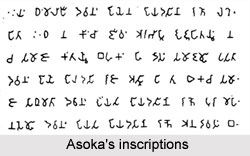 Ashoka"s Inscriptions provide enough knowledge about the reign of Ashoka. His inscriptions are found on the rocks, and the pillars scattered from the Himalyas to Mysore and Odisha to Kathiawar. The object of his inscriptions is religious and ethical. These inscriptions can be divided into three categories- rock edict, pillar edicts, and cave inscriptions.
Rock Edicts of Ashoka"s Inscriptions
Minor Rock Edicts: These rock edicts belong to 258 or 257 B.C. They are of two types. One type of the minor rock edict can be found in the Shabhaz district of Bihar, Bairat district of Rajasthan, and Jabalpur district of Madhya Pradesh. The minor rock edicts of the other type have been found at Brahmagiri in Mysore and at Rameshvaram. The first enlightens us with the personal life of Ashoka while the second contains a code of morals.
Fourteen Rock Edicts: These have been found at the following places- Shabhazgarhi in Peshawar district, Mansera in Hazara district, Kalsi in Dehradun, Girnar near Junagarh, Sopara in Thane district, Dhauli in Puri district, Jangarh in Ganjam district, and Ira Gurhi in Karnal district.
Kalinga Rock Edicts: Two Kalinga rock edicts can be found at places called Dhauli and Jangarh. These inscriptions belong to 256 B.C. These rock edicts refer to the administrative systems through which the people of Kalinga and other frontier states should be administered.
Bhabru Rock Edict: This rock edict was placed near Viratt in Jaipur. Dr. Smith fixes its date from 258 to 257 B.C. In this inscription Ashoka expressed or rather confessed his faith in the Buddha, Dharma and the Samgha. He also refers seven examples of Buddhism which his subjects should also follow.
Pillar Edicts of Ashoka"s Inscriptions
Seven Pillar Edicts: These have been found at six places. Two pillar edicts have been found at Delhi. The other pillar edicts have been found at Meerut, Prayag, Ambala district and also in Champaran etc.
Two commemorative Pillar Inscriptions: These inscriptions have been found in the Terai of Nepal at Rummindai and Nigilava villages. These describe Ashoka`s Dharmyatras and the holy places of Buddhism. These inscriptions belong to 246 B. C.
Four Minor Pillar Edicts: Two of these minor pillar edicts have been found at Sanchi and the other two have been found at Prayag. These inscriptions were issued to remove the differences of Buddhism.
Cave Inscriptions of Ashoka"s Inscriptions
Language and the Script of Ashoka"s Inscriptions
Language and the Script of Ashoka"s Inscriptions
Ashoka`s Inscriptions in South India
<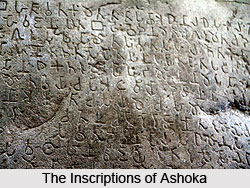 Often cited as one of India`s greatest emperors, Ashoka reigned over most of present-day India after a number of military conquests. He was internationally known as Ashoka the Great of the Mauryan Dynasty of North India. Ashoka ruled in the 3rd century BC. It is well knoen that after the battle of Kalinga, which ended in a lot of bloodshed and hardship for the people, Ashoka turned to Buddism and followed the path of non-violence or ahimsa. This emperor also made a unique attempt to communicate to his subjects, spread over a vast area, the message of Gautama Buddha. This he did by inscribing the teachings on specially erected stone pillars and rocks for the common man to read. Most of these inscriptions are found across the length and breadth of North India and even in Nepal.
There are a collection of 33 inscriptions or the Edicts of Ashoka. However very few are aware about the many epigraphs found in several places in South India. His inscriptions on rocks, called rock edicts are found in many areas in present-day Karnataka and Andhra Pradesh like Gavimath, near Koppal in the Raichur district, Maski in Raichur district, Brahmagiri, Jatinga-Rameshwara and Siddhapura in the Chitradurga district of Karnataka and Erragudi and Rajula-Mandagiri in Kurnool district, Andhra Pradesh. These are written in the ancient Brahmi script and the Prakrit language.
The inscriptions proclaim Ashoka`s beliefs in the Buddhist concept of dharma ("righteousness") and his efforts to develop the dharma throughout his kingdom. Edits of Ashoka tend to focus on social and moral precepts rather than religious practices. While some texts of few of these inscriptions speak about respecting parents, elders, teachers and following the Dharma on the other inscriptions speak about being kind, humble and speaking the truth. It says by following these beatitudes one shall propound the attributes of Dharma. This is an ancient rule and the principle is venerable.
It is certain that some areas of ancient Karnataka and perhaps Andhra Pradesh were part of Ashoka`s far-flung empire, which extended to the south. In any case it is certain that he intended to spread the message of the Buddha in as many regions as possible.
Importance of Ashoka`s inscription
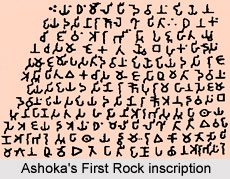 Ashoka`s inscriptions are very significant from the historical point of view.
They furnish with sufficient information regarding the following subjects that can be mentioned below.
• Extent of Ashoka`s empire: Ashoka`s inscriptions provide us information regarding the provinces, which formed Ashoka`s empire. On the basis of these inscriptions it can be known that leaving aside the far distant states of south, the whole of India was within Ashoka`s empire.
• Knowledge regarding Ashoka`s religion: These inscriptions, also tells about the personal religion of Ashoka and his attitude towards other religions. On the basis of these inscriptions it can be known that Ashoka was a follower of Buddhism and he laid great emphasis on the truthful speech, ahimsa and charity. Though a Buddhist himself, he was tolerant and kind towards other religions.
• Ashoka`s relations with foreign countries: Ashoka`s inscription also tells that Ashoka had sent his ambassador to Syria, Apriast, Egypt, Syria, etc. and had established friendly relations with these countries as well.
• Administrative organization of Ashoka: General people`s knowledge of Ashoka`s administrative organization and the reforms he made in the existing administrative system and machinery can also be derived from his inscriptions. Many of his inscriptions refer to his administrative orders to his officers and the people.
• Character of Ashoka: Ashoka`s inscriptions also throw a flood of light upon his character. Through these inscriptions it can be known that the mind and heart of Ashoka completely changed after the Kalinga war. The death and destruction caused in the Kalinga war filled his heart with remorse, sorrow and regret. He made up his mind that from onward he would not resort to force and violence for the conquest of the territories. This period also marks the beginning of new epoch in which started his dharma vijay. After the Kalinga war he was greatly influenced by Buddhism and in "Bhabru rock edict he confessed his faith in the Buddha and the `Samgha. In course of time, Ashoka became a symbol of charity, mercy, service and kindness."