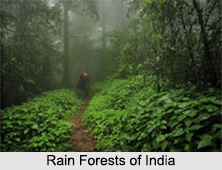
 Rain forests, as the name suggests, are those forests which are characterized by high annual rainfall of around 1750mm to 2000mm. The global distribution of equatorial rainforest is closely tied to the warm, moist climates that occur near the Equator. India is located in Southern Asia between Burma and Pakistan. Here tropical rain forests are to be seen. A tropical rainforest is one which is wet and warm throughout the year. It is hot and humid here in these regions. The Tropical rain forests are located near the equator and the tropic of cancer.
Location of Indian Rain Forests
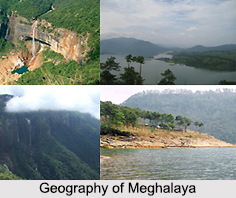
The evergreen Rain forests are found in the Assam Valley, the foothills of the eastern Himalayas (Tinsukia district and Dibrugarh districts) and the lower parts of the Naga Hills, Meghalaya, Mizoram, and Manipur where the rain fall exceeds 2300 mm per annum. Most of this region is at an altitude of around 900 meters. The entire northeast India is known for the moist sal (Shorea robusta) monsoon forests. In the upper part of Assam, there is the Joydihing wildlife sanctuary which consists of the Joypur reserve forest, Dirak reserve forest and Dihing reserve forest. Evergreen rainforests are also found in the Andaman & Nicobar Islands and the Western Ghats. The rich and dense forest cover starts from Southwestern part of Maharashtra and extends as far as Karnataka and Kerala in South India.
Features of Indian Rain forests
The tropical vegetation of India in the north eastern side (which includes the states of Assam, Nagaland, Manipur, Mizoram, Tripura and Meghalaya as well as the plain regions of Arunachal Pradesh) are most typically seen at elevations of up to 900metres. These tropical rainforests are characterized by rainfall and evergreen species. They encompass evergreen and semi-evergreen rain forests, riparian forests, moist deciduous monsoon forests and swamps and grasslands. The ecosystems in these forests comprise rich biodiversity of flora and fauna. Due to dense canopy, the sunlight does not penetrate the forests and there is a constant fight for sunlight among the plants for photosynthesis. It results in competition among the living organisms for their survival. This brings interdependence among living the organisms.
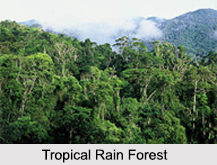
 The equatorial rainforest in India occurs in two separate areas- along the strip of hills and mountains near to the west coast, the Western Ghats and in the north-eastern state of Assam close to the border with Myanmar (Burma). In both these areas, semi-evergreen rainforest is more widespread than evergreen forest, probably due to a long history of human influence, which has degraded the structure of the forest and its soils and led to a more precarious water balance.
Food obtained from Indian Rainforests
A wide variety of food items can be obtained from the Rain forests in India. These include coconut, guava, jackfruit, sweet potato, banana, citrus fruits, mango, papaya, lychee, pineapple, rice, sugarcane, tamarind, yam, coffee, black pepper, cardamom, cinnamon, ginger, nutmeg, turmeric and vanilla.
Flora of Rainforests of India
In the Rainforests of the Assam Valley, the giant Dipterocarpus macrocarpus and Shorea Assamica occur singly. They can occasionally attain a girth of up to 7m and a height of up to 50m. The monsoon forests are mainly moist sal Shorea robusta forests, which occur widely in this region. The Andamans and Nicobar islands have tropical evergreen rain forests and tropical semi-evergreen rainforests as well as tropical moist monsoon forests. The dominant species is Dipterocarpus grandiflorus in hilly areas, while Dipterocarpus kerrii is dominant on some islands in the southern parts of the archipelago. The monsoon forests of the Andamans are dominated by Pterocarpus dalbergioides and Terminalia sap. The Western Ghats are more diverse than those of Assam, with over 4,000 plant species occurring in this relatively small area of hill land. Of these, 1,800 species are endemic to the Western Ghats, most of these being confined to the rainforest rather than the other drier vegetation types that occur mixed in with it.
Fauna of Rainforests of India
Different kinds of animals are found inhabiting the Indian rain forests. They are Howler monkeys which live in the canopy of the rain forest, Pythons, Vinesnake, Elephant, Sloth, many different kinds of Bats, Jaguars, Tapirs which are rather difficult to spot in the forest, Chameleon, Crested Guan which live in the lowland rain forest region, Tiger, King Cobras, Gecko which lives high up in the rain forest, Bearded Dragon, Slow Loris and Gibbon which live in the canopy. There are many more animals that live in India`s rain forests. A lot of the animals are endangered. The clouded leopard, flying squirrel, leopard, tiger and Indian bison are just a few. Some birds that are endangered are pheasants, eagles, owls, wood ducks and hornbills.
 Rainforests of Western Ghats
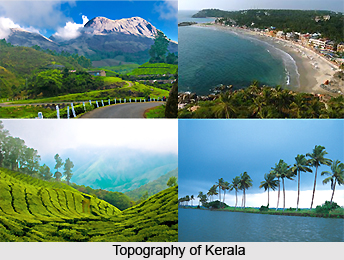
The North Western Ghats montane rain forests are a tropical moist broadleaf forest eco-region of southwestern India. It covers an area of 30,900 square kilometers (11,900 square miles), extending down the spine of the Western Ghats range, from Maharashtra state in the north through Karnataka to Kerala state in the south. The montane rain forests are predominantly evergreen laurel forest, dominated by trees of the laurel family (Lauraceae), including Litsea, Phoebe, and Cinnamomum. The South Western Ghats montane rain forests are an eco-region of southern India, covering the southern portion of the Western Ghats range in Kerala and Tamil Nadu, at elevations of over 1000 meters. They are cooler and wetter than the lower-elevation South Western Ghats moist deciduous forests, which surround the montane rain forests. Periyar Tiger Reserve, Kerala and Bandipur National Park, Karnataka are most famous amongst the forests of the Western Ghats.
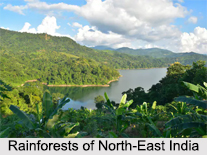
Rainforests of the North-East
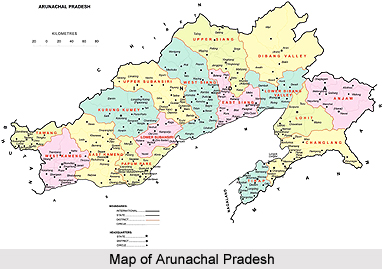
Today, the North-eastern states of India have become the only region where Rainforest wealth of India survives. The state of Arunachal Pardesh is gifted with enormous wealth of wildlife and forested land. However the rainforests of the northeast state of Assam are facing fast depletion. The newly discovered Joydihing wildlife sanctuary comprises the Joypur reserve forest, Dirak reserve forest and Dihing reserve forest. It houses 32 species of mammals, more than 300 species of birds and several other rare and endemic wild species. A critical aspect of this forest zone is that of the 15 species of non-human primates found in India often inhabit in this belt. They include Rhesus Macaque, Assamese Macaque, and slow Loris, capped Langurs, pig-tailed Macaque, stam-tailed Macaque and Hoolock Gibbons. This rainforest stretch is also one of the largest elephant zone in India, through which more than 2,000 elephants migrate to Arunachal Pradesh every year.
 Rainforests of the Andaman-Nicobar Islands
These are the tropical evergreen, semi-evergreen and monsoon rainforests of Andaman and Nicobar islands. Several species of flora and fauna are indigenous to the monsoon rainforests of Andaman and Nicobar islands. The tropical forests of this region have a mixed range of Indian, Myanmar, Thai, Malaysian and endemic flora. There are around 2,200 varieties of plants available here, out of which 200 are endemic and 1,300 are not found in the mainland of India.
The Rainforests of India are getting depleted at a rather alarming rate. This destruction of the forests has been exceptionally rapid during the last 50 years. The main reasons why these forests are being destroyed is increasing human population, negligence on part of the state authorities and the communities that reside within the forest areas and poorly controlled logging over the years. These can prove extremely hazardous to the future of mankind and need to be addressed at the earliest.