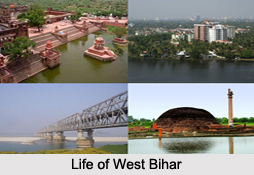
History of Bihar dates back to the rule of powerful rulers and the establishment of mighty kingdoms. Bihar was called Magadha in ancient times. Its capital Patna, then known as Pataliputra, was the center of the Maurya Empire, which dominated the Indian Subcontinent from 325 BC to185 BC. Ashoka was the most famous ruler of this Dynasty. Bihar remained an important place of power, culture and education during the next 1000 years. Bihar was the region where Buddhism evolved and finds mention in the Vedas, Indian Puranas and Epics.
Ancient History of Bihar
Human settlement in Bihar dates back to the prehistoric period. The state is related to various legends and finds mention in Ramayana also. Mithila was the birth place of Sita, wife of Lord Rama. During this period, Gautama Buddha and Jain Mahavira took birth and preached the two great religions of Buddhism and Jainism respectively. Gautama Buddha was enlightened at Bodh Gaya and Jain Mahavira attainted his salvation in Pawapuri, both in Bihar. Bihar has been ruled by many dynasties and powerful rulers. In the ancient period the Sixteen Mahajanapadas, Magadha, Gupta Empire and the Pala Dynasty ruled the state. The first kingdom in Bihar was established by Bimbisara and his son Ajatashatru. Mighty rulers like Chandragupta Maurya, Samudra Gupta, Chandragupta II, Skanda Gupta and others established their dynasties here.
 Medieval History of Bihar
During the Medieval period, Bihar witnessed the Muslim invasion, which was followed by the rule of local Rajput clans. The first Muslim conqueror was Mohammad Bin Bakhtiar Khaliji. The Tughlaqs and then the Mughals followed the Khaljis. The Mughals established a prosperous dynasty in Bihar. However, with the downfall of the Mughals, the Nawabs of Bengal exercised their rule.
Modern History of Bihar
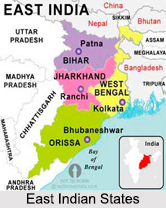
The British East India Company established its sway over Bihar after the Battle of Buxar in 1764. The different British attitudes and practices towards the people led to migration to lands like Africa, South East Asia, etc. Under the British, Bihar was first a part of Bengal Presidency. In 1911, Odisha and Bihar were separated from Bengal. In 1936, they became separate provinces. Jharkhand became a separate state on November 15th, 2000.
Bihar"s contribution in the freedom struggle has been immense with outstanding leaders like Swami Sahajand Saraswati, Bihar Bibhuti, Anugrah Narayan Sinha, Jayaprakash Narayan, Satyendra Narayan Sinha, Basawon Singh, Yogendra Shukla, Sheel Bhadra Yajee and many others. They worked for India"s freedom relentlessly and helped in the upliftment of the underprivileged masses. Khudiram Bose and Prafulla Chaki were also active in revolutionary movement in Bihar.
History of Bihar contributed a lot to social, cultural, religious, political and economic life not only of India but also across the world. In the field of education and knowledge Bihar"s contribution is praiseworthy because of its ancient universities at Nalanda and Vikramashila.