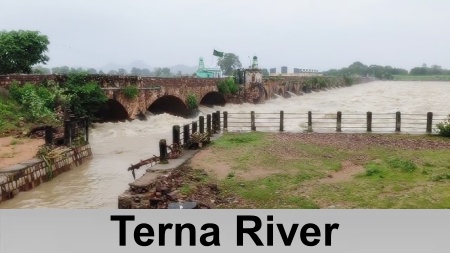
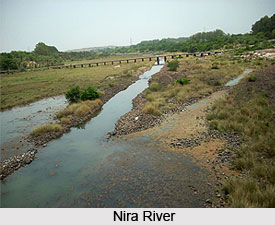
The Terna River originates at Terkheda in the Washi taluka
of Osmanabad
district, now known as Dharashiv, in Maharashtra. Serving as a vital
water resource for the region, the river plays a crucial role in supporting irrigation
activities across the district, contributing significantly to the local
agricultural economy. To harness its waters for irrigation and water
management, major infrastructure projects such as the Upper Terna Dam and the
Makni Dam have been constructed along its course. These dams help regulate the
river's flow and ensure a reliable supply of water for farming and other
regional needs.
Terna River flows eastward for approximately 125 kilometers
across the Deccan
Plateau before merging with the Manjira River. Originating in the
northwestern uplands, the river initially follows an east-west course before
gradually turning eastward under the influence of regional geological
structures, including lineaments and fault systems. Along its journey, the
river traverses basaltic terrain characteristic of the Deccan Trap region.
The landscape through which the Terna River flows changes
considerably from its upper to lower reaches. In its upper course, the river
passes through steep gradients and deeply incised valleys. Further downstream,
the terrain becomes gentler, giving way to broad pedi-plains and flat alluvial
plains. Geological and geomorphological evidence indicates that the river has
undergone channel migration, avulsion, and the development of entrenched
meanders.
In the middle and lower reaches, particularly around 10
kilometers west of Killari village, the river's gradient decreases
significantly, resulting in a flatter longitudinal profile. This reduced slope
encourages greater channel sinuosity and the deposition of fine clay and silt
across the floodplain. The river’s present form reflects its long-term
interaction with the underlying basalt formations and Quaternary sediments,
including paleo-levees and river terraces that preserve traces of earlier
courses. Terna River is not marked by major waterfalls or dramatic bends,
instead exhibiting a gradual and evolving fluvial landscape.
The Terna River basin forms an integral part of the larger
Manjira sub-basin within the extensive Godavari River system, which ultimately
drains into the Bay of
Bengal. Through this connection, the basin contributes to one of
India's major river networks and plays a significant role in the region's
hydrological framework.
The basin is nourished by four principal tributaries, most
of which are minor seasonal streams originating from the surrounding plateau
and hill regions resembling the Balaghat ranges.
These ephemeral watercourses provide additional runoff during the monsoon
season, enhancing the river's flow and supporting the basin's drainage system.
Near its confluence with the Manjira River, the Terna also gives rise to two
notable distributaries, further reflecting the complexity of its fluvial
network and its interaction with the surrounding landscape.