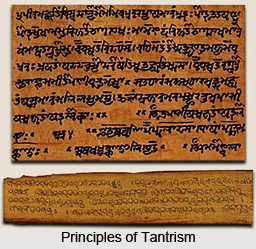
 Principles of Tantrism emphasizes that all that exists in the universe must also exist in the individual body. Tantrism originates in old Hindus religious texts especially in Atharva Veda. It has influence from Yoga, Upanishads and Puranas. Principles of Tantrism disseminate its profound knowledge with mystic diagrams thereby attaining salvation. A new form of "Sadhana" is instituted in teachings of the Tantras based on Vedas, the Upanishads and the Bhakti Marga of the Puranas. It preaches a new doctrine accepted by all sects like the Shaivas, Buddhists, Vaishnavas and so on.
Hindu, Buddhist and Jains are the three disciplines of Tantric philosophy. This classification is done based on the Gods or Goddess revered and customary practices followed. According to the Narada Purana there are seven kinds of Tantras: Vama, Bhairava, Soma, Langala, Pasupata, Nakula and Kapala.
Sadhana in Tantra
The principle of Sadhana in Tantra emphasizes that the body contains the highest power. If it is utilised properly, it can lead the sadhaka to the highest goal. It enables him to control universal energy. Various ways of Sadhana are Puja, knowledge of Shastras, repeating a mantra, penance and invocation.
Basic Tenets of Tantrism
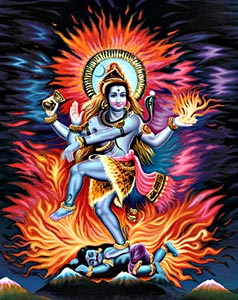
Basic tenet of Tantrism was that the woman possesses more spiritual energy than the man. Therefore the man could achieve realization of the divinity through sexual and emotional union with a woman. Thus women are a very integral part of Tantric practices. In this way he became similar to Lord Shiva, the God in perpetual union with the Goddess. In Hindu Tantrism, Shakti is active female energy and Shiva is passive, male consciousness. The Tantras explains the purposes of the various rites and the philosophy underlying them. The roots of Tantric principles are Prakriti and Purusha .The Purusha is not active while his other half is active. Activities like creation are her functions. Consequently she is considered more significant than Purusha.
Tantrism is a quest for spiritual perfection and magical power. Tantric principles teach to achieve complete self control, have power over natural forces, to attain cosmos and divine unity. The divine power that flows through the universe is used mystically to attain one"s goals. Tantrism is very rich in symbols which are used in meditation and rituals. The body itself is a symbol of the cosmos. Other Tantric symbols are mantras; sacred diagrams and Mudra.