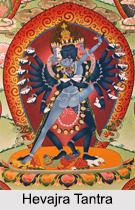
 Nature of Ultimate Reality in Hevajra Tantra includes several Mahayanic philosophies. However, the notion of the Absolute in Hevajra Tantra is not a mere repetition of Mahayanic notions but a modification of the same under Vajrayanic influence. Those Absolutes resulting from such an interaction are Vajra, Sahaja, Mahasukha and Immanent.
Concept of Vajra
In the Paramitanaya, Prajna, which is the voidness (Sunyata) of all natures, is the supreme truth (prajnaparamita), and is personified as the Goddess Prajnaparamita. In Hevajra Tantra, she is Nairatmya (the absence of the notion of selfhood). Here the void (Sunyata or Prajna) is called "Vajra". Vajra is also regarded as Karuna, as for example, when Hevajra is in union with Nairatmya, then "vajra" symbolizes Hevajra, the male aspect. Thus, "Hevajra" (vajra) is Karuna and "Nairatmya" (kapala) is Prajna.
Hevajra Sadhana is also called the "Vajra-Kalpana Yoga". Thus, Vajra is a comprehensive term incorporating within itself the twin aspects of Prajna and Karuna which stands for the Ultimate Reality.
Concept of Sahaja
"Sahaja", the Innate, means something that is born or arisen together or simultaneously. In Vajrayana, the Innate is equated with the very nature of things. The intrinsic nature is known as "sahajam". The intrinsic nature is thus, the Absolute Void. Sahaja is the concealed essence of all things. It is calm and it abides in all bodies. The Siddhi attained through Hevajra Sadhana is also of the nature of Sahaja.
Concept of Mahasukha
In Vajrayana, the conception of the Absolute is a great Bliss or Mahasukha. In Yogacara, a brief reference to the nature of the Absolute as perfect bliss (sukha). It is the perfect quintessence of consciousness devoid of subject-object duality. In Mahayana Buddhism, nirvana is supreme bliss in as much as it involves the extinction of the five skandhas, the basis of ego-centric personality and the cause of misery. However, the conception of Mahasukha is not treated as elaborately as it is in Vajrayana schools of Buddhism.
Concept of Immanent
In Yogacara, the Absolute is immanent in phenomena only in as much as the former is the reality, the substratum of the latter. However, the Ultimate Reality is not shown as pervading phenomena. In the Madhyamika, Tattva is not shown as immanent or as constituting the very soul or Jiva of the objects of the world. The immanence of the Ultimate Reality is highlighted in the Hevajra Tantra.
The Innate is all-pervading. One"s own consciousness itself is nothing but the Innate. The yogi is reminded of the fact that in all things there is the Supreme principle and that he should conceive them in the light of the Supreme Principle. Hevajra Tantra states, "This knowledge is the very life-breath of all living things and is the imperishable supreme. It is all-pervading and abides in all living bodies. It is truly the great life-breath and the world-pervader, existence, non-existence and anything else whatsoever originate from it".