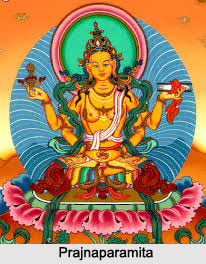
 Prajnaparamita means "Perfection of (Transcendent) Wisdom" in Mahayana Buddhism.
She is the goddess of learning. Prajnaparamita refers to this perfected way of seeing the nature of reality, as well as to a particular body of sutras and to the personification of the concept in the Bodhisattva known as the "Great Mother".
Prajnaparamita means "Perfection of (Transcendent) Wisdom" in Mahayana Buddhism.
She is the goddess of learning. Prajnaparamita refers to this perfected way of seeing the nature of reality, as well as to a particular body of sutras and to the personification of the concept in the Bodhisattva known as the "Great Mother".
Meaning of Prajnaparamita
The word Prajnaparamita combines the Sanskrit words prajna "wisdom" with paramita "perfection".
Concept of Prajnaparamita
Prajnaparamita is a central concept in Mahayana Buddhism and is generally associated with the doctrine of emptiness (Shunyata) or `lack of Svabhava` (essence) and the works of Nagarjuna. Its practice and understanding are taken to be indispensable elements of the Bodhisattva path.
Iconography of Prajnaparamita
The goddess Prajnaparamita is seated cross-legged on a lotus-throne with her hands forming dharmachakra-mudra and with a book-on-lotus on each side.
Sutras of Prajnaparamita
The earliest sutra in the Prajnaparamita has the class to be the Astasahasrika Prajnaparamita Sutra or "Perfection of Wisdom in 8,000 Lines", which was probably put in writing in the 1st century BC.
Origin of Prajnaparamita
 It was believed that the Astasahasrika Prajnaparamita Sutra originated amongst the southern Mahasamghika schools of the Andhra region (now Andhra Pradesh and Telangana), along the Krishna River Banks.
Astasahasrika Prajnaparamita Sutra and Mahanaya Buddhism
Mahayana Buddhism took root in ancient Java Sailendra court in the 8th century BC. The Mahayana reverence of female Buddhist deity started with the cult of Tara enshrined in the 8th century Kalasan temple in Central Java. Some of the important functions and attributes of Prajnaparamita can be traced to those of the goddess Tara. Tara and Prajnaparamita are both referred to as mothers of all Buddha, since Buddha is born from wisdom. The Sailendra dynasty was also the ruling family of Srivijaya in Sumatra. During the reign of the Pala king Devapala in India, Srivijaya Maharaja Balaputra of Sailendras also constructed one of main monasteries in India itself. Thereafter manuscript editions of the Ashtasahasrika Prajnaparamita Sutra circulating in Sumatra and Java instigated the cult of the Goddess of Transcendent Wisdom.
Prajnaparamita in Middle Age
In the 13th century, the Tantric Buddhism gained royal patronage of Kertanegara of Singhasari, and thereafter some of Prajnaparamita statues were produced in the region, such as the Prajnaparamita of Singhasari in East Java and Prajnaparamita of Muaro Jambi Regency, Sumatra. Both of East Java and Jambi Prajnaparamitas bear resemblance in style as they were produced in same period, however unfortunately Prajnaparamita of Jambi is headless and were discovered in poor condition.