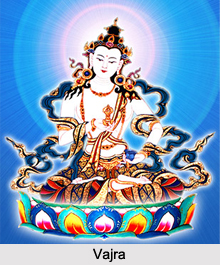
 Vajra means the void (sunyata or prajna) in Hevajra Tantra. Again, while analysing the term `Hevajra`, `He` is interpreted as karuna and `vajra` is interpreted as prajna. `Hevajra` is the union of prajna and karuna and it is the ultimate reality. Vajra is also considered as karuna, as for example, when Hevajra is in union with Nairatmya, then `vajra` symbolizes Hevajra (vajro Hevajrah), the male aspect. Hevajra sadhana is also called the Vajra-Kapala Yoga. Here `Hevajra` (vajra) is karuna and `Nairatmya` (kapala) is prajna. The term `vajra` stands at times for prajna and at other times for karuna, sometimes for Nairatmya and at other times for Hevajra, each of which is a coefficient of the Enlightened Consciousness (`sunyata karunabhinnam bodhichittam iti smrtam`). Thus, `vajra` is a comprehensive term incorporating within itself the twin aspects of prajna and karuna, and stands for the Ultimate Reality.
Vajra, in relation to paramartha (nirvana), is prajna; and in relation to samvrti (samsara), is karuna. Both nirvana and samsara are vajra. That is why in Vajrayana everything is vajra. Bhagavan himself is called Vajri. The Tathagatas are called Abhedyavajra (the indivisible vajras), which again shows that vajra stands for the Absolute. The Guru is called `Vajradhari`, the one who bears the non-dual knowledge. Elsewhere, the Guru is identified with vajradhara himself. Thus, vajra is used to indicate the ultimate Reality and all its manifestations.
Vajra is not synonymous with the sunyata of Madhyamika, though they share much in common, and the terms sunyata and prajna are frequently used in Vajrayana. While in Mahayana Buddhism the Ultimate Reality (sunyata) is primarily referred to as only prajna, and karuna seems to be secondary and extraneous to it, in Vajrayana both seem to have equal status; in fact the Real (vajra) is a fusion of the two. In Vajrayana, the Ultimate Reality is the inseparability of sunyata and karuna (sunyata karunabhinnam). Again, while in Madhyamika the Real (tattva) is an epistemic entity, in Vajrayana the Real (vajra) bears ontological overtones. Madhyamikakdrika defines tattva as, that which is independently realised, peaceful, unobsessed by obsessions, without discriminations and a variety of meanings. For Vajrayana, the Ultimate Reality (vajra) is first and foremost the void which is the firm essence (saram). Bhagavan defines vajra in Vajrasekhara as, "the Void which is firm essence, indestructible, indepletable, indivisible and not capable of being consumed is called Vajra". The attributes of vajra, as we can see, are ontological while those of tattva in Madhyamika karika are epistemological.