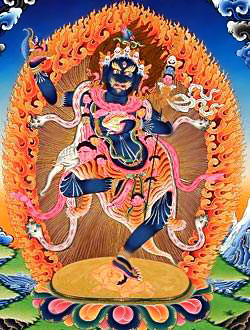
 The meaning of the term Naitramya means no-soul. It indicates nirvana or sunyata. Over time, sunyata came to be conceived as a goddess in whose embrace the bodhisattva remains in absolute bliss. Since Sunyata is often compared to the blue-coloured sky, Nairatmya too has the colour blue. Nairatmya is described in two sadhanas in the Sadhanamala. Her form is similar to that of Vajravarahi with the kartri and kapala. The difference is on the position of the corpse on which each stands. When the corpse is presented as lying on its chest, the goddess is Vajravarahi; when it lies on its back the goddess is Nairatmya. Another difference is that Vajravarahi, being an emanation of Vairocana, bears an image of Vairocana on the crown. On the other hand, Nairatmya, being an emanation of Aksobhya, bears the image of Aksobhya instead. Sadhanamala gives a description of Nairatmya as blue in colour, terrible in appearance, holding the kartri and kapala while dancing n the ardhaparyanka on a corpse that lies on its back.
The entire concept of the Nairatmya shows how tantric Buddhism systematically defied the principles of Mahayana Buddhism. In the Mahayana tradition, In the Mahayana tradition the highest perfection is prajnaparamita, the supreme truth of void (sunyata), which in Vajrayana is deified as the goddess Prajnaparamita. In the Hevajra Tantra she is called Nairatmya, which means `the absence of the notion of selfhood` (i.e. nonsubstantial). The supreme truth, under the male aspect, is vajra, expressed as, Aksobhya, Vairocana or Hevajra.
An explicit description has been given of the nature of Nairatmya in the Hevajra Tantra. It is said of her that she is of the nature of the first vowel `a`, and she is conceived of as wisdom personified by the enlightened ones. She is said to be of the nature of the five aspects of the enlightened one. In the process of completion, she is the noble lady Wisdom, and the bliss of Mahamudra is located in the navel centre. She is said to be neither tall nor short, neither square nor round. She is beyond taste smell, flavours, and is the cause of the innate joy, the Divine Yogini. It is along with her that the Accomplishment, which bestows the Bliss of Mahamudra, is attained. Form, sound, smell, taste, touch and thought, characterised by the Essence of Nature, are all enjoyed only in this Wisdom. She is the mirror-like awareness of Equanimity, the Differentiating Awareness of the six components of sensory experience, the Awareness of the Performance of Duty and the Awareness of Pure Nature. Nairatmya is said to be the very epitome of the Essence of Nature, the Mandala circle.
This description of Nairatmya reveals her relative and absolute characters. In the relative sense, she is the wisdom consort, the yogini with whom the yogi should practice and experience all cognitions as charecterised by the Essence of Nature (dharmadhatu). As regards her understanding from the absolute point of view, she is almost indescribable. She is said to be beyond all shape, size and sensory experience. Nairatmya from the absolute perspective is seen as the embodiment of the five aspects of Enlightened Awareness. In other words, she is the culmination of the dhyani Buddhas who are nothing but these five wisdoms. In the Hevajra Tantra, Hevajra, when defining Nairatmya, declares that `she is me, the `Lord of the Mandala` (saivdham mandaladhipah). Thus as the essence of Nature, she is seen as belong identical with Hevajra.
The concept of Nairatmya is significant in that it marks the gradual departure of tantric Buddhism from Mahayana principles.