
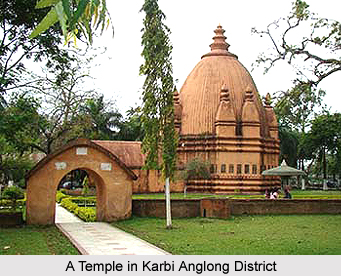
 Karbi Anglong District is one of the 27 administrative districts of Assam. In fact, it is the largest amongst all the districts. Karbi Anglong District is covered on the east by Golaghat District, on the west by Meghalaya and Marigaon District, on the north by Nagaon District and Golaghat districts and on the south by North Cachar Hills District and Nagaland. The administration of Karbi Anglong District is well administered by the governmental officials. The administrative headquarters of Karbi Anglong District is located at Diphu town. Karbi Anglong District is positioned between 25 degrees 33 minutes to 26 degrees 35 minutes north latitudes and 92 degrees 10 minutes to 93 degrees 50 minutes east longitudes. This administrative district of Assam covers a total area of 10,434 sq km.
Karbi Anglong District
Karbi Anglong District is the largest administrative district of Assam. This administrative district is located at the central part of the state with its headquarters located at Diphu town..
Introduction
Karbi Anglong District is one of the 27 administrative districts of Assam. In fact, it is the largest amongst all the districts. Karbi Anglong District is covered on the east by Golaghat District, on the west by Meghalaya and Marigaon District, on the north by Nagaon District and Golaghat districts and on the south by North Cachar Hills District and Nagaland. The administration of Karbi Anglong District is well administered by the governmental officials. The administrative headquarters of Karbi Anglong District is located at Diphu town. Karbi Anglong District is positioned between 25 degrees 33 minutes to 26 degrees 35 minutes north latitudes and 92 degrees 10 minutes to 93 degrees 50 minutes east longitudes. This administrative district of Assam covers a total area of 10,434 sq km.History of Karbi Anglong District
The birth of Karbi Anglong District took place on 17th November 1951. The new district was formally created with some parts of Golaghat District, Nagaon, Cachar District and United Khasi district of Meghalaya for all round development of the tribal folk of the Central Assam. It was followed by bifurcation of the former district of United Mikir and North Cachar Hills district into two separate districts under the name of `Mikir Hills` and North Cachar Hills district in 1970. The Mikir Hill district was again rechristened as `Karbi Anglong District` on 14th October, 1976 under government notification. Thus, Karbi Anglong District came into being as a full-fledged separate district with its Head quarter at Diphu. This district enjoys autonomy under the provision of Sixth Schedule of the Constitution of India.
Geography of Karbi Anglong District
The Karbi Anglong Distrcit is situated in the central part of Assam. The district has extensive dense tropical forest covered hills and flat plains. The geography of Karbi Anglong District mostly consists of plains and covered hills. Due to variation in the topography, this hill zone experiences different climates in different parts.
The cold weather season commences from October and continues till February. During the hot weather season, the atmosphere becomes humid. The temperature ranges from 6 degree to 12 degree and 23 degree to 32 degree Celsius in summer. The average rainfall is about 2416 mm. There are numerous rivers and tributaries in this district. Some of the prominent rivers of this district are Kopili River, Nambor River, Amreng River, Deopani River, Borpani River, Yamuna River, Kolioni River, Patradisha River, Dhansiri River and more. Even though, the district is dotted with hills, a few of them can be categorized into Mountain. Among them, the highest is the Singhason Peak which is at around1360 metres above the sea level.
The cold weather season commences from October and continues till February. During the hot weather season, the atmosphere becomes humid. The temperature ranges from 6 degree to 12 degree and 23 degree to 32 degree Celsius in summer. The average rainfall is about 2416 mm. There are numerous rivers and tributaries in this district. Some of the prominent rivers of this district are Kopili River, Nambor River, Amreng River, Deopani River, Borpani River, Yamuna River, Kolioni River, Patradisha River, Dhansiri River and more. Even though, the district is dotted with hills, a few of them can be categorized into Mountain. Among them, the highest is the Singhason Peak which is at around1360 metres above the sea level.
Demography of Karbi Anglong District
Population of Karbi Anglong District is predominantly tribal. The major tribal ethnic groups of this district of Assam are Karbi tribe, Bodo tribe, Kukis, Dimasa tribe, Hmar tribe, Garo tribe, Naga tribe and Tiwas. Besides, a large number of non-tribal groups also live together in this hill region. According to the Population Census in the year 2011, Karbi Anglong District had a population of 965,280 of which male and female were 493,482 and 471,798 respectively. The population of Karbi Anglong District constituted 3.10 percent of total population of Assam. The population density of Karbi Anglong district is 93 people per sq. km. The average literacy rate of Karbi Anglong in 2011 was 73.52 percent. If things are looked out at gender wise, male and female literacy were 82.12 and 64.62 respectively.
Economy of Karbi Anglong District
Karbi Anglong District is basically an agricultural district. Thus, its economy entirely depends on agriculture. Different types of agricultural crops are cultivated among which paddy is the main crop. Except for the valleys, the people in this region follow the jhum system of cultivation. The economy of this district is also depending on art and crafts. The crafts of Karbi Anglong District is famous not only in Assam, but also different parts of India.
Tribes of Karbi Anglong District
Tribes of Karbi Anglong District mirror the tribal world and the tribal culture of the Anglong District. As the great historian of Assam Dr. Surya Kumar Bhuyan observes a vital lesson which the tribal can teach us is their self-sufficiency in domestic economy. And the lesson is but a didactic moral when it comes to the life of million mortals. The tribes are less dependent on supplies from outside.
Although that makes them confined to the culture and economy of their life, the issue of economic independence and the one of specialization of labour can hardly be avoided. The Anglong craft here therefore bears the nuances of the ancient tradition of the ethnic culture which the people cherish with pride. They carve out utensils from wood; they spin out cotton and make quilts and traditional apparels. In other words the craft of hill areas is a rare combination of aesthetic and technical intricacy.
A large numbers of Tribal Communities swarm the area some of them being The Dimasas in Dhansiri / Mohendijua area. The Bodos in Langhin area, Kuki / Thadou / Hmar Tribes in Singhason and Koilamati areas, Tiwas in the areas bordering Nagaon and Morigaon District. Garos in Hamren Sub-division. The Man-tai speaking community inhabiting in Bokajan Sub-Division are some of the community tribes. Some Khasi Tribes inhabiting in areas adjoining Meghalaya mostly in Hamren Sub-Division, Scattered population of Chakmas mostly in Borlangphar area, Rengma Nagas in Nilip Block area.
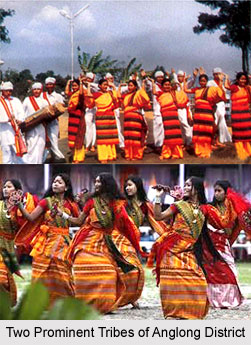 The Karbis tokenised as the Mikirs in the Constitution Order, Govt. of India, constitutes of a vital ethnic group in the hill areas of Assam. However, they prefer calling themselves as Karbi instead of Mikir and sometimes Arleng which literally refers to a man. Although at present, they are found to inhabit in the Karbi Anglong District, nevertheless, some Karbi inhabited pockets are found in the North Cachar Hills, Kamrup, Morigaon, Nagaon District and Sonitpur Districts also. Apart from the original Karbi Tribes, there are also a large number of other tribal communities residing in the district.
The Karbis have 5(five) clans called "KUR". These are Terang, Teron, Enghee Ingti and Timung. Each of the five clans again is divided into some sub clans. While Enghee and Timung have 30(thirty) sub-clans each, Terang and Teron have 6(six) sub-clans each and the remaining clan Ingti has only 4(four) sub-clans. These clans are completely exogamous and a nuptial knot between a boy and a girl belonging to the similar clan can is bound not to happen as the children of the same clan are considered as brothers and sisters. Desecration of this perennial customary law obviously leads to ex-communication of the couple involved. Again after death the classification of the clans is kept in action. The cremation ground called Tipit or Thiri, area is kept demarcated for each clan. Although all the five clans are socially on the similar level based on equality, Ingti being a clan of the priestly order, the clan was supposed to have a higher status in former times.
In spite of monogamy being the prevailing practice, there is no bar to polygamy and the cases of polygamy are very rare. Cross-cousin marriage is a preferential one. Like other tribal societies, the Karbis do not have the system of bride price. After marriage, the wife continues to use the surname of her father. But the children assume the title of their father. Thus, the Karbis follow the patriarchal system of family structure.
Racially the Karbis belong to the Mongoloid group whereas linguistically they belong to the Tibeto-Burman group. The original home of the various people speaking Tibeto-Burman languages was in western China near the Yang-Tee-Kiang and the Howang-ho rivers and from these places they went down the courses of The Brahmaputra Basin, the Chindwin and the Irrawaddy and entered India and Burma.
The Kabis, along with others entered Assam from Central Asia in one of the waves of migration. But, it is very difficult to trace the history of the early settlement of the Karbis bereft of any written documents and other evidence like archaeological remains, etc. Of course, in the old chronicles and Buranjis occasional references here and there were made to the people of this race. But from these references also it is very difficult to trace the chronological events of the Karbis. Their folk-tales and folk-lore are the only sources from which it can have an idea regarding their early history.
The folk-lore of the Karbis, however, indicate that during the long past, once they used to live on the banks of the rivers the Kalang and the Kapili and the entire Kajiranga area, the famous National Park situated in Assam, was within their habitation. During the reigns of the Kachari kings, they were driven to the hills and some of them entered into Jaintia hills, the erstwhile Jaintia kingdom and lived under the Jaintia suzerainty.
While a section of the Karbis remained in the Jaintia kingdom, others moved towards north-east by crossing the river Barapani, a tributary of the Kapili and entered into the Rongkhang Ranges. There they established their capital at a place called Socheng. Those who continued to live under the suzerainty of the Jaintia king had to face constant harassment at the hands of the Jaintias and this had compelled them to migrate towards north ward. A good number of them had entered into the Ahom territory and prayed for protection from the Barphukan at Raha. Thus migration took place at the beginning of the 17th Century. The Karbis who migrated to the Ahom kingdom had to face the Burmese invasion. The Burmese who invaded Assam perpetrated inhumane oppression on the people. The Karbis took refuge in the deep jungles and high hills leaving their hearth and home in the surmounting regions. In order to save themselves from the greedy eyes of the Burmese invaders, the young Karbi girls started to use a black line from the forehead to the chin which is known a "DUK" with a view to making them ugly looking. While some of the Karbis migrated to lower Assam, some had crossed the Brahmaputra and settled in the north bank./karbi_tribe
Crafts of Karbi Anglong
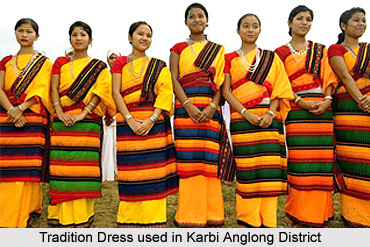 Crafts of Karbi Anglong offer to the tourists in the manufacture of conventional costume, handloom elements, musical instruments and household items. These reflect the proficiency of the artisans. The crafts of Karbi Anglong District is famous not only in Assam, but also different parts of India. Assam is chiefly dominated by the Karbi Tribes. These people are known for their age-old handicrafts and weaving works. The traditional dresses made by the Karbi Tribes are adorned with unique designs.
The people of Karbi Tribe are also proficient in making utensils. One of the remarkable craftwork of the Karbis is `Jambiliathan.` It is usually made by carving of wood. Some of the important craftwork of the local artisans here are basketry, utensils, musical instruments, and decorated furniture. Apart from these, several other products are also manufactured for interior decoration. The easy availability of raw materials like bamboo, cane and wood has given a thrust to the traditional craftwork of the local artisan to produce exquisite creative works. The Karbi tribes have also been proficient in making typical houses of cane, bamboo and wood. Handlooms also form an important feature of Karbi life. The womenfolk are highly skilled in weaving of pini, pekok, turban, scarf etc. Some of the villages are known for their delicate and brilliant craft work. These are described below.
Hamren : Hamren is regarded as the capital of Karbi traditional life. It is known for different Karbi crafts and culture. Wood carving and cane and bamboo works are some of the prominent craft works of Hamren. Some of the significant villages located near Assam are Langtupthepi, Phongjungre, Kongseck, Langsude, Chandrapur, Rongkhang Rongbo (Rong Arak), Hamthor, Phonkrei.
Boithalangsu : Biothalangsu is also known for its traditional craftwork. Traditional looms, cane and bamboo works are some of the important craftworks practising here. The nearby hamlets that practise artisanship are Umru, Longri, Rongkarlasu, Khong, Dongka, Menmeji and Pungahidi.
Kherani : The place is known for their jute works, mat making, rope making and cane and bamboo works.
Bokajan : Bokajan is known for cane and bamboo works used for making both household and decorative products, woodcarving and looms.
Manja : Manja has earned name for pottery and wood carving.
Dhanshiree Valley : Dhanshiree Valley is known for traditional crafts of Dimasa Tribe
Dengaon : Dengaon is popular for their traditional bamboo craft and cane craft and wood carving.
Types of Craftwork of Karbi Tribes
The Karbi Tribes specialise in different types of craftworks that have been discussed below:
Traditional Dress : Some of the traditional dresses made by the Karbi Tribes are Pekok, a cloth to cover the lower portion of woman`s body, Pini, a cloth to cover the upper portion of women, Pecharpi, Stoles /scarf, Jackets, Poho, a headgear for men, muffler and Venkok, a textile waist band for women. The Jackets manufactured by the Karbis are gaining much popularity among the urban people.
Handloom Instruments : Some of the handloom instruments produced here are Harpi (Dopodi), Thenging and Baptheli.
Musical Instruments : The Karbi Tribes also specialise in making few musical instruments like Cengbaruk, Kundengdong and Kumliang.
Household Items : Tibuk, a pot, Horbong, a wooden pot for keeping traditional rice beer, Harluk Tob, a kind of tub made of cane, bamboo and wood, Seru, a wooden kettle, Hatan, baskets made of bamboo and cane, Hak, a basket with a strap taken on the shoulders and used for carrying goods and fire wood, Bora, a beautiful cane box use to keep clothes, Murjong, a cane made basket to keep rice, Khangra, a basket used to carry wood, Hingru, a filter made of bamboo used while making rice beer, Chignam, a very significant strap made of cane used for carrying basket, Lumphuk, a wooden rice spoon huge in size, Beleng, a bamboo tray, Hangkrung, a bamboo filter to sort rice and Tar, a stiff mat made of bamboo.
Festivals of Karbi Analong District
Festivals of Karbi Analong District delineate the religious-ethnical ambience of the place. Among the festivals observed by the Karbis, mention may be made of the "Chojun Puja" or "Swarak Puja" ;"Rongker"; "Chokk-eroi"; "Hacha-Kekan", "Chomangkan", etc. While the former four festivals are socio-religious in nature and the latter is a social one. The spot for "Chojun Puja" or "Swarak Puja" is the selected spot near the house of the family that desires to perform the puja and the deities in this festival are Barithe, Shar Arnam, Arni and the Devil Hii-i and other smaller Gods. Hemphu, the greatest God of the Karbis is also taken into consideration. The puja is performed for the welfare of the family.
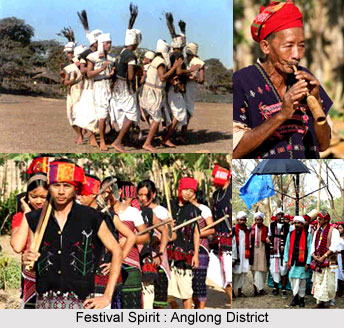 Rongker is performed at the beginning of the New Year by propitiating the different Gods and Goddesses for the well being of the entire village. The deities are worshipped by all the elderly male people of the village so that with their blessings the people of the village could be free from diseases, natural calamities during the year and the families could have a good harvest. The women are not allowed to enter into the worship arena.
There is another kind of Rongker performed in a greater scale. This type of Rongker which is performed at the beginning of every 5 years is called Wofong Rongker. This Wofong Rongker is performed for the well-being of all the people of the villages that fall within the jurisdiction of a Mauza (a revenue administrative region consisting of a number of revenue villages). Each revenue village is represented by the village headman and a number of village elders (males only) in the performance of the Wofong Rongker. While the Rongker performed for a village is only of one day`s duration, the Wofong Rongker continues for two days.
Sokkerroi festival is observed when the paddy field is ripened to the fullest extent. The ripened paddy is cut and taken to a place specially cleared in the field. Then the paddy is de-husked on the floor and the paddy is collected. A large number of young men go and collect paddy in bags and carry it to home. There starts a great rejoicing and the young ones dance to their hearts` context. Sok-erroi means the carrying of the paddy from the field. In the festival, one person is selected as the leader who provides the leadership in dancing and singing. He is called `Lunse". He is the director of singing and dancing.
The Hacha-Kekan is not exactly based on the folk-tales. Hacha-Kekan festival is associated with the after harvest rejoicings. There is no fear element in it and there is no need to propitiate any god. Hence it is to be assumed that the Hacha-Kekan is secular in its activities and differs substantially from another festival - Rongker.
Although, the Karbis perform the funeral ceremony at the time of the cremation of the deceased, they also perform the death ceremony called "Chomangkan" at a later date for the eternal peace of the deceased. It is the most elaborate and expensive socio-religious ceremony of the Karbis which continues for four days and four night non-stop. The ceremony does not require any formal invitation and all are welcome to it. In spite of the sad undertone, it is the proud day for the family and they welcome all with great warmth. They come in batches and everyone carries a symbolical rod with 5(five) branches and at the end of each branch, there is a wooden bird, which is called in Karbi "Vo-rali". The whole rod is called "Jambili Athan". This is the symbolical representation of the tribe and it is also the symbol of clan unity.
Rongker is performed at the beginning of the New Year by propitiating the different Gods and Goddesses for the well being of the entire village. The deities are worshipped by all the elderly male people of the village so that with their blessings the people of the village could be free from diseases, natural calamities during the year and the families could have a good harvest. The women are not allowed to enter into the worship arena.
There is another kind of Rongker performed in a greater scale. This type of Rongker which is performed at the beginning of every 5 years is called Wofong Rongker. This Wofong Rongker is performed for the well-being of all the people of the villages that fall within the jurisdiction of a Mauza (a revenue administrative region consisting of a number of revenue villages). Each revenue village is represented by the village headman and a number of village elders (males only) in the performance of the Wofong Rongker. While the Rongker performed for a village is only of one day`s duration, the Wofong Rongker continues for two days.
Sokkerroi festival is observed when the paddy field is ripened to the fullest extent. The ripened paddy is cut and taken to a place specially cleared in the field. Then the paddy is de-husked on the floor and the paddy is collected. A large number of young men go and collect paddy in bags and carry it to home. There starts a great rejoicing and the young ones dance to their hearts` context. Sok-erroi means the carrying of the paddy from the field. In the festival, one person is selected as the leader who provides the leadership in dancing and singing. He is called `Lunse". He is the director of singing and dancing.
The Hacha-Kekan is not exactly based on the folk-tales. Hacha-Kekan festival is associated with the after harvest rejoicings. There is no fear element in it and there is no need to propitiate any god. Hence it is to be assumed that the Hacha-Kekan is secular in its activities and differs substantially from another festival - Rongker.
Although, the Karbis perform the funeral ceremony at the time of the cremation of the deceased, they also perform the death ceremony called "Chomangkan" at a later date for the eternal peace of the deceased. It is the most elaborate and expensive socio-religious ceremony of the Karbis which continues for four days and four night non-stop. The ceremony does not require any formal invitation and all are welcome to it. In spite of the sad undertone, it is the proud day for the family and they welcome all with great warmth. They come in batches and everyone carries a symbolical rod with 5(five) branches and at the end of each branch, there is a wooden bird, which is called in Karbi "Vo-rali". The whole rod is called "Jambili Athan". This is the symbolical representation of the tribe and it is also the symbol of clan unity.
Culture of Karbi Anglong District
Culture of Karbi Anglong District traces the path towards it and from it. Sociologists are of the notion that human wholeness is achievable only through the recovery of or approximation to an original pre-discursive or pre-rational natural unity. It is a civilization that leads to a cultural identity. The onward march of civilization of Karbi Analong district in actuality has paved the way for cultural progress.
It is from the point of view of folk-lore and folk songs, the Karbis are very rich. It has been mentioned earlier that they have their own version of the Ramayana called Sabin Alun which has been handed down from one generation to another orally. However, during the recent years, the Karbi society has undergone transformation and changes. The grip of inertia in which this society was found in the past, has now been slackened. In this connection, the pioneering leadership was given by Late Khorsing Terang who was not only the first Chief Executive Member of the Karbi Anglong Autonomous Council but also the first member of the Assam Legislative Assembly from the Karbi community. Among the other leaders, mention may be made of Late Nihang Rongpher, Late Chandra Sing Teron, Late Chatra Sing Teron, Late Dhaniram Rongpi, who were not only the Chief Executive Member of the KAAC, but were the members of the Assam cabinet also, Late Joysing Doloi, Ex.CEM; Late Sai Sai Terang, Ex. Chairman; Late Samsing Hanse, was a member of Assam cabinet; Mr. Biren Singh Engti, Ex.M.P. and Ex.Central Deputy Minister ; Mr. Bidya Sing Engleng, Ex. CEM and sitting M.L.A. ; Dr. Jayanta Rongpi, Ex.CEM and sitting M.P.(Lok Sabha) ; Mr. Holiram Terang, Ex. M.L.A.; Mr, Jagat Sing Engti, sitting M.L.A.; Mr. Dharam Sing Teron, Ex. Chairman and sitting M.L.A. and many others.
In the literary field, Padmashree Rongbong Terang, Mr. Longkam Teron, Dr. Phukan Chandra Phangcho, Mr. Lunse Timung, Samsing Hanse, Mr. Jeet Rongpi, Song Bey and many others have made significant contribution for the development of Karbi literature. In this connection, reference of "Karbi Lamet Amei" (Karbi Sahitya Sabha) may also be made. The Karbis have now come forward to accept the developmental schemes of different sectors with a view to changing their own destiny. But at The same time, they are maintaining their culture which distinguishes them as a separate ethnic group.
It is from the point of view of folk-lore and folk songs, the Karbis are very rich. It has been mentioned earlier that they have their own version of the Ramayana called Sabin Alun which has been handed down from one generation to another orally. However, during the recent years, the Karbi society has undergone transformation and changes. The grip of inertia in which this society was found in the past, has now been slackened. In this connection, the pioneering leadership was given by Late Khorsing Terang who was not only the first Chief Executive Member of the Karbi Anglong Autonomous Council but also the first member of the Assam Legislative Assembly from the Karbi community. Among the other leaders, mention may be made of Late Nihang Rongpher, Late Chandra Sing Teron, Late Chatra Sing Teron, Late Dhaniram Rongpi, who were not only the Chief Executive Member of the KAAC, but were the members of the Assam cabinet also, Late Joysing Doloi, Ex.CEM; Late Sai Sai Terang, Ex. Chairman; Late Samsing Hanse, was a member of Assam cabinet; Mr. Biren Singh Engti, Ex.M.P. and Ex.Central Deputy Minister ; Mr. Bidya Sing Engleng, Ex. CEM and sitting M.L.A. ; Dr. Jayanta Rongpi, Ex.CEM and sitting M.P.(Lok Sabha) ; Mr. Holiram Terang, Ex. M.L.A.; Mr, Jagat Sing Engti, sitting M.L.A.; Mr. Dharam Sing Teron, Ex. Chairman and sitting M.L.A. and many others.
In the literary field, Padmashree Rongbong Terang, Mr. Longkam Teron, Dr. Phukan Chandra Phangcho, Mr. Lunse Timung, Samsing Hanse, Mr. Jeet Rongpi, Song Bey and many others have made significant contribution for the development of Karbi literature. In this connection, reference of "Karbi Lamet Amei" (Karbi Sahitya Sabha) may also be made. The Karbis have now come forward to accept the developmental schemes of different sectors with a view to changing their own destiny. But at The same time, they are maintaining their culture which distinguishes them as a separate ethnic group.
Administration of Karbi Anglong District
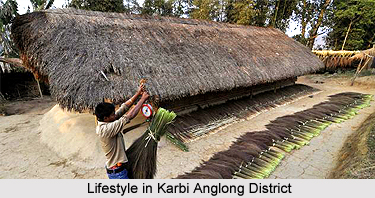 Administration of Karbi Anglong District is somewhat slightly different from that of the plains district of Assam as far as its pattern is concerned. Karbi Anglong district is one of the autonomous hill districts of Assam constituted under the provision of Sixth Schedule of the Constitution of India. That is why the pattern of administration of this district is different. There is an Autonomous Council in Karbi Anglong District constituted under the provision of the said schedule namely Karbi Anglong Autonomous Council (KAAC). Almost all the development departments of this district are under the administrative control of the Karbi Anglong Autonomous Council. Karbi Anglong District consist of three sub-divisions out of which two are Civil Sub-Division namely Bokajan and Hamren with its headquarters at Bokajan and Hamren respectively where the Sub-Divisional Officer (Civil) functions as the Sub-Divisional head. The third sub-division of Karbi Anglong District is Diphu Sadar Sub-Division with its headquarters at Diphu town. There are various development blocks under each sub-division of Karbi Anglong District.
Diphu Sadar Sub-Division : Lumbajong Development Block, Howraghat Development. Block, Samelangso Development. Block and Langsomepi Development Block
Bokajan Civil Sub-Division : Bokajan Development Block, Nilip Development. Block and Rongmongwe Development Block
Hamren Civil Sub-Division : Rongkhang Development Block, Socheng Development Block, Chinthong Development Block and Amri Development Block
Just like the plains district of Assam, Deputy Commissioner is the head of the administration of the Karbi Anglong District. He is also responsible for the maintenance of law and order in the district as well as administration of justice. He also acts as the District Magistrate and has to function as the District and Session Judge of the district too. Deputy Commissioner also functions as the District Election Officer. Further, he has to function as Returning Officer for conducting elections in three Autonomous Districts, Parliamentary Constituency and 19 Diphu Legislative Assembly Constituency. A number of officers aid him in his functioning. For instance, there are a number of subordinate officers like Additional Deputy Commissioner, Extra Assistant Commissioner and Election Officer who help the Deputy Commissioner in the entire civil administration. Moreover, the Deputy Commissioner is also assisted by police force headed by the Superintendent of Police in the maintenance of law and order in the district and in the prevention and detection of crimes. There are 6 police stations and 11 outposts throughout Karbi Anglong District.
Tourism in Karbi Analong District
Tourism in Karbi Analong District is the tour of the Karbi Anglong or the land of the Karbis that may be deciphered as the heart-beat of Assam. This beautiful, large sprawling district lies in the centre of Assam. This enchanting hills district with its diversely rare flora and fauna has remained virgin, untouched and undiscovered. Mother Nature has indeed been very generous to Karbi Anglong yet its potentialities for tourism remain sadly untapped.
The peculiarity in the topography of the district lies in the fact that there are actually two parts in this district. The western part is bifurcated from the Eastern side by a part of. Thus we have the Hamren Sub-division on the Western part with its rolling hills, dense forests, Waterfalls, rivers and streams. When one comes to the East and one is greeted with a combination of flat paddy lands, green hills interspersed with blue meandering rivers. While summer in Karbi Anglong may be hot and humid and generally lasts from June to August, the remaining parts of the year are pleasant and bracing. The Peak season for tourists to visit the district is October to March.
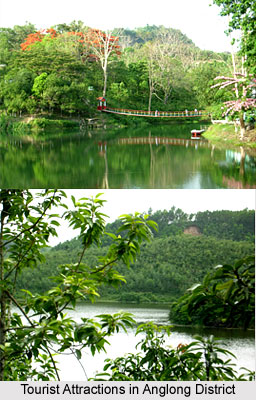 Located at 120 Kms. from Diphu ; 30 Kms from Lanka (Nogaon District) Amreng is a river cape situated between Kapili river and its tributary "Amreng River" surrounded by mystic blue hills and evergreen forest, it is famous for unique natural beauty. Tourist Map had referred to it as Panimur, Koka Hills or Amreng, All the same area. The founder of the village named it as "River Cape India". Tourist Lodge is on the river bank.
Khanduli Tourist Centre is endowed with temperate grassland in Tropical country; Khanduli is New Zealand of East. Extensive grassland with undulating moulds which looks like desert sand dunes in the clear moonlight, 26 Kms. from Hamren Sub-Division, Head quarter of West karbi Anglong, on Jowai-Shillong Road, 70 Kms from Jowai, Meghalaya. This Location with unattended beauty suitable for pensive study trip, reclusive honeymoon, family holidays throughout the year.
Umang is temperate grassland, having characteristic similar features with Khanduli. The entire area of 35 sq. Km is high table land with natural grassland more or less flat surface and surrounded by one big river and one small perennial river on three sides. Situated at just 15 Kms. from Umroi Airport (Meghalaya), Umang is adjacent to another tourist centre at Khanduli which will be connected by Birdle Path to facilitate beautiful trekking expedition of 12 Kms. and another tracking path of 16 Kms to Baithalangso Tikka Tourist Centre. Rafting and Angling expedition on river Barapani, golf course of 15 to 20 holes, horse riding, hand gliding expedition are suitable attractions of this centre.
In Karbi Anglong context, Kaziranga is Kohora and both are of same entity. Kaziranga Wild Life Sanctuary has peak season for four months and remaining eight months of the year is too long to keep dormant of revenue oriented organisation like tourism. Further Sanctuary visit involve an hour or less and tourist may require incentive activity for the remaining hours of the day.
The peculiarity in the topography of the district lies in the fact that there are actually two parts in this district. The western part is bifurcated from the Eastern side by a part of. Thus we have the Hamren Sub-division on the Western part with its rolling hills, dense forests, Waterfalls, rivers and streams. When one comes to the East and one is greeted with a combination of flat paddy lands, green hills interspersed with blue meandering rivers. While summer in Karbi Anglong may be hot and humid and generally lasts from June to August, the remaining parts of the year are pleasant and bracing. The Peak season for tourists to visit the district is October to March.
Located at 120 Kms. from Diphu ; 30 Kms from Lanka (Nogaon District) Amreng is a river cape situated between Kapili river and its tributary "Amreng River" surrounded by mystic blue hills and evergreen forest, it is famous for unique natural beauty. Tourist Map had referred to it as Panimur, Koka Hills or Amreng, All the same area. The founder of the village named it as "River Cape India". Tourist Lodge is on the river bank.
Khanduli Tourist Centre is endowed with temperate grassland in Tropical country; Khanduli is New Zealand of East. Extensive grassland with undulating moulds which looks like desert sand dunes in the clear moonlight, 26 Kms. from Hamren Sub-Division, Head quarter of West karbi Anglong, on Jowai-Shillong Road, 70 Kms from Jowai, Meghalaya. This Location with unattended beauty suitable for pensive study trip, reclusive honeymoon, family holidays throughout the year.
Umang is temperate grassland, having characteristic similar features with Khanduli. The entire area of 35 sq. Km is high table land with natural grassland more or less flat surface and surrounded by one big river and one small perennial river on three sides. Situated at just 15 Kms. from Umroi Airport (Meghalaya), Umang is adjacent to another tourist centre at Khanduli which will be connected by Birdle Path to facilitate beautiful trekking expedition of 12 Kms. and another tracking path of 16 Kms to Baithalangso Tikka Tourist Centre. Rafting and Angling expedition on river Barapani, golf course of 15 to 20 holes, horse riding, hand gliding expedition are suitable attractions of this centre.
In Karbi Anglong context, Kaziranga is Kohora and both are of same entity. Kaziranga Wild Life Sanctuary has peak season for four months and remaining eight months of the year is too long to keep dormant of revenue oriented organisation like tourism. Further Sanctuary visit involve an hour or less and tourist may require incentive activity for the remaining hours of the day.
Recently updated articles in States of India
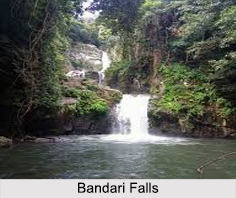
Bandare Waterfalls, Meghalaya
Bandare Waterfalls in South Garo Hills, Meghalaya, is a secluded natural attraction surrounded by dense subtropical forests and rugged mountain terrai...
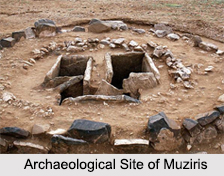
History of Thissur District
Early History of Thissur District explains flourishing of the port cities. Now these port cities are transformed into archaeological sites.
Tippi Orchid Research Centre, Arunachal Pradesh
Tippi Orchid Research Centre in Arunachal Pradesh is renowned for its rich collection of exotic and endangered orchids. Surrounded by lush rainforest...
Tourism in Nashik District
Pilgrimage tourism in Nashik district involves visiting the various places of Hindu and Jain worship located here. Some of the holiest sites for Hind...
Mangadu, Kerala
Mangadu in Kerala’s Kollam district is a significant megalithic site known for its urn burials, cist burials, menhirs, and stone circles. Excavations...
Related articles in States of India
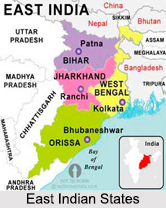
East Indian States
East Indian States comprises of Bihar, Jharkhand, West Bengal, Odisha and also the Union Territory of Andaman and Nicobar Islands. It defines the cult...
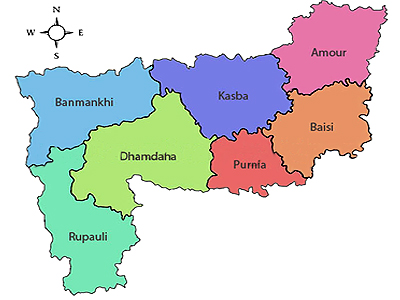
Purnia District in Bihar
Purnia District is located in Bihar and extends from River Ganga to Nepal. The district has a rich Hindu history and glorious past.
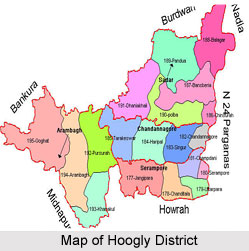
Hooghly district
Hooghly District along the bank of the river Hooghly is one of the principal trading ports of West Bengal.
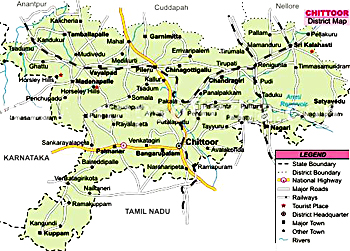
Geography Of Chittoor District
Geography of Chittoor district is spread along the topography of the land which is divided into two natural divisions; Chittoor has a dry and healthy...
Districts of West Bihar
Districts of West Bihar is comprised of medieval monuments that were built by the different governors of Mughal era.