 Goddess Chinnamasta is one of the most outrageous forms of divinity in Hinduism. She is the Goddess of courage and discernment. Chhinnamasta, also known as Chhinnamastika, is one among the Ten Mahavidyas. The literal meaning of Chhinnamasta is one with a "severed head". Goddess Chinnamasta is a form of Shakti who is depicted as ferocious wrathful deity.
Iconography of Goddess Chhinnamasta
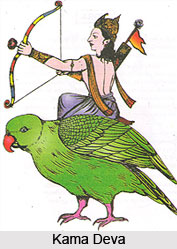
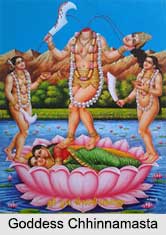
Goddess Chinnamasta is mostly depicted nude and with dishevelled hair in blood red or black coloured body striding on the bodies of Kama and his wife Rati. She has severed her own head with her own sword and holds her cut head in one of her hands. Three jets of blood spurts out of her bleeding neck, one stream goes directly to the mouth of her cut head, while the other two streams go into the mouths of her two female associates, Dakini and Varnini.
Goddess Chinnamasta is considered as a representation of self-control on sensuous desire as well as a personification of sexual energy. She symbolizes a life-giver and a life-taker. The image of Chhinnamasta signifies that death, life and sex are inter-reliant. Concept of sacrifice and rebirth are the two aspects that can be deduced from the image. She is the only Goddess who displays the motif of self-decapitation.
Origin of Goddess Chhinnamasta
The folklore behind her origin is that once Parvati along with her attendants Jaya-Vijaya went to take bath in the Mandakini River. While bathing, the Goddess became sexually exited and thus turned black. At that moment her two attendants begged the mother for food as they were very hungry. Parvati tried to calm them down promising to give them food once they returned home but the attendants kept on pleading. Goddess Parvati looks around but couldn"t find anything to eat. The Goddess then finally beheaded herself by her nails and gave her blood to satiate their hunger.
Invocation of Goddess Chhinnamasta
A variety of rituals lead to the invocation of the Goddess. The rituals that are performed for the invocation of the deity are; Avahana, Pranapratistha, Six Limbed Nyasa, Shakti Worship of Goddess, Sacrificial Offerings, Worship of Eight Petelled Lotus Deities, Flower Offerings, Worship of the Goddess Attendants and finally Valediction to Chinnamasta.
Worship of Goddess Chhinnamasta in Tantra
Tantric practitioners worship Chhinnamasta for acquiring Siddhis or supernatural powers. Worship of Chinnamasta in Tantra comprises of regular preliminaries, Tantric regular preliminaries, invocation of the deity and the fire ceremony.
Stotras of Goddess Chhinnamasta
Stotras of Chinnamasta elucidates upon the greatness of Goddess Chinnamasta. The practitioner chants these mantras daily after completing the ritual worship. The stotras comprises of lauds and depiction of Chinnamasta and her both attendants, Varnini and Dakini. The stotras are foremost a tribute to Goddess Chinnamasta. It is believed that a devotee by chanting the name and mantra of the Goddess will result in receiving the desired goals, wealth, grain, great knowledge and the 8 Siddhis.
Temples of Goddess Chhinnamasta
As her approach is dangerous and ferocious, she is not worshipped everywhere. Her temples are mostly found in Northern India. Temples solely dedicated to her are not common. She is usually worshipped by Tantrikas, Yogis and Sanyasis. Some shrines are dedicated to Chhinnamasta like the one that exists in Ramnagar, near Varanasi. Shrines of this Goddess are also found in Jharkhand in Rajrappa on the hill Nandan Parvat, Kamakhya Temple complex in Assam and in Bishnupur, West Bengal.