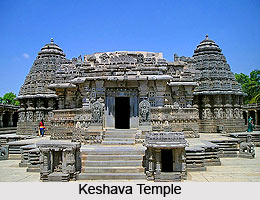
About Keshava Temple
The Keshava Temple in Mysore, Karnataka was built in 1268 A.D. by Somadannayaka, a minister to King Narasimha III of the Hoysala dynasty. The temple is built in the Hoysala style of architecture. It is a superb example of the wonderful work of ancient Indian artists in stone. The Somnathpur temple is enclosed by huge courtyard, measuring 220 feet by 180 feet. A veranda, divided into cells, runs around the courtyard. The towers are all elegantly carved with beautiful designs and the workmanship on all three of them is faultless.
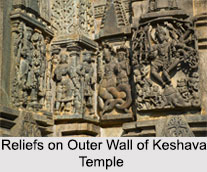
The most alluring of the art of the Somnathpur lies on its outer walls. The walls contain beautiful figures of gods and goddesses from the Hindu mythology, carved with a fineness that is exquisite. There are as many as 194 such images and every one of them is a work of art, sculptured with patient accuracy. Of the images, most represent Lord Vishnu in his different forms and avatars. Amongst the rest, those that deserve mention are of Garuda with Vishnu and Goddess Lakshmi on his shoulders, Indra on his divine elephant Airavata and the gods and goddesses like Ganapati, Lakshmi and Saraswati in various dancing poses.
Running completely around the walls of the temple are four friezes. The first contains rows of caparisoned elephants, each elephant being delicately sculptured in full detail. The third frieze is of scroll-work. The fourth is the most interesting one of the series, for it contains scenes from the Indian epics curved on it. The Ramayana, the Mahabharata and the Bhagavata are all represented there, one of the friezes being devoted for one incident from an epic.
The temple originally contained three images in it, of Keshava, Venugopala and Janardan. The figure of Keshava, which, according to all accounts, must have been a brilliant example of a god in stone, is missing. Nobody knows who carried it off and in spite of best efforts, it has not been traced. The other images, of Venugopala and Janardana were good specimens of work. Both stand six feet high on their pedestal and unfortunately both are mutilated.
The roof of the temple carries with it a set of fifteen ceilings. Each one of these ceilings is nearly three feet deep and is carved out of a single stone. The carvings are excellently done and represent intricate floral and geometrical designs.
Though tradition ascribes the building of this temple to one sculptor, Jakanachari, it was constructed by a group of sculptors, who, very singularly, have left their signatures in stone. The signatures, which occur under most of the big images of the temple, tell us that a group of eight artists carved out the image of the temple. Of these, the most prominent sculptor was Mallitamma, for he has left his name under as many as forty different pieces of work. There is a legend around this temple, a legend supported by the unusual position of its Pillar of Garuda. In all Hindu temples, this pillar must be exactly in front of the main entrance, but here it is a few feet to a side.
It seems that the gods in Indra`s heaven were so pleased with the beauty of this temple that they thought it unfit to be on the earth and wished to have it in heaven. In accordance with their wish, the temple began to rise from its foundations. Jakanachari seeing that the earth was about to be bereft of so fine a structure, ran towards it and made one of its figures imperfect by striking at it with his mallet. As the temple new lost its perfection, it descended to the earth again, but in doing so, occupied a position which was different from the former one.
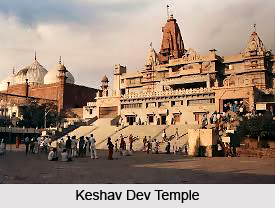
History of Keshava Deo Temple
Keshava Deo Temple is one of the most important temples in Mathura. It has the mythological and historical significances. Every year, a large number of pilgrims from different parts of the world come and visit this place.
Keshava Deo Temple is also known as Krishna Janmasthan is a temple located in Mathura (Uttar Pardesh). This temple is known as one of the most sacred of Hindu sites as it is birthplace of Lord Krishna.
Keshava Deo Temple is considered as the birthplace of Lord Krishna. This temple still carries the local touch and feel of the several other temples in the twin towns of Mathura and Vrindavan.
Early History of Keshava Deo Temple : Early History says that the first temple here was constructed almost 5,000 years ago by Vajranabha, the great-grandson of Lord Krishna. The next big temple was constructed here during the time of the Gupta Emperor Chandragupta II around 400 AD.
Medieval History of Keshava Deo Temple : The second temple at the Keshava Deo Temple came up during the rule of Chandragupta Vikramaditya. It was destroyed by Mahmud of Ghazni in the year 1017. In Katra Keshavdeva, they found an inscription on a stone slab which speaks of the third temple, built by Jajja in Vikrama Samvat 1207, which is 1150 in the Georgian Calender during the rule of Vijaypal Deva. It is said Chaitanya visited the same temple when he came to Mathura before its destruction by the forces of Sikandar Lodhi in the 16th century. The fourth temple of Keshava Deo Temple by the King of Orchha came up after the destruction of the magnificent temple which was built by Guptas. The fourth temple of Keshava Deo Temple was built by Veer Singh Dev Bundela of Orchha when Jahangir was on the Mughal throne. Later the last Mughal Emperor, Aurangazeb ordered the destruction of the temple in the year 1669. There he built an Idgah that was constructed over a part of the raised plinth of the Keshava Deo Temple.
Modern History of Keshava Deo Temple : Modern History of Keshava Deo Temple traces from the decline of Mughal rule. The area came under direct rule of British India in the first phase of 17th century. In the year 1815 the British East India Company auctioned the area of Katra Keshavadeva Temple, which was purchased by the then Raja Patnimal of Varanasi. Although, the Raja of Benares (Varanasi) wanted to build a temple there, but his wish remained unfulfilled and the family had fight several legal battle for ownership of land with Muslim community of Mathura, in which, the court finally ordered that the land belongs to present heirs of Raja of Benaras (Varanasi). In 1944, Madan Mohan Malviya was distressed at plight of the site and arranged for purchase of land from Raja Krishna Das of Benaras, who sold the land only at cost of Rs. 13,000 recovering just the cost of fighting court battles.
Then Jugal Kishore Birla of Birla group decided to take the leading role to fulfil the wishes of Madan Mohan Malviya and formed a private trust in 1951 to which the rights of land were later transferred.
Jaidayal Dalmia of Dalmia Group was another leading personality who took untiring efforts and the temple was finally constructed over the site. The trust which runs Keshava Deo Temple has a glorious list of Trustees besides Birla family and Dalmia family members like Ganesh Vasudev Mavalankar, Anantashayanam Iyengar, Swami Akhandananda Saraswati, Swami Vamdevji Maharaj. The present head of temple is Mahant Nrityagopal Das. The construction of Keshava Deo Temple was completed in 1965.
Next to Keshava Deo Temple, within the complex is a small room that looks like a prison cell, where it is said that Lord Krishna was born.
The excavation of Keshava Deo Temple began in 1953 under the chairmanship of Swami Akhandanada, when the volunteers started the excavation continued for several decades later under supervision of Babulal Bajaj and Phool Chand Khandelwal, till the prison complex was completed in 1982.
Sculpture of Keshava Temple
There are many ancient temples in South India which now stand testimony to the sculptural and architectural greatness of the Pallavas, the Cholas, the Chalukyas but the Keshava Temple at Somnathpur in Karnataka speaks the sculptural art of the Hoysalas. The temple is a trikutachala temple with 3 shrines dedicated to Lord Krishna and his 3 incarnations- Janardhana, Keshava and Venugopala.
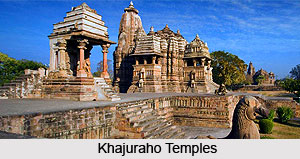
Every inch of the temple is adorned with various sculptures and the entire shrine is raised on a star shaped moulded platform. The Hoysalan art is known for using ornamental elaboration and a profusion of iconography with figure sculptures, the shrine of Keshava is no different with its abundance of figure sculptures on the superstructure over the shrine. The base for their carving was on soft chlorite schist, also known as soapstone, which enabled a virtuoso carving style. The walls of the temple are covered in beautiful friezes of scenes from great epics, figures of elephants and battle scenes depicting cavalry. The outer face of the main building has 3 different divisions, out of which the lowest part of the basement has a frieze of caparisoned war elephants with one or two riders. The elephants are not an exact copy of each other, rather show different natural expressions and playfulness of elephants.
The immediate next frieze shows a long line of horsemen charging forward on their steed. In some spots, camels substitute for horses suggesting that the Hoysala had adopted camels into their army. In various places, the artists added humour by placing dwarfs and monkeys supporting the front raised leg of the horses. The sculpted animals are shown to have well proportioned snouts and their various animal movements like jumping, trotting, prancing are well depicted. The band above the horsemen friezes is a scroll of nature. It shows flowers, fruits, occasionally some peacocks and wildlife like lion faces in the outer corners. The band above it is the mythology frieze and it depicts the legends and spiritual stories found in the Ramayana, starting from King Dasharatha"s ritual offerings and prayers for children to the birth of Lord Rama and his brothers. The Ramayana frieze ends with the meeting of Hanuman and Sugriva, who later end up joining Lord Rama on his quest to rescue Sita. The next frieze is the Puranas especially the Bhagavata Purana, it starts with Vishnu reclining in the cosmic ocean and Vasudeva"s marriage and ends with Lord Krishna slaying various demons and ultimately slays Kamsa. Some scenes of the Bhagavata are repeated. And lastly in the outer wall, the final frieze is of the Mahabharata, starting with Dhritarashtra`s court and the rivalry between Pandavas and Kauravas as they were growing up. The Mahabharata frieze ends with the victory of the Pandavas and their return to their kingdom in Hastinapur.
Immediately above the basement level are a series of small pilasters. The panels between these pilasters shows Lord Vishnu in various aspects and avatars in the Vaishnavism tradition, they also include Lord Shiva of the Shaivism tradition. There are deity-related reliefs of Devis depicting the Shaktism tradition and Lord Surya of the Saura tradition of Hinduism. The reliefs also show the daily lives of the people including festive scenes, dancers in various mudras, and musicians with 13th century musical instruments, couples in courtship and sexual scenes. Erotica was a subject the Hoysala artist handled with discretion. There is no exhibitionism in this, and erotic themes were carved into recesses and niches, generally miniature in form, making them inconspicuous. These erotic representations are associated with the Shakta practice. Sculptures also included mothers nurturing babies, hunters and other professionals with pets such as dogs along-with soldiers, yogis, saints, and individuals doing namaste along-with couples praying. These reliefs also include numerous friezes showing the story of Prahlada , Hiranyakshipu and the Vishnu avatar- Narsimha.
In the case of the three towers, above the peacock band of carvings is a row of larger size deity reliefs that wraps around the temple. There are about 90 reliefs showing mostly Lord Vishnu with Goddess Lakshmi, as well as Shakti, Shiva, Brahma, Saraswati, Indra, Indrani, Kama, Rati, and others. Most of these are partially defaced and deformed. The larger images show illustrative carvings of the Dancing Saraswati, the Tandava Ganesha, and Devi Durga as Mahishasuramardini among others. The first 60 and the last 60 reliefs have a superior finish and details, while the middle 65 panels are less detailed. In some of the panels, the artist has signed below. It was the first known instance of signed artwork in India.
The most characteristic feature of this temple is its 16 different ceilings, each depicting a different stage of a blooming plantain mainly banana flower. There are complicated patters of small and large pieces of finely carved stone chips. One of the main highlights of this temple is the central wall space. There are images of deities decorated with heavy jewellery, bangles on every arm, towering crowns and chunky anklets. The vimana over the sanctums have greatly carved images of Gods.
The Keshava temple is a fantastic piece of art, now protected under the Archaeological Survey of India. It is regarded as perfect in symmetry with exquisite stone carvings.