As per the Hindu calendar month of Ashwin, the festival of Durga Puja commences on the sixth day of Ashwin shukla paksha, which is known as Maha Sashthi and marks the formal beginning of the festivities in the state of West Bengal. Durga Puja is celebrated all over the country but is most popular in the north eastern states of Assam and Tripura, along with Odisha and West Bengal.
The festival is celebrated with much zeal and fervour with elaborate temple and stage decorations like pandals, performance arts, revelry and processions. Durga Puja is a multi day festival and the celebrations end on the tenth day of Ashwin shukla paksha, which is known as Vijayadashami or Dusshera by the other traditions of Hinduism. The festival of Dusshera marks the victory of Lord Rama over the demon king Ravana and on this day effigies of Ravana are burnt. Durga Puja is a major festival in the Shaktism tradition and the Shakta Hindu Diaspora.
Other Names of Durga Puja
In the states of West Bengal, Bihar, Assam and Tripura, the festival of Durga Puja is also known as Akalbodhan, which means the untimely awakening of the Goddess, Sharad Pujo or Sharodotsab, which means the festival of autumn. In other states of India like Gujarat, Uttar Pradesh, Punjab, Kerala, and Maharashtra, the festival is known as Navaratri. In Tamil Nadu, it is called Bommai Golu and Bommala koluvu in Andhra Pradesh.
History of Durga Puja
With unclear documentations and evidences, the origin of Durga Puja is a bit vague. But the surviving manuscripts from the 14th century provide guidelines for the festival. Historical evidences discovered reveal that it was royalty and wealthy families that sponsored major Durga Puja festivities until the 16th century.
 In the sacred Jainism text called Yasatilaka by Somadeva, there are mentions of a festival and annual dates dedicated to a warrior goddess, celebrated by the king and his armed forces, and the description has similarities to the Durga Puja. There are also mentions of the Goddess Durga in hymns from the Vedic literature like Rig Veda and Atharva Veda but with fewer details about the goddess and Durga Puja. A deity named Durgi also appears in a section of the Taittiriya Aranyaka. In the Hindu religious text of Devi Mahatmya or the Glory of the Goddess, which is read during Durga Puja, the nature of demonic forces or evil is symbolised by Mahishasura and Goddess Durga counteracts this evil in order to fulfil her solemn goal.
Goddess Durga is a symbol of Shakti or power and is one of the most celebrated deities in the Hindu pantheon. The Goddess has been mentioned in popular epics which have led to her worship. Example: the Mahabharata, where Yudhisthira and Arjuna invoke hymns to the Goddess, then in Harivamsa in the form of Lord Vishnu"s eulogy and in Pradyumna prayer.
The significance of Durga and other goddesses in Hindu culture increased after the Islamic forces conquered Indian subcontinent and attempted to deny iconographic representation of its male and female idols. It was during the 14th to 16th century Bengal Sultanate that persecuted the Bengali Hindus and the late medieval era religious politics that led to a revival of Hindu identity and an emphasis on Durga Puja as a social festival that publicly celebrated the warrior goddess.
Aspects of Durga Puja
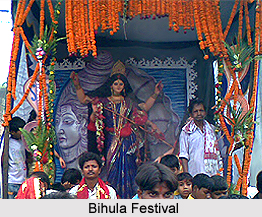
Durga Puja is a social event that also maintains the religious worship. Dedicated to Goddess Durga, the deity is put on a stage along with other major deities like Goddess Lakshmi, Goddess Saraswati, Lord Ganesha and Lord Kartikeya. In Bengali tradition, the other Gods and Goddess" are considered to be the children of Goddess Durga or Parvati, who is the consort of Lord Shiva.
 The idols of these deities are made with clay or local soil collected from different parts of the region. In the city of Kolkata, one of the main customs is to include soil samples from forbidden territories like brothels in the clay mixture for Durga. Other than clay, these days biodegradable materials like straw, resin and wood are used in the creation of the idols with eco friendly colours. With contemporary times, the scale of competition has increased and theme based pandals are a big hit especially in the eastern states. The competition takes many forms, such as the height of statue. In 2015, an 88 ft statue of Durga in Kolkata`s Deshapriya Park attracted numerous devotees, with some estimates stating visitors at about 1 million.
Rituals of Durga Puja
The festival of Durga Puja begins with Mahalaya, a day when Hindus offer tarpa?a waters to their dead ancestors and continue till Dashami. The rituals include Bodhon, Amantron, Mangal Ghat, bathing of Nabapatrika and so on. Sacrifices are also included in the rituals. Earlier there was animal and human sacrifice. Since the rule of Vaishnava kings there has been no such sacrifice instead vegetables are sacrificed. The sacrifice of pumpkin was one of the most common substitutes. Sacrifice is basically casting away of one`s sins and faults.
Celebration of Durga Puja
Durga Puja is celebrated with great pomp and glory, even outside the city of Kolkata. Many portions of North Bengal also engage themselves in worshipping Goddess Durga. Some of the most ancient Durga Pujas are held in the regions of Cooch Behar, Chanduli near Katwa, Lataguri in Jalpaiguri District, Siliguri, Berhampore and Jalpaiguri.
Apart from West Bengal, many other Indian states observe the grand festival of Durga Puja. Durga Puja pandals are built and adorned with electric lights and themes, to commemorate this festive occasion in the states of Bihar, Jharkhand, Assam, New Delhi, Maharashtra, Goa, Tripura, Andhra Pradesh, Tamil Nadu, Kerala and Karnataka. In states of Gujarat, Punjab, Madhya Pradesh, Durga Puja is celebrated in the form of Navaratri for 10 days. On the tenth day, `Dussehra` is observed, which is the day of Vijayadashami according to the Bengali culture of Durga Puja. However, as per Bengali traditions, Vijayadashami is celebrated on the fifth day of Durga Puja.