
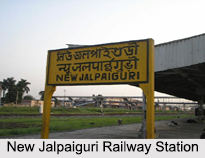
 Jalpaiguri is a modern and well developed city in Jalpaiguri District of West Bengal. Jalpaiguri is the largest city in the northern part of West Bengal.
Jalpaiguri
Jalpaiguri in Northern part of West Bengal is known for its pristine nature. This city has the influence of Bengali culture, traditions and the Bhutanese traditions. Jalpaiguri had many olive trees.
Introduction
Jalpaiguri is a modern and well developed city in Jalpaiguri District of West Bengal. Jalpaiguri is the largest city in the northern part of West Bengal.Naming of Jalpaiguri
"Jalpaiguri" is derived from the Bhutanese language term "je-le-pe-go-ri", which means that where the business of warm clothes are successful.
Location of Jalpaiguri
This city of north Bengal is located on the banks of the Teesta River on the foothills of the Himalaya Mountain Range in India. Jalpaiguri is situated at about 40 kilometers away from Siliguri, and more than 80 kilometers from Malda District.
Geography of Jalpaiguri
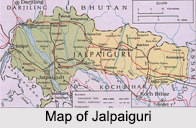 The latitudinal and longitudinal limit of Jalpaiguri is about 26.52 degree North to 88.73 degree East. The city has an average altitude of 75 meters from the sea level. The plain is fertile on the foothills of Himalaya Mountain Range in India. Jalpaiguri has many North East Indian Rivers and small streams.
Climate of Jalpaiguri
The temperate season is prevailing through out the year. The summers of this city are tropical and quite hot with temperatures. The temperature is ranging in the mid 30 degree Celsius.
Demography of Jalpaiguri
According to the Population Census of 2011, Jalpaiguri had a population of 107,341. The population of the metropolitan region was 169,002, out of which 85,226 males and 83,787 females.
Education in Jalpaiguri
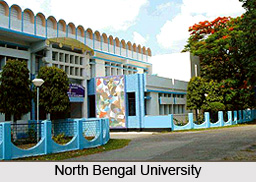 To cope up with the changing scenario of educational development, the State Government had worked for the upliftment of the standard of education in Jalpaiguri, since it emerged as the separate functional unit of independent India. Presently the educational status of Jalpaiguri is no less significant in West Bengal.
Jalpaiguri is the home of several renowned schools. The schools here are either run by the West Bengal State Government (affiliated to WBHSE) or by the Catholic institutions or the private concerns (affiliated to the ICSE and CBSE, Delhi.). Several well-known state-run schools Zillah School, Government Girls` school, the Fanindra Dev Institution, the Central Girls School etc. are the seat of academics. Jalpaiguri is presently a prominent name in the educational arena of West Bengal.
A considerable number of colleges (all affiliated to the North Bengal University) providing a superior quality of education enhanced the educational significance in Jalpaiguri. The colleges offer education in the streams of Arts, Commerce and Science.
Different types of academic institutions are also there in Jalpaiguri. Jalpaiguri Government Engineering College, providing training to all the branches of engineering presently is the second oldest of all the technical institutions in West Bengal. Jalpaiguri Polytechnic institution is one of the remarkable institutions in Bengal. Apart from the colleges providing technical trainings, Jalpaiguri B.T College is equally important.
On a whole, Jalpaiguri has undergone a significant change in the field of education.
Administration of Jalpaiguri
Jalpaiguri is the home to the circuit bench of the Kolkata High Court. The other seat is at Port Blair in the Andaman and Nicobar Islands.
Economy of Jalpaiguri
 According to the Government, Jalpaiguri is a non-industry district, though tea industry is the backbone of Jalpaiguri`s economy since its advent. The economy of Jalpaiguri is essentially agriculture-based. Moreover the staple resources of the tea industries are tealeaves, which are also cultivated.
The northern strip of the region is a hilly tract, which is congenial for tea cultivation. Jalpaiguri is the second largest producer of tea in West Bengal. It is the regional topography, which supports the economy greatly. The brand "Jalpaiguri tea" is extremely popular worldwide. The ample production of tea, in the region laid the foundation of the tea industry here. The tea industries constituting the parts like tea processing, tea packaging etc. involves a large-scale employment, thereby supporting the local economy of Jalpaiguri.
The tea industries lend a dual support to the economy of Jalpaiguri. The industries fetch a large amount of labors locally at a low rate and the superior quality of tea are exported to the neighboring region even in abroad.
Again in the present era of industrialization, some policies have been undertaken by the government to ensure the economic prosperity of Jalpaiguri. An Oil refinery in Baranhat is the principal project adopted by the Government. In the adjacent areas of Jalpaiguri, medicine factory, cold storage for fruits and different other factories of electronic goods etc. have grown up, which augment the economic growth. Besides projects have also been taken up, for the proper utilization and suitable marketing of tea. Recently a Tea- Auction Company has come up in the town. However the policies and plans that are being adopted are instrumental to the economic development of Jalpaiguri.
The physical homogeneity of the central and the southern part of the district is formed of alluvium and the silt carried by the rivers like Teesta, Mahananda, Torsha, etc. All these are originated from the northern glacier- hence perennial; they provide continuous water to the region for the growth of agriculture. The conducive landscape with the continuous supply of water is favorable for the cultivation of rice. Rice is the principal crop of the district, though the major part of its production is meant to serve the domestic requirement. Wheat also shares a position in serving the local economy of Jalpaiguri.
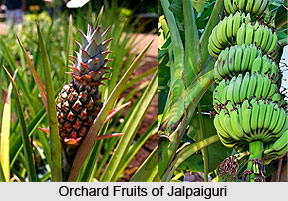
Moreover the cultivation of the horticulture is also promoted thereby serving the district`s economy to a large extent. Jute, Tobacco and mustard are the principal products here, much of which is exported. The orchard cultivation of Jalpaiguri is also famous. The superior quality of orchard fruits (mainly pineapple and banana) draws a large quantity of export income.
Hence the economy of Jalpaiguri, though agriculture based, it has attained the status of the economically developed district of West Bengal.
Tourism in Jalpaiguri
The scenic beauty and the dense forest of the region, which often evoke eerie and romanticism at the same time, help the growth of the tourism industry in Jalpaiguri.The network of rivers Jalpaiguri is often been recognized as a land of "Tea, Timber and Tourism".
 The diversified flora and fauna and the exquisite splendor of Jalpaiguri gathers a vast chunk of tourist in its core. Sanctuaries, Tiger Reserves and the National Parks are the key interest about the region and are also the popular tourist places in Jalpaiguri. Gorumara Sanctuary at the flood plains of Murti and Jaldhaka rivers offers scenic landscape and magnificent forest. The principal attraction here is the Rhinoceros, Elephant, Gaur, Leopard, hornbill etc. Except the rainy seasons, the Gorumara tourism gathers a variety of visitors.
The Chap Mari Wild Life Sanctuary at the foothills of the Himalayas in the district of Jalpaiguri is the abode of diverse avifauna and the mammals like elephant, gaur and leopard. The dense forest against the backdrop of Kanchenjungha and other Himalayan peaks offers a charismatic view whilst augmenting the tourism industry in Jalpaiguri.
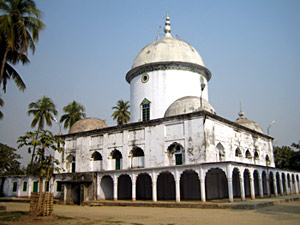 Chalsa has magnificent view of small hillocks, along which the river Kurti flows and the vast expanse of the tea gardens. In the flood plains of river Torsha, Jaldapara Wild life sanctuary is the home of Great Indian One-horned rhinoceros and the Royal Bengal Tiger. The Jalpesh Temple, some 8 km away from Jalpaiguri is the only religious place attracting tourists. The presiding deity of Shiva in the temple is invested with immense historical importance. The Cooch King Prananarayana had constructed this temple in the year 1655. The tourism industry of Jalpaiguri is one of the principal sources of income of Jalpaiguri. Completely an agriculture based economy, the district of Jalpaiguri owes its popularity as an economically developed district mainly due to the thriving prosperity of tourism industry in Jalpaiguri.
The diversified flora and fauna and the exquisite splendor of Jalpaiguri gathers a vast chunk of tourist in its core. Sanctuaries, Tiger Reserves and the National Parks are the key interest about the region and are also the popular tourist places in Jalpaiguri. Gorumara Sanctuary at the flood plains of Murti and Jaldhaka rivers offers scenic landscape and magnificent forest. The principal attraction here is the Rhinoceros, Elephant, Gaur, Leopard, hornbill etc. Except the rainy seasons, the Gorumara tourism gathers a variety of visitors.
The Chap Mari Wild Life Sanctuary at the foothills of the Himalayas in the district of Jalpaiguri is the abode of diverse avifauna and the mammals like elephant, gaur and leopard. The dense forest against the backdrop of Kanchenjungha and other Himalayan peaks offers a charismatic view whilst augmenting the tourism industry in Jalpaiguri.
Chalsa has magnificent view of small hillocks, along which the river Kurti flows and the vast expanse of the tea gardens. In the flood plains of river Torsha, Jaldapara Wild life sanctuary is the home of Great Indian One-horned rhinoceros and the Royal Bengal Tiger. The Jalpesh Temple, some 8 km away from Jalpaiguri is the only religious place attracting tourists. The presiding deity of Shiva in the temple is invested with immense historical importance. The Cooch King Prananarayana had constructed this temple in the year 1655. The tourism industry of Jalpaiguri is one of the principal sources of income of Jalpaiguri. Completely an agriculture based economy, the district of Jalpaiguri owes its popularity as an economically developed district mainly due to the thriving prosperity of tourism industry in Jalpaiguri.Recently updated articles in Cities of India
Places of Interest in Deogarh Uttar Pradesh
A place of historical and archaeological significance, Deogarh is a site with few popular places of interest.
Deoghar in Jharkhand
Deoghar is the divisional headquarters of Santhal Parganas located in Jharkhand and is popular for the famous Baidyanath temple and Shiva Temples.
The Asiatic Society of Mumbai
Asiatic Society in Mumbai is the temple of Asian Studies from the time of British rule in India.
Vasco da Gama / Vasco City
Vasco da Gama / Vasco is the biggest city of Goa and is one of the most visited for its perfect amalgamation of business as well as leisure options.
Agriculture of Ladakh
Agriculture in Ladakh is primarily practiced in the short summer season due to its cold desert climate. Farmers grow hardy crops like barley, wheat, p...
Related articles in Cities of India
Holy Cities of North India
Holy Cities of North India are having the rich history of Hinduism and the entire civilization was grown up with the hands of beliefs, rituals and the...
Holy Cities of South India
Holy Cities of South India gives the detailed cultural formation of Dravidians from the early era, which later developed to the world by the Pallavas...
Holy Cities of West India
Holy Cities in West India were established by the rulers of Rajputs and the Satvahana Dynasty and the medieval rulers of Junagadh.
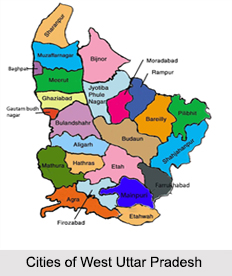
Cities of West Uttar Pradesh
Cities of West Uttar Pradesh include Meerut, Bulandshahr, Ghaziabad, Saharanpur, Muzaffarnagar, Bijnor, Bareilly, Rampur, Agra, Aligarh, Mathura and m...

Port Cities of South India
Port Cities of South India are developed from the early phase of colonial era when the Portuguese and the French traders came to India