 Hindu mythology says Paksha is a lunar fortnight. It is the fifteen days of thirty Muhiirttas each. The literal meaning of paksha is "side". It is the period either side of the Full Moon Day. A lunar month in the Hindu calendar comprises of two fortnights, and begins with the New moon. The lunar days are called tithis and each month has 30 tithis. A paksha has 15 tithis which are calculated by a 12 degree motion of the Moon. The first fortnight between New Moon Day and Full Moon Day is called Shukla Paksha and the second fortnight of the month is called Krishna Paksha.
Shukla Paksha and Krishna Paksha
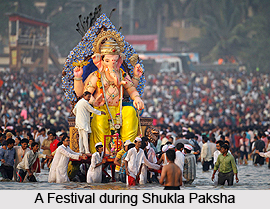
The terms Shukla and Krishna are Sanskrit words which mean white and dark respectively. Shukla Paksha is the period of the brightening of the moon. It refers to the bright lunar fortnight. Shukla Paksha is a period of 15 days, which begins on the New Moon day and Full Moon day. Shukla Paksha is considered auspicious by people and numerous festivals are organized during this Paksha. The festivals celebrated during this period include Govardhan Puja, Bhaibeej, Teej, Akshaya Tritiya, Ganesh Chaturthi, Ganesh Jayanti, Nuakhai, Vivaha Panchami, Sitalsasthi, Rama Navami, Vijayadashami, Shayani Ekadashi, Vaikunta Ekadashi, Samvatsari, and Guru Purnima.
Krishna paksha is the period of the fading of the moon. It refers to the dark lunar fortnight. Krishna Paksha is a period of 15 days, which begins on the Full Moon day culminating on New Moon day. Krishna Paksha is considered inauspicious by people. However, there are certain festivals that are celebrated during this period such as Karva Chauth, Krishna Janmashtami, Vaikunta Ekadasi, Dhanteras, Maha Shivaratri, and Naraka Chaturdashi.
This article is a stub. You can enrich by adding more information to it. Send your Write Up to content@indianetzone.com