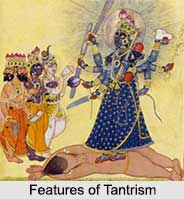
 Features of Tantrism are essentially followed by the Yogis to achieve the realisation of the Absolute Truth. The salient features of Tantrism are namely the spirit of Heterodoxy, the Spirit of Revolt, Ritualism, Centrality of the Body, the Ultimate Reality as Bi-polar, Realisation as the union of polarities, the Pursuit of Siddhis, Predominance of Female Deities, Deities of Terrifying Nature and Emphasis on Guru and Diksha.
Spirit of Heterodoxy
One of the main features of Tantrism is that it is a departure from tradition, especially the Vedic. The term "Tantrika" was used as a mark of distinction from "Vaidika". Tantra advocated certain peculiar and heterodox guidelines. The cult of the body, including sex -yogic practices along with esoteric geometric patterns, gestures and incantations are nothing but instruments to attain spiritual transcendence.
Spirit of Revolt
Tantrism as a movement of the masses is a reaction against the social ills and excesses of the established religions. It professed equality of all encouraged free social interaction among all castes and unrestricted access to ritual worship for all, in blatant opposition to the existing Brahmanic traditions.
Ritualism
Tantrism is essentially ritualistic with rites and rituals of varying complexity occupying a fundamental position in all Tantras whether Hindu, Buddhist or Jain. It echoes the strong trend that probably affected all religions to substitute tangible and popular ritual for the earlier abstract meditations.
Centrality of the Body
One of the fundamental postulates of Tantrism is that truth resides within the body of the adept. The human body is credited to be the earliest medium through which truth can be realised. Body and bodily faculties are employed in the practice of Sadhana.
Ultimate Reality as Bi-Polar
The notion of the bi-polar structure of the ultimate is the corner stone of Tantric speculation. The polarities may be characterised as negative and positive or static and the dynamic.
Realisation as the Union of Polarities
Liberation from the bondage is the chief goal of Tantrism. Liberation is the perfect state of union between the two aspects of reality and the realisation of the non-dual nature of the self and the non-self. Tantric Sadhana is designed to bring about the reintegration of the adept`s body, speech and mind with the cosmic entities that is a fusion of the microcosm and the macrocosm.
Predominance of Female Deities
Tantrism in general has a predominance of female manifestations. Tantrism assigns a leading role to Shakti in her Jnana aspect since without her grace or revelation no redemption through the body is possible. However, the role of the female deities in Buddhist tantric tradition is different from that of the Hindu counterpart.
Emphasis on Guru and Diksha
Tantrism proves to be a dangerous path for those who are initiated and unaccompanied by a competent Guru. No sadhaka should attempt it by him. The Guru is identified with the principal deity and the initiate is expected to abide by the Guru`s directions. Every tantric tradition insists on the necessity of initiation from a competent spiritual guide. Diksha exclusively refers to spiritual initiation.
Puja in Tantrism
Tantras proclaim that the worshipper must identify himself with the deity he worships. Nyasa is an essential element of Puja in Tantrism. Dhyana and Japa are other basics in Puja. Tantra lays emphasis on mental worship.
Siddhi in Tantrism
Siddhi is to be achieved through Sadhana. The Mantra Siddhi is by which mantras used by a sadhaka produce the desired result. "Vak Siddhi" refers to the words uttered by a Sadhaka that becomes infallible. After reaching the peak of spiritual life one can possess eight Siddhis. The greatest of all Siddhi is Moksha.
Mantra and Purascharana
Mantra occupies a high place in the tradition of Tantra. God is envisioned as mantra which has been mentioned as the definite means of attaining Moksha. The power of mantras is diverse. The word Purascharana means performing before something. It also means the perfecting of the procedure of mulamantra as it has to be performed before the acts in which it is to be employed.
Yoga in Tantrism
Tantric Yoga is twofold - Hatha yoga and Samadhi yoga. Hatha yoga consists of physical methods by which the way to mind-control is paved. It has Yama, Niyama, Pranayama, Asana and Pratyadhara. Samadhi yoga is divided into six types, namely; Dhyana yoga, Nada yoga, Rasa Nanda yoga, Laya Siddhi yoga, Bhakti yoga and Raja yoga.
Mandala in Tantrism
Mandalas or diagrams of various shapes and colours are indispensable for Tantric rites. The word "Mandala" also indicates a gathering of Tantric devotees who assemble to perform rituals involving Panchamakara.