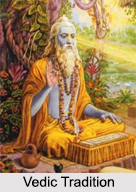
 Vedic Tradition is the teachings and experiences of various lineages of sages who lived on the Indian subcontinent in ancient times. Vedic Tradition, also known as "Brahmana Parampara" was a major tradition which believes in authorities of Vedas in the ancient India. The Vedic tradition of knowledge is the oldest tradition of knowledge in the world. It is the world"s most ancient and largest, continuous spiritual tradition.
The Vedic tradition is based on Universal Truths of Dharma or natural laws that are applicable for anyone, at anytime and anywhere in the world. It is a tradition that emphasizes individual freedom to investigate spiritual truth to its deepest level and provides the methods by which one can have personal experience of the spiritual dimension.
Origin of Vedic Tradition
The religion of the Vedic period was the religion of the Indo-Aryans of Northern India. The Vedic liturgy is conserved as a form of Mantra in the four Vedas. Texts dating to the Vedic period are composed in Sanskrit. Vedas is the oldest part of Sanskrit literature. The word "Veda" means "knowledge", the sacred religious knowledge. The hymns of the Vedas were divinely revealed to the Rishis, and thus are called Shruti.
Features of Vedic Tradition
The three ancient Indian religions; namely Hinduism, Buddhism and Jainism, share the following common features of Vedic Tradition:
1. They believe in the Law of Karma, the Cycle of birth and death and Moksha as the final supreme goal of life.
2. They all accept that there can be different approaches to Reality. They show tolerance and even respect for other religions and paths.
3. They subscribe to certain common virtues like Ahimsa, Satya, Asteya, Brahmacharya and Aparigraha. They lay emphasis on self-control, austerity and inner transformation of human being.
4. Philosophy and Religion are communal in all these three traditions.
Antiquity of Vedic Tradition
The individual verses contained in a compilation is known as Mantras. Some of the Vedic Mantras are still recited at prayers, religious functions and other auspicious occasions. The mode of worship was worship of the elements like fire and rivers, worship of Gods, chanting of hymns and performance of sacrifices. The Brahmins performed the solemn rituals for the Kshatriyas and Vaishyas. This mode of worship has been preserved even today for prosperity, wealth and well-being.
Thus, the Vedic Tradition is one of the most ancient surviving spiritual and mystical traditions on the planet.