 Vedic `mantras` in Agni Purana include the various mantras for worshipping different gods and goddesses of Hinduism. According to Pushkara, the mantras or chants contained in Rig Veda, Atharva Veda, Sama Veda and Yajur Veda amount to 1,00,000. Chapters 301 to 316 of Agni Purana mention the numerous kinds of mantras, wherein chapters 309 to 314 speak about the mantras which are essential for worshipping Goddess Tvarita. In this particular adhyaya it has been said that the Agni Purana grants salvation to those who earnestly strive for liberation of their encaged souls, whereas by going through it, the worst sinners may purge off the sins that lie thick on their souls.
History of Vedic Mantras in Agni Purana
The holy `Vyasa`, an incarnation of the Supreme Lord Brahma, divided the Vedas into different groups or Shaakhaas, each containing 10,600 mantras and a hundred Upanishads. Lord Vishnu, who manifests in the shape of the holy Vyasa, also composed the books known as the Indian Puranas and the Itihasas. The six sages such as `Suta`, `Lomaharsana`, `Sumati`, `Agni-Varcha`, `Mitraya`, `Shanshapayana`, `Kritavrata` and `Savarni`, having received the Puranas from the holy Vyasa, became his disciples. The sages, such as Sanshapayana, etc., made Samhitas of the eighteen Puranas, such as the Brahma, etc. The god Hari, who is beyond all illusion, and of whom has evolved this illusory universe, and who sometimes assumes a definite form despite being shapeless, and who is the fountain source of all knowledge, is the pervading spirit of the present work of Agni Purana.
Significance of Vedic Mantras
A man by worshipping and singing hymns in praise of Lord Vishnu is enabled to enjoy all the creature comforts in this life, and to work out his salvation in the next. It has been said that the Almighty, ever victorious Vishnu, is manifested in the fire and in the sun. As fire, he serves as the mouth of the gods, by receiving the libations offered in the course of a sacrifice. The god Vishnu, as manifested in the shape of the religious sacrifice, forms the theme of the Vedas and the Puranas. The present work (Agni Purana) is the best of all shapes that had ever been assumed by the Infinite Vishnu. The god `Janardana` is the author and hearer of the present Agni Purana. Therefore, the present work is full of the essence of all the Vedas, and ranks supreme among its sister compositions.
The Agni Purana is replete with all knowledge worth acquiring, is holiest of the holies, and is great with the infinite greatness of the god Hari, One in quest of wisdom, should read and hear the verses of the present work recited, whereby he will gain proficiency in learning, since it (Agni Purana) is but another manifestation of the god Hari running through all as universal soul. The seekers of beauty, wealth, kingdom, virtue, fame, learning, cow, village and attributes of good fortune in general, are sure to attain their respective objects of solicitation by a single perusal of the present work.
 Vedic Mantras in Rig Veda
Rig Veda, which contains a thousand mantras possesses two branches or `shaakhaas`, `Sankhayana` and `Ashvalayana`. The holy sage Sri Krishna Dwaipayana considered Rig Veda as the standard or `Pramana` Veda. This Veda has as many as 10,552 mantras. There are 2,000 mantras in `Rigvediya Brahmana Bhhaga. Ancient sages or `rishis` like `Vishwamitra`, `Atri`, `Vashistha`, `Jamadagni`, `Kanwa`, `Bharadwaja` and `Gotama` were believed to be the creators of these mantras. The mantras of Rig Veda are capable of inspiring mankind and are full of positive thoughts. They aim to purify the mind of humans with the aide of knowledge.
Vedic Mantras in Yajur Veda
There are 19,000 mantras in the Yajur Veda. The Brahmana Grandhas in this Veda has 1,000 mantras while the branches or Shaakhaas possess about 1,608 mantras. The Shaakhaas known as the `Maitriyani`, `Taittiriya`, `Vaishampayanika`, `Kanvi`, `Kathi`, `Maadhyanandini` and `Maadhya Kathi` belong to the Yajur Veda.
Vedic Mantras in Sama Veda
Sama Veda contains 9,425 mantras, which are all associated to Lord Brahma. `Gaanas` or verses are the main vedic hymns in Sama Veda. There are two Shaakhaas in Sama Veda, `Aatharvaayani`or Raamaayaniya` and `Kouthuma`. These two branches of Sama Veda has certain verses like `Aaranyaka`, `Veda`, `Vuuh` and `Ukha`. The Brahma Sankatas are hundred and four in all, out of which twenty five appertain to the Sama Veda. It is said that a majority of the mantras of Sama Veda are extractions from Rig Veda. However, they are pronounced differently in both the Vedas, since a single alphabet can alter the meaning and significance of the mantras or verses. In Sama Veda, all the mantras are not chanted, but sung in melodious tunes. Devotees recite the mantras to invoke the blessings of gods, to whom the sacrifice if being offered.
Vedic Mantras in Atharva Veda
Agni Purana says that the sages, such as `Shlokaayani`, `Shounaka`, `Pippalada`, `Muncha-kesha`, `Sumanta, `Javali`, etc., were the first rhapsodists who sang the verses of the Atharva Veda. Together, they contain 16,000 mantras and 100 `Upanishads`.
Examples of Some Vedic Mantras
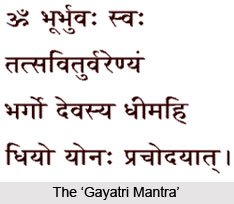
`Gayatri Mantra`, `Mahamrityunjay Mantra`, `Navagraha Mantra`, `Shiv Mantra`, `Lakshmi Mantra`, `Saraswati Mantra` are a few of the innumerable Vedic mantras in Agni Purana.
`Yagas` and `yajnas` or ritual sacrifices utilized Vedic mantras for ensuring the welfare of mankind and society at large. Such sacred mantras were chanted to pray for adequate and timely rainfall, fertile land and abundant crops, steady healing of various physical and psychological ailments, and general prosperity of the world. It is believed that the Vedic mantras, which constitute a portion of `Karma Kanda` or the path of rituals, enable man to achieve happiness and peace.