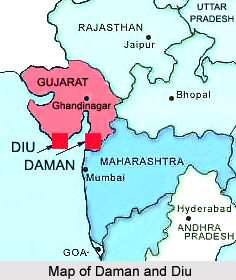
 Thar Desert in India is a large, arid region located in the north-western part of the Indian subcontinent. The Desert is also popularly known as the Great Indian Desert and is spread across a huge area of more than 200,000 square kilometres. The desert is considered to be the seventh largest desert in the world and it lies mostly in the Indian state of Rajasthan. The desert also extends into the southern portion of Haryana and Punjab states and into the northern part of Gujarat. A portion of the desert is located in Pakistan.
Origin of Thar Desert in India
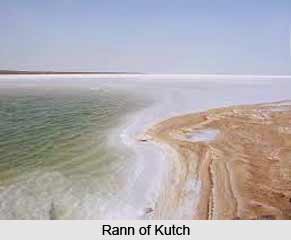
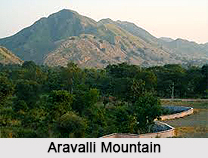
The Thar Desert in India is believed to be 4,000 to 10,000 years old and is bounded on the north-west by the Sutlej River and on the east by the Aravalli Mountain Ranges. The desert is also bounded on the south by the salt marsh known as the Rann of Kutch district, and on the west by the Indus Valley. The desert receives a very little annual rainfall of between 100mm and 500 mm during the months of July to September. The average temperature in the Thar Desert ranges between 24 degrees to 26 degree Celsius during summer and between 4Aø - 10AøC, during winter. A number of studies have been conducted so far in this desert and most of the studies found that the palaeo channels of the Saraswati River coincide with the bed of present day Ghaggar River, in this desert. The studies also believe that the Sutlej along with the Yamuna once flowed into the present Ghaggar river bed.
Description of Thar Desert in India
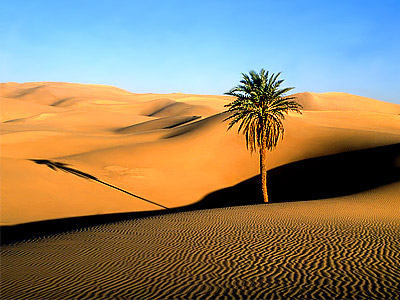
The Thar Desert in India contains three principal landforms, namely the predominantly sand covered Thar; the plains with hills including the central dune free country; and the Hills. The soils of the Arid Zone in this desert are generally sandy to sandy-loam in texture and the consistency and depth, vary according to the topographical features. The low-lying loams are heavier and likely to have a hard pan of clay, calcium carbonate (CaCO3) or gypsum. The soils usually improve in fertility from west and northwest to east and northeast. The desert soils are actually Regosols of wind blown sand and sandy fluiratile deposits. The Thar Desert in India mainly consists of the wind-blown sand and the area is covered not only by sheet of sand but also by the rocky projections of low elevations that constitute the older rocks of the country. Water is scarce in the desert and can only be found at great depths, from 30 to 120 m below the ground level.
The natural vegetation in the Thar Desert in India is classified as the Northern Desert Thorn Forest. The plant species found in this desert occur in small clumps scattered in a more or less open forms.
Tree Species of Thar Desert in India
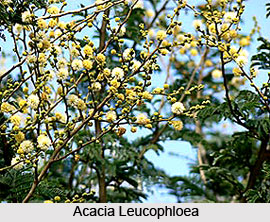
The density and size of patches increase from West to East following the increase in rainfall. The natural vegetation of Thar Desert is composed of the tree species like Acacia jacquemontii, Acacia leucophloea, Acacia senegal, Anogeissus rotundifolia, Prosopis cineraria, Salvadora oleoides, Tecomella undulata, Tamarix articulata, etc. The prominent small tree and shrubs found in the Thar Desert include the species like Calligonum polygonoides, Acacia jacquemontii, Balanites roxburghii, Ziziphus zizyphus, Ziziphus nummularia, Calotropis procera, Suaeda fruticosa, Crotalaria burhia, Aerva tomentosa, Clerodendrum multiflorum, Leptadenia pyrotechnica, Lycium barbarum, Grewia populifolia, Commiphora mukul, Euphorbia neriifolia, Cordia rothii, Maytenus emarginata, Capparis decidua. Apart from these, a large number of Herb species can also be found in this desert.
Biodiversity of Thar Desert in India
The Thar Desert in India is rich in biodiversity and is home to several flora and fauna species. The desert provides habitat to about 23 species of lizards and 25 kinds of snakes and several of them are endemic to the region. Apart from these, some endangered animals in other parts of India, also inhabit here. These animals include the Great Indian Bustard, the Black Buck, the Indian Gazelle or Chinkara, and the Wild Ass in the Rann of Kutch, etc.
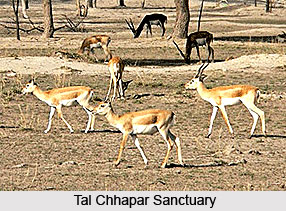
The Thar Desert in India houses a few famous and important National Parks including the Desert National Park, Jaisalmer. The species like Desert Fox, Bengal Fox, Wolf, Desert Cat etc. can be easily seen in this Park. The seashells and massive fossilised tree trunks in this park record the geological history of the desert. Apart from the Desert National Park, the Tal Chhapar Sanctuary is also a small sanctuary, located in Churu District, 210 km from Jaipur, in the Shekhawati region. This sanctuary is home to a large population of graceful Blackbuck.
Agriculture of Thar Desert in India
The main occupation of the people living here is agriculture and animal husbandry. The agricultural production is mainly derived from the Kharif crops. They are grown in the summer season and are seeded in the months of June and July. These crops are harvested in the months of September and October. Bajra, pulses, jowar (Sorghum vulgare), maize (zea mays), sesame and groundnuts are generally harvested crops.