Dams in Karnataka - Informative & researched article on Dams in Karnataka
  Indianetzone: Largest Free Encyclopedia of India with thousand of articles Geography of India


in  
Art & Culture | Entertainment | Health | Reference | Sports | Society | Travel
Forum  | RSS Feeds  | Free E-magazine
Geography of India : Indian Climate l Indian Mountains l Indian Forests l Indian Soil l Indian Vegetation l Animal Husbandry in India l Resources in India l Indian Demography l Indian Industries l Indian Islands l Indian Airports l Zoos in India l Indian Mines & Minerals l Indian Physiography l Indian Transport l Indian Geology l Communication in India l Indian Trade l Indian Astronomers l Indian Telecommunications
Home > Reference > Geography of India > Resources in India > Water Resources in India > Dams of India > Dams in Karnataka
Dams in Karnataka
Dams in Karnataka provide water to different parts of the state, control flood and help in power generation.
  Tunga Bhadra Dam   Supa Dam   Narayanpur Dam
  Linganamakki dam   Krishna Raja Sagara Dam   Kodasalli Dam
  Kadra Dam   Harangi Dam   Basava Sagara Dam
  Alamatti Dam   Ghataprabha Reservoir   Hemavathi Reservoir
  Kabini Reservoir      

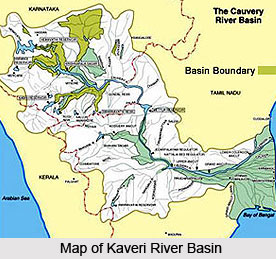
Dams in Karnataka are constructed over several rivers flowing in the south Indian state. In this state, nine rivers flow in different places and the water of these rivers with the help of dams are utilized for the purposes like irrigation, drinking and hydel power generation, etc. Karnataka is among the four south Indian states having its border as the Arabian Sea to the west. The other neighbors are the states of Maharashtra, Goa, Andhra Pradesh, Kerala and Tamil Nadu.

Ghataprabha is a reservoir constructed over the Ghataprabha River in the state of Karnataka. The objective of constructing this reservoir across Ghataprabha River was to store water for irrigational purpose. The first stage started in the year, 1897 and comprised a 71 km long left bank canal from the Dupdal weir across Ghataprabha River near Dupdhal in Gokak canal for providing irrigation to an extent of 0.425 lakh hectares. The second stage of construction of the reservoir comprised left bank canal from the Dupdal weir from 72 kilometers to its full length extension of 109 kilometers across Ghataprabha River, near Hidkal, upto a height of 650.14 meters. The Ghataprabha reservoir has a storage capacity of about 659 Mcum for providing irrigation to a total extent of 1.396 lakh hectares of land, inclusive of the area under stage I. The third stage of the project includes raising the FRL of Hidkal dam to its final level of RL 662.94 meters (RL 2175.00 feet). The storage capacity is 1448 Mcum, which is channelised into 202 kilometers long Right Bank Canal and 86 kilometers long Chickkodi Branch Canal in order to irrigate 191386 hectares of land bringing the total area under the project to 3.31 lakh hectares of land. The Ghataprabha reservoir is a composite dam, 53.34 meters high and 10183 long.

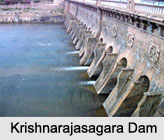
Krishnarajasagara DamKrishnarajasagara Dam is famously known as KRS and is situated at a distance of about 12 kilometers from Srirangapatna in the district of Mandya in Karnataka. The remarkable dam is skillfully constructed across the Cauvery River and it is located in close proximity to Mysore. Dr M Visvesvaraya, the architect of Krishnarajasagara Dam designed the dam with utmost expertise. The dam features 130 ft height and 152 sluice gates. Apart from serving as a vast reservoir, the Krishnarajasagara Dam is also a well-known tourist destination. The famous Brindavan Gardens is situated on the patio of the Krishnarajasagara Dam. These gardens are very elegantly decorated and have several colorful fountains. These fountains are normally decorated with lights, making it a visual treat for the viewers every evening. The closest airport terminal from this dam is the Bangalore International Airport.

Another dam situated in the state of Karnataka is the Alamatti dam. This dam stands across the Krishna River. It benefits the states of Karnataka, Andhra Pradesh and Maharashtra. The Basava Sagara is a dam and reservoir in Karnataka. The Basava Sagar Dam is built on the Krishna River and it is situated at Narayanapur in the district of Gulbarga. This dam is one of the most valuable dams in Karnataka state which is helpful in irrigation. It is also one of the major irrigation projects in the basins of Krishna and Godavari River.

The Linganamakki dam stands across the Sharavathi River in the state of Karnataka. The State Government of Karnataka erected the Linganamakki dam in the year 1964. This dam was situated in the premises of Sagara taluk. It has a length of 2.4 kilometers, extending across the Sharavathi River. The Linganamakki dam is also a tourist attraction, owing to the Jog Falls which is at a distance of about 6 kilometers from the site of this dam. The dam was designed to hold 4368 million cubic meter of water in an area of around 300 km, submerging 50.62 km of swamp land and 7 km of arid land, with the remaining being wasteland and forest land. The dam rises to a height of 1819 feet above sea level. The Linganamakki dam receives water mainly from rainfall and also from the Savahaklu and Chakra reservoirs, which are linked through Linganamakki through a canal. The water from the Linganamakki dam flows through a trapezoidal canal into the Talakalale Balancing Reservoir. The discharge capacity of this canal is around 175.56 cumecs. This channel is about 4318.40 meters long with a submersion of 7.77 km. Encompassing a catchment area of about 46.60 km, the gross capacity of the reservoir is 129.60 cu meters. There is a large reservoir behind the dam and the discharge from the dam can be quite heavy. Many tourists also visit this spot, when the dam`s sluice gates are kept open. While the gates are closed upstream from Jog Falls, often nature lovers walk down into the fall`s ravine. The dam generates 227.5 MW power.

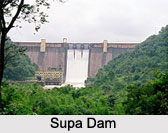
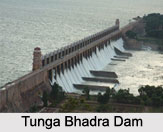
Standing across the Kalinadi (Kannada) or the Kali River, Supa Dam is a very important reservoir in the Indian state of Karnataka. The Supa dam is situated in Joida taluk of the district of Uttara Kannada. The main objective of building this dam was to generate power. Karnataka Power Corporation had constructed this dam and the electric power generating station successfully serves the purpose of a Hydroelectric Power station. A powerhouse is installed at the foot of the Supa dam, along with two electricity generators with a capacity of fifty megawatt each. The electricity generated by this dam is supplied to different parts of the state of Karnataka. The dam is built and maneuvered by Karnataka Power Corporation Limited. The powerhouse was approved in the year 1985. Another notable dam in Karnataka is the Kadra Dam. This dam is located in the Uttara Kannada district of Karnataka. It stands on the River Kalinadi. The basic objective to construct this dam was to start about a hydroelectric project for the supply of water to turbines of electric power generating station. KPCL completed the project. The Tungabhadra project is a joint venture of the states of Andhra Pradesh and Karnataka. The Tungabhadra dam is 2441 metres in length and 49.38 metres in height and it is built on the River Tungabhadra at Mullapuram in the district of Bellary, about 4.8 kilometers from Hospet.

Harangi DamOver the Kabini River, the Kabini Reservoir Project was designed. It is close to Bidarahally and Beechana halli in Heggadadevanakote Taluk, in the district of Mysore with canals on both the banks. However, apart from this particular dam, the project plan also includes a reservoir across Bandigadu stream near Sagaredoddakere in Heggadadevanakote taluk with canals on either bank. Arrangements were made for lifting 28.00 TMC of water in four monsoon months from the foreshore of Kabini Dam to the combined system of Sagaredoddakere and Upper Nugu Dams. One of the well-known dams in Karnataka state is the Harangi Dam. This is a large and impressive dam built on the Cauvery River in tranquil and unruffled surroundings. The dam is an ideal picnic spot and there are some short walks along selected paths. It is a beautiful reservoir cuddled in north Kodagu, in the district of Kodagu in Karnataka. Harangi Dam is placed at a distance of 36 kilometers from Madikeri. The length of this dam is 846 meters and its height if 47 meters. It is the main picnic spot in Dubare and the forest of Dubare surrounds the dam. The offshoot of River Kaveri in Karnataka is close to this dam, which lies near Kushalnagar. One can access its beauty when the reservoir is fully filled with water during the monsoon period, primarily in the months August and September. The site of the dam is best known for its quiet environment, beauty of calm and gentle breeze. Guesthouse facilities are available for tourists near the Harangi Dam, looking for settling calmly for a night on reservation from the public works department.

Situated in the district of Gulbarga in Karnataka state, the Narayanpur Dam is built on the River Krishna. The construction of Narayanpur Dam was done in the form of earthen dam, which included 9, 00,000 cubic meters of embankment, non-overflow masonry dam, 5 blocks of additional spillway and 25 blocks of main spillway. Moreover, 2, 50,000 cubic meters of pre-chilled concrete were also poured to make the construction flawless. The casting of the deck slab for the bridge at a rate of one span per week was the incredible achievement while building this dam.

The Hemavati reservoir is impounded behind the Gorur Dam, which is located at a distance of about 12 kilometers from Hassan to Arakalagud. Hemavathi Reservoir is also a pilgrim spot, owing to the notable temples located in close proximity to the site. The temple of Yoganarasimha, situated in the vicinity is the center of devotion. This town is a devotee of Goruru Ramaswamy Iyengar, who has been an admired personality to the Kannada Literary World. At the entrance of Gorur Dam, the Paravasudeva Temple is also situated. In both the temples daily rituals of Puja is performed and the annual car festivals take place, which is a star attraction for the tourists.

Kodasalli Dam is built across the River Kali in the state of Karnataka. The River Kali is also known as the Kali nadi which flows in Joida taluk in the district of Uttara Kannada. Karnataka Power Corporation had constructed this dam and the electric power generating station successfully serves the purpose of a Hydroelectric Power station. The Kodasalli Power house is situated on the right bank of the Kodasalli Dam. This powerhouse utilizes an average yield of 647 M cum of water. The project generates approximately 512 MU of energy per annum with three Kaplan turbines coupled to the 40 MW generating units. The generating units measure a design head of 37 metres. Dams in the state of Karnataka not only facilitate the availability of water to all quarters of the state, but are also the site for power generation. Most of the dams in this state are also important tourist destinations because of the presence of temples and other attractions situated in their vicinity.

(Last Updated on : 12/10/2009)
  More on Dams of India...
 
Dams In Andhra Pradesh Dams In Gujarat Dams In Himachal Pradesh
Dams Of Jammu & Kashmir Dams In Jharkhand Dams in Karnataka
Dams In Kerala Dams in Maharashtra Dams In Orissa
Dams In Tamil Nadu Dams In Uttar Pradesh Dams In Uttarakhand
Dams In Madhya Pradesh Damodar Valley Project Bhakra-Nangal Project
Tungabhadra Project    
Recently Updated Articles in Geography of India
  • Hydroelectricity in India
    Hydroelectricity is produced in several parts of the country. India is regarded a big potential as far as the generation of hydro-electric powers is concerned.
  •  
  • Copper Ore in India
    Copper ore reserves are found in various regions of the country. Several states like Bihar, Karnataka, Madhya Pradesh and Rajasthan accounts for a huge portion of the total output of copper ore of India.
  •  
  • Iron Ore in India
    Iron ore is found abundantly in the country. In fact, India is considered as one of the rich iron ore reserves.
  •  
  • Desert Soils
    Desert Soils are mainly of sandy quality as they contain very less content of clay. Rajasthan desert are mainly surrounded by desert soils.
  •  
E-mail this Article | Post a Comment
Free E-magazine
Subscribe to Free
E-Magazine on Geography of India

 
Dams in Karnataka - Informative & researched article on Dams in Karnataka
Sitemap
Contact Us   |   RSS Feeds
Copyright © 2008 Jupiter Infomedia Pvt. Ltd. All rights reserved including the right to reproduce the contents in whole or in part in any form or medium without the express written permission of Jupiter Infomedia Pvt. Ltd.