Introduction
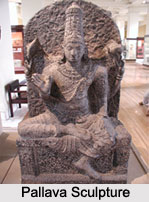 Pallava sculptures came into being from the 4th to 9th centuries. It was during the Pallava reign that the rock cut architecture flourished. The earliest specimens of Pallava art and architecture dated back to the 610 to 690 AD. The other temples, on the other hand, were constructed from 690 to 900 AD. In fact, the rock cut caves also came into trend during the Pallava Empire. For the first time the, a predominant feature of the South Indian temples, were fast replaced by the innovative rock architecture and sculptures.
History of Pallava sculptures
Sangam Period"s traditional Manimekalai, features the beginning of the first Pallava King from a connection between the daughter of Naga king of Manipallava, named Pilli Valai with a Chola king Killivalavan. One more description states that "Pallava" was born from the union of the Brahmin Ashvatthama with a Naga Princess also supposedly supported in the sixth verse of the Bahur plates. The Pallavas themselves claimed to move down from Brahma and Ashvatthama. Although to the Manimekalai posits, Ilam Tiriyan as a Chola, not a Pallava, the Velurpalaiyam plates dated to 852, do not bring up the Cholas.
Various Pallava Sculptures
The Pallavas initiated the skill of excavating temples from the rock. In fact, the Dravidian style of temple architecture began with the Pallava rule. It was a regular development starting from the cave temples to monumental rathas and concluded in structural temples. The growth of temple architecture under the Pallavas can be seen in 4 stages. Mahendravarman I introduced the rock-cut temples. This style of Pallava temples are seen at places like Mandagappattu, Mahendravadi, Mamandur, Dalavanur, Tiruchirappalli, Vallam, Siyamangalam and Tirukalukkunram pallava art. The second stage of Pallava architecture is represented by the monolithic rathas and Mandapas found at Mamallapuram. Narasimhavarman I took the recognition for these magnificent architectural monuments. The five rathas, generally called as the Panchapanadava rathas signifies five diverse styles of temple architecture. The mandapas enclose stunning sculptures on its walls.
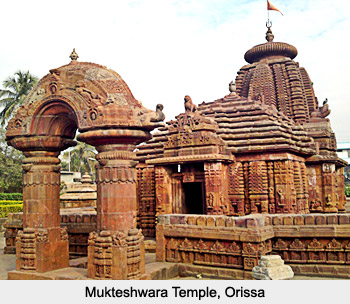
The last stage of the Pallava art is also represented by structural temples built by the later Pallavas. The Vaikundaperumal temple, Muktheeswara temple and Matagenswara temples at Kanchipuram belong to this stage of structural design. The Pallavas were involved in the evolution from rock-cut architecture to stone temples. The earliest examples of Pallava constructions are rock-cut temples dating from 610 to 690 and structural temples between 690 to 900. A number of rock-cut cave temples bear the message of the Pallava king, Mahendravarman I and his descendants. The Kailasanatha temple in Kanchipuram and the Shore Temple built by Narasimhavarman II, rock cut temple in Mahendravadi by Mahendravarman are fine examples of the Pallava style temples.
Features of Pallava Sculptures
The features of Pallava sculptures are identical to the Dravidian art and sculpture. It was during the reign of the Pallavas that the rock cut architecture was replaced by stone structures. The detailed sculptures and the colossal temples stand tall even today and bear testimony to the artistic wizardry of the age. The temples at Kanchipuram and Mahabalipuram are some of the finest examples of Pallava architecture. As far as sculpture and architecture are concerned they were mainly concentrated to religion. The sculptures were mainly carved out of granite that is considered one of the hardest rocks.
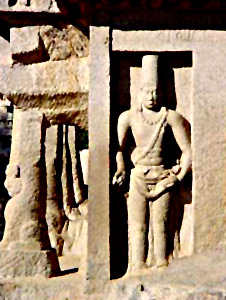 Inspite of being influenced by the Dravidian style the Pallava architecture and sculpture evolved its own set of features as well. the temples that were built have big forms, the anatomy of the sculpted figures were plain and simple, less ornamentation, elongated faces with large eyes, thick lips, double chin, broad nose and others were common features for the sculptures.
As far as the Pallava temple sculptures are concerned the figures of mythological gods and goddesses, elephants and warriors are found on the temple walls. The black coloured Goddess Kali as the destroyer is also seen. Besides these the image of Lord Shiva is also a popular motif. The sculpture of Kailashanath temple at Kanchipuram is a fine example to get acquainted with the features of Pallava sculptures and architecture. Apart from this there is the Shore Temple at Mahabalipuram has also been built on the Pallava idiom. Pallava art also travelled to South East Asia. The features of this style are evident from the Temple of Angkor Vat in Cambodia.
Pallava Bronze Sculptures
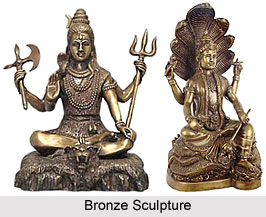
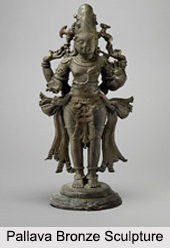 Pallava bronze sculptures were staunch Shaivites and dedicated various forms of Shiva in temple complex. The bronze sculptures built by the early Pallavas were very small in size. Pallavas developed the Shaivite iconography and they also worshipped Lord Vishnu. They utilised their remarkable wealth earned through their wide-ranging conquests in building long-lasting stone temples and wonderful bronze sculptures.
Features of Pallava Bronze Sculptures : During the Pallava period, metal sculpture strongly followed the principles of contemporary stone sculpture. Most of the Bronze sculptures were less than one foot high and the figures were natural in pose and moulding. The faces of these Bronze sculptures were slightly taller and broad with a flat nose and double chin. The front of the torso of these sculptures was almost flat and the emblems were as a rule either held naturally in the hand or placed just above them.
The "kirita" or headdress of these bronze sculptures is usually cylindrical, the "hara" or necklace is rather simple in shape and their number is not more than one or two. There is no trace of the metal images of the early phase of the Pallava period as at that time the rituals were very simple. After the 8th century, the bronze started appearing from time to time. The Bronze sculptures of the Pallavas have rounded and chubby face with distinct features, fleshy nose, almond-like eyes, naturalistic eyebrows and tender lips with a smile.
Prominent Bronze Sculptures of Pallavas : Few of the bronze sculptures of Pallavas include the Vishnu as Srinivasa from Peruntottam in the Mayavaram region of Thanjavur district. This bronze sculpture of Vishnu is said to be the earliest of the bronzes of the Pallava period. The recent study of Vishnu forms discloses him with four hands, the upper left carrying a conch (sankha) and the right carrying the "chakra" (discus) while the lower right in the "abhaya" (protection) form and left resting on the hip. He is represented with two spouses; one being Sridevi (Goddess of prosperity), identified as Goddess Lakshmi, and the other is Bhudevi (Earth Goddess). Both these goddesses are shown standing on the right and left sides of Vishnu, each having a pair of arms, while one carries the flower, the other hangs freely. The Devis are shown wearing the prominent elbow ornaments of like the simple conch and striped lower garment. The discus of Srinivasa, the girdle of Srinivasa, the "padmas" (lotuses) of the deities with naturalistically rendered petals and the characteristic modelling of Srinivasa with a majestic torso with somewhat proportionate legs as well as the slender and beautiful rendering of the Devis identify these sculptures belonging to the Pallava period.
The Vishnu sculpture, now situated in the Indian museum, Kolkata belongs to a slightly later period and it is supposed to hail from the Mayavaram region. Some other bronze sculptures of the Pallava period include the standing Vishnu (9.5 centimetres tall) from Valududaiyur, hamlet in Adikudi in Tiruchirapalli district and the gold-plated Maithreya from Melayur in Thanjavur district 39.5 centimetres in height. All the details of these sculptures represent the characteristic style of this period. The Pallava bronze belong mainly to the Mayavaram region and are mostly Vishnu images except for the Maithreya, but the latter has many points in correspondence with the former. The first stone and mortar temples of South India were constructed during Pallava rule and were based on earlier brick and timber first of its kinds. Pallava sculptors later adapted to free-standing structural shrines which inspired Chola temples of a later age. Some of the best examples of Pallava art are the Kailasanathar Temple at Kanchipuram, the Shore Temple and the Pancha Rathas of Mahabalipuram. Akshara was the greatest sculptor of their time.