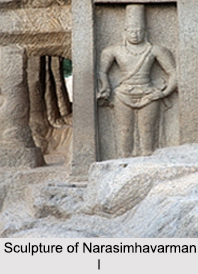
 The famous, Shore Temple in Mamallapuram, the sea-side town, near Chennai, is a very popular tourist destinations in South India, as to citizens of Chennai this little town gives them a break from the hush and puff of the metro life. Well besides this, Mamallapuram has a very interesting history that dates back to 630 A.D. This town got its name from a title of the great Pallava emperor Narasimhavarman I, who was affectionately called Mamalla because he was a great wrestler. The word malla in Sanskrit means wrestler and his passion for and excellence in this sport earned him this title.
Narasimhavarman succeeded his father the illustrious king Mahendravarman I to the throne at Kanchi, the Pallava capital city, in 630 A.D., one of the first daring exploits of this great warrior was to wreak revenge on the famous Chalukyan ruler Pulakesin II who had defeated his father and ventured far into the Pallava territory. His army marched to Vatapi (Badami, in present-day Karnataka), defeated Pulakesin and razed his capital to the ground. Acquiring victory Narasimhavarman returned to his capital, assumed the title Vatapikondan (captor of Vatapi).
Narasimhavarman is commemorated today, not for his conquests, but for his contribution to the art and architecture of Tamil Nadu. The port-city of Mamallapuram was converted into an Eldorado for architects and sculptors, who were allowed to give full vent to their artistic imagination. Mamalla continued in the tradition set by his father in excavating cave temples and the numerous cave-shrines seen at Mamallapuram belong to his reign. He went a step ahead and chiselled small shrines out of solid rock and these monolithic temples have come to be called rathas. Also of his reign is an enormous sculpted panel known as Arjuna`s Penance, the largest bas-relief sculptural panel in the whole of Asia.