
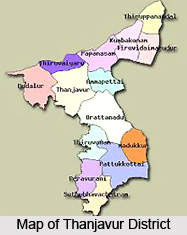
 Thanjavur district is the rice bowl of the state of Tamil Nadu. The Big Temple and a number of other major temples in the district are known all over the world. The district of Thanjavur used to be the cultural capital of the country in 1790. It gained prominence during the period of the Chola Kings, who made Thanjavur their capital. Thereafter, it was ruled by the Nayakas and the Maratha Kings, who nurtured art and culture. The cultural, the architectural and the scholarly pursuits of these rulers are seen in the great monuments like Grand Anaicut, Big Temple and the Serfoji Mahal Library in the district. This district enjoys a fairly healthy climate which facilitates the visit of a large number of tourists to this district throughout the year.
Thanjavur District
Thanjavur District is considered to be the ‘Rice Bowl’ of Tamil Nadu and it is also called the granary of south India. One of the famous temples in this district is the Sri Brahadeeswarar temple.
Introduction
Thanjavur district is the rice bowl of the state of Tamil Nadu. The Big Temple and a number of other major temples in the district are known all over the world. The district of Thanjavur used to be the cultural capital of the country in 1790. It gained prominence during the period of the Chola Kings, who made Thanjavur their capital. Thereafter, it was ruled by the Nayakas and the Maratha Kings, who nurtured art and culture. The cultural, the architectural and the scholarly pursuits of these rulers are seen in the great monuments like Grand Anaicut, Big Temple and the Serfoji Mahal Library in the district. This district enjoys a fairly healthy climate which facilitates the visit of a large number of tourists to this district throughout the year.History of Thanjavur District
 History of Thanjavur district deals with the rule of the Cholas, the Pandyas, the Nayakas, the Marathas and also the British. The district of Thanjavur district stands unique from a long time due to its agricultural works and is rightly called the granary of the south India lying in the deltaic region of the famous River Kaveri and intersected by lengthy network of irrigation canals. The Thanjavur district abounds in tall coconut groves, vast gardens of mango, green paddy fields and plantain trees and a number of other verdant vegetation.
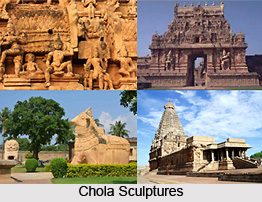
The district of Thanjavur attained prominence under the rulers of the Chola dynasty who were regarded as the paramount in South India in the ninth and the twelfth centuries. They were excellent rulers as well as mighty builders, who erected a large number of exquisite temples in their empire, some of which are the finest specimens of architecture. Hence this district has a distinct identity in the state even in its large number of temples, whose legends extend deep into early historic times. Several temples reflect the power, genius and architectural grandeurs of their authors portraying the magnificent and unique proficiency in painting, sculpture and wood carving.
 The period of Chola dynasty was not only regarded as epoch-making but also an era of the cultural renaissance. The district of Thanjavur under the Chola rulers was the cradle of Tamil Culture and the civilization, literature and the rare Tamil manuscripts in the Thanjavur library supports this fact. Another prominent feature is that despite several onslaughts, alien invasions and internal conflicts, the ancient culture and civilization have not suffered much devastation. As per the known history which dates back to the Sangam Age, the Cholas ruled over Thanjavur for nearly one thousand years. It was during their rule over Thanjavur plans were formulated to extent the supremacy of the Cholas by spreading their glory from Kanyakumari in the south to Himalayas in the north. They also, under their patronage cultivated fine arts, constructed anaicuts, erected temples, built ports and cities. Among the Chola Kings whose names are mentioned in the Sangam literature, Koccengan and Karikala were the most prominent.
The Chola dynasty became extinct in the beginning of the thirteenth century and it paved way for the supremacy of the Pandyas. The regime of the Pandiyas was short lived. When the Pandyan kingdom was in the thrones of civil war, the Muslim ruler Ala-Ud-Din Khilji, the Sultan of Delhi, seized the opportunity and over-powered the Pandyas and the Thanjavur district came under the Muslim rulers.
Thanjavur district remained under the control of the Vijayanagar Kings for a long period. During this period the Nayak dynasty was established and Sevappa, the founder of Nayak Kingdom of Thanjavur made his appearance on the scene (1532-1560). In the year 1560, Sevappa Nayak passed the rule of the kingdom to his son Achuyutappa Nayak. His rule, unlike that of his father was not one of unbroken peace and after getting old he abdicated the crown in favour of his son Ragunatha. During his reign, a Danish settlement was established at Tranquebar in 1620. The Nayaks of Thanjavur remained loyal to Vijayanagar after the battle of Talikotta and helped the Vijayanagar rulers in repulsing the attacks of the Nayaks of Madurai and their temporary ally Golkonda, but the beginning of the 17th Century saw the end of the Vijayanagar Empire.
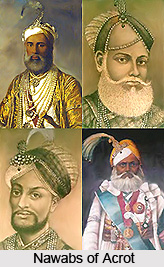
The Marathas came to the Thanjavur district in the later half of the seventeenth century and Ekogi was the first Maratha ruler of Thanjavur. They ruled over Thanjavur for some time but later became vassals of the Mughal Governor of Karnataka. Afterwards there were hostilities between the Nawabs of Arcot and the Maratha ruler of Thanjavur. The English and French also began interfering in the internal affairs of South India and the supremacy of the English was later established. Saraboji II, the adopted son of Tuljaji, was made the King of Thanjavur in the year 1798, after agreeing with all the conditions laid down by the British Government. A pact was signed between the English and the Maratha ruler by virtue of which the status of the Raja was reduced to a mere vassal.
The Thanjavur administration was totally given over to the English under the Treaty of 1799 and the ruler of the Thanjavur was allowed to retain the fort of Thanjavur only with limited power of administration. When the ruler of Thanjavur died in the year 1841 without an heir, the Thanjavur fort was annexed by the British. The district of Thanjavur remained under the British until 1947 when India attained freedom.
Geography of Thanjavur District
The district is located between nine degree fifty minutes and eleven degree twenty five minutes on the North latitude and seventy eight degree forty five minutes and seventy nine degree twenty five minutes to the East longitude. The total area covered by this district of Thanjavur is 3396.57 square kilometers. The maximum temperature experienced by this district is 37.48 degree Celsius and the minimum temperature is 20.82 degree Celsius. The annual rainfall received by this district is 303.1 millimetres from the south-west monsoon and 953.2 millimetres from the north-east monsoon. The total area under cultivation in the district of Thanjavur is 241292 hectares and the major crops grown in this district are rice, millets, groundnut, pulses, cotton, sugarcane, etc.
Climate of Thanjavur District
 The climate of this district in the state of Tamil Nadu is termed as a fairly healthy one like other coastal areas. The month of November, December, January and February are the pleasant months in a year with climate full of warm days and cool nights. From the month of March onwards, the climate becomes sultry and the mercury reaches its peak by the end of May and June depending upon the set of summer rain. The North-East monsoon in the month of October brings complete relief. The South-West monsoon sets in June and continues till the month of September. Rainfall during this period in lower than that of North-East monsoon which sets in the month of October and it continues more or less till the month of February. However, this district is benefited more by North-East monsoon because of its heavy rainfall and the Western Ghats invariably feeds the Kaveri and helps greatly for the vast cultivation of the deltaic area.
The River Kaveri and a number of irrigation projects that have been carried out even from the days of Chola Kings can be regarded as the best irrigation system in the state of Tamil Nadu. In the erinaceous soil tracts in Pattukkottai, facilities of irrigation have been very useful. The requirement for irrigation was realized very early and irrigation systems of this district dates back to days of early Cholas. Today, Thanjavur district possesses one of the best irrigation systems in Tamil Nadu and ranks foremost in the area irrigated. More than seventy percent of the gross cropped area is under irrigation systems from one source or the other. The chief sources of irrigation in the district are rivers, a few rain fed tanks, wells and tubes wells. These wells and tanks located mostly in the upland regions. Kaveri and Coleroon are the major rivers in the district and as these rivers are fed by the south-west monsoon. Agriculture in this district is dependent on the River Kaveri as a majority of the irrigated areas derive water from Kaveri and its numerous branches. Thus, the River Kaveri is the chief source of irrigation in the district.
Temples of Thanjavur District
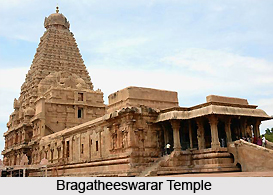 Temples of Thanjavur District in Tail Nadu reflect the marvellous art of the Cholas, Nayaks and the Mahrattas. Thanjavur was the royal district and it derived its name from Tanjan-an asura (giant), who according to local legend devastated the neighbourhood and was killed by Sri Anandavalli Amman and Vishnu, Sri Neelamegapperumal.
There are several temples of Thanjavur District locate in different parts of the district. Bragatheeswarar Temple was build by the Great Chola kings. Also known as Big Temple, it`s an example for the Indian sculptural architecture greatness. This temple is surrounded by moat on two sides and Grand Anaicut River on the other side and the stupa at the top is made of bronze. The walls of the sanctum are covered, with the wall paintings of Chola and Nayak periods, similar to the famous Ajanta cave frescoes. The gigantic statue of Nandi, the Bull guards the inner shrine of the temple.
Puliyur Vyagrapureeswarar Temple and Sikkal Singaravelavar Temple are the two premier temples of Thanjavur District. The former one is also referred as Dhakshina Chidambaram. The latter temple bears the evidences of ancient history saying that here only Lord Murugan got the `Sakthi Vel` from Parvathi and killed Suran. This temple is one of the few temples of Thanjavur District, which has both Siva and Vishnu in the same campus. The `Vel vankuthal` festival in the Tamil month of Iyappasi is very famous here.
Sirkazhi is one of the most visited temples of Thanjavur District, where Goddess Parvathi gave Gnana milk to Thirugnana Sambandar, when he was a child. Lord Shiva as Thoniappar resides in a thoni (boat). The boat symbolizes that Thoniappar helps people cross their sea of birth. The famous Thirumulaippal Utsav is held every year during Thiruvadirai Nakshatra of Chiithirai month. Swamimalai is another temple of Thanjavur District, which is one of the six abodes (Arupadaiveedu) dedicated to Lord Murugan. Lord Murugan preached Pranava mantra "OM" to Lord Shiva and that why he is called Swaminathan. The 60 steps to the temple specify the 60 years of the Tamil calendar.
Thirubuvanam, Thiruvaiyaru, Thiruvarur and Vaitheeswaran Kovil are some of the eminent temples of Thanjavur District. Vaitheeswaran literally means the divine provider of cures; this temple is adorned with imposing towers called the Mandapams and pillars. It is an ancient temple dedicated to Shiva and this shrine is also referred to as an Angarakasthalam. The temples of Thanjavur District are widely known in south India for their ancient traits and historical aspects.
Navagraha Sthalas in Thanjavur District
This lush green district, through which the Cauvery flows, has nine Shiva temples. Each of these enshrines a Navagraha. Six of them are situated on the northern bank of Cauvery and three on the southern bank.
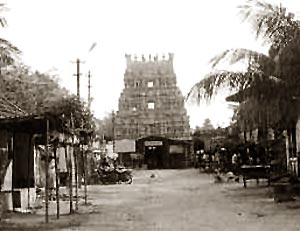 Suryanarcoil: Situated at a distance of 15 kilometers from Kumbakonam this is the only temple in South India dedicated exclusively to Surya (Sun God). In the sanctum, Brihaspati is depicted as worshipping Lord Shiva Suryanarayana. The other planets are enshrined separately.
Thingalore (3 km from Thiruvaiyaru): According to legends Chandra worshipped Lord Kailasanatha here. In the months of Purattasi (Sept-Oct) and Panguni (March-April), Moon`s rays fall on the Lingam. Shaivite saint Appar revived Saint Appoothi Adigal`s son, who died of snake bite, by singing in praise of the Lord at this particular site.
Vaitheeswarancoil (6 km from Sirkali): The presiding deity, Sri Vaidyanathaswamy, is hailed as the healer of all ills. The Lord came here as a Vaidya or doctor and cured Angaraha of leprosy. Among the Navagrahas, Angaraha is worshipped here with great reverence. Hence this shrine is also known as Angaraha Kshetra.
It is also staunchly believed that Jatayu, Rig Veda, Muruga and Surya worshipped the Lord here. There is a shrine dedicated to Muruga who obtained the trident here. He is known as Selvamuthu Kumarar.
Neem tree is the Sthala Vriksha here. The Jatayu Kundam in the southern prakaram is considered to be the spot where Sri Rama performed the last rites of Jatayu.
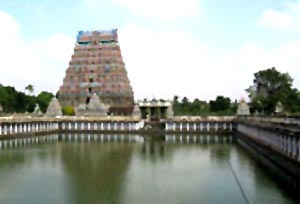 Thiruvengadu (10 km from Vaitheeswarancoil): The Shiva shrine here is dedicated to Sri Swetaranyeswara. The Goddess is Brahma Vidyambika. Legends glorify this place as Swetaranyam, Adi Chidambaram and Nava Nritta Sthala.
Buddha, the bestower of knowledge, has a separate shrine. Wednesdays are auspicious days of worship.
What make the image of the god worth seeing is that it has 5 faces - Easanam, Tatpurusham, Aghoram, Vamadevam and Satyojatam. According to Purana tales the Lord assumed the form of Aghoramurti, the furious aspect of God, to vanquish demon Maruthwasura. The Lord also saved a devotee named Swetaketu from the clutches of Yama. For the sake of this devotee, Shiva danced all His seven Tandavas - Anand, Sandhya, Samharam, Tripuranda, Urdhva, Bhujanga and Lalitha.
There are separate shrines for Bhadrakali, Ashtalakshmi and Nataraja. Agni, Chandra and Surya Theerthams in the temple are considered holy.
Shaivite saints Meikandar, Appar, Sundarar, Sambandar and Pattinathar have sung in praise of the Lord.
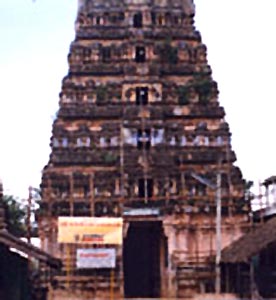 Alangudi (6 km from Needamangalam): The presiding deity here is Sri Abathsagayeswara or Aranyeswara, a Swayambu Lingam, and the Goddess is Umai Ammai. There is a separate sanctum for the special deity Sri Dakshinamurthi. Being a Guru Kshetra, Thursdays attract a large number of pilgrims and special poojas are performed. There are about 15 Theerthams in the temple.
Kanchanur (3 km from Suryanarcoil): Lord Vishnu worshipped Agniswara, the presiding deity here, to rid Himself of Shukra Dosha. The divine consort is Karpagambal. Fridays are very auspicious and devotees offer white flowers to the Lord.
Thirunallar (5 km from Karaikal): The temple here is dedicated to Sri Dharbaranyeswara. King Nala attained emancipation here from the hardships and miseries to which he was subjected by Sani.
Enshrined within the temple is Saniswara. The devout believed that they could get rid of their curses and the spells of ill fate if they pray in this temple.
Pilgrims usually take a dip in the Nala Theertham and offer worhship at the temple. The worship here includes lighting holy lamps with til (gingelly) seeds and oil. After prayers, balls of cooked rice are offered to the Crow at the mount of Saniswara.
The festival, Sani Peyarchi, which takes place once in two and a half years, attracts thousands of pilgrims. On this day, Saturn moves from one Rasi to another.
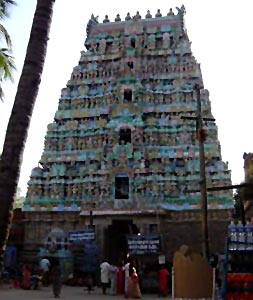 Thirunageswaram (5 km from Kumbakonam): The Shiva temple here is dedicated to Sri Naganathaswamy. His consort is Giri Gujambika, who is enshrined with Lakshmi and Saraswathi by Her side. It is said that Rahu worshipped the Lord here on Sivaratri day to redeem himself from the curse of a sage. Sundays are considered quite auspicious and devotees perform milk abhishekam for Rahu, who is enshrined with His consorts. A noteworthy feature is that the milk turns blue. A dip in Soola Theertham is said to cure one of diseases and give prosperity.
Kizhaperumpallam (near Tarangampadi): Vasuki, the King of Serpents, did penance and worshipped Lord Shiva here. Kethu, considered the bestower of Gyana (knowledge), is worshipped in a separate shrine.
Tourism in Thanjavur District
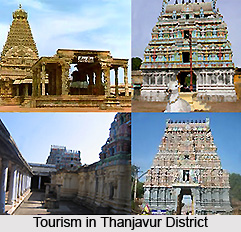 Tourism in Thanjavur district offers various options including the visit to some of the renowned places of interest, a number of places of pilgrimage and several festivals. Some of the major places of worship in this district which also form major tourist attractions include the Sri Brihadeeswarar Temple, Marriamman koil, etc. The Schwartz Church and the St. Mary`s Church are the prominent centers of pilgrimage for the Christians.
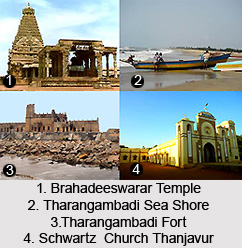
Sri Brahadeeswarar temple in the district of Thanjavur was constructed by the great Chola King; Rajaraja Chola I in the tenth century AD. This is a spectacular example of the Cholas art and architecture. A palace is there situated close to this temple which was constructed partly by the Nayaks around A.D. 1550 and partly by the Marathas. The various other attractions inside the palace are the Art Gallery, Saraswati Mahal Library, Hall of Music, etc. The Schwartz Church is situated in the palace garden which was erected in the A.D. 1779 AD by Rajah Serfoji as a token of his affection for the Rev.C.V.Schwartz of the Danish mission. Another place of interest is the Sivaganga Tank which is closely-located to the palace. This tank is known for its sweet water.
Some of the other temples in this district are the temples of Brahmasirekandeswarar and Harshavimochana Perumal which are of great importance. Kumbakonam is one of the prominent places of tourist interest in this district which possesses the famous Kumbeswarar temple, Sarangapani temple, Nageswara temple and Ramaswamy temple. Here the Mahamagam congregation takes place once in every twelve years. The coastal town of Tharangambadi was earlier a Danish settlement from 1624 to 1825 where two churches and a fort still exist. It is one of the most prominent tourist attractions in the district of Thanjavur.
Swamimalai is one of the six Abodes dedicated to Lord Subramanya and it forms one of the renowned places of Hindu pilgrimage. Thiruvaiyaru is the place where the great Thyagaraja lived and attained eternity. A music festival is held here in the month of January in honour of the saint. Kodikkarai is a famous place which is well-known for its congregation of migratory water fowl, especially flamingoes from November to January. Other wildlife seen at this lace includes blackbuck and wild ponies. One of the major tourist attractions in this district is the Manora. Here the eight story victory tower erected by Rajah Serfoji in the year 1814 draws tourists from different parts of the state as well as from outside throughout the year.
Recently updated articles in States of India
Bandare Waterfalls, Meghalaya
Bandare Waterfalls in South Garo Hills, Meghalaya, is a secluded natural attraction surrounded by dense subtropical forests and rugged mountain terrai...
History of Thissur District
Early History of Thissur District explains flourishing of the port cities. Now these port cities are transformed into archaeological sites.
Tippi Orchid Research Centre, Arunachal Pradesh
Tippi Orchid Research Centre in Arunachal Pradesh is renowned for its rich collection of exotic and endangered orchids. Surrounded by lush rainforest...
Tourism in Nashik District
Pilgrimage tourism in Nashik district involves visiting the various places of Hindu and Jain worship located here. Some of the holiest sites for Hind...
Mangadu, Kerala
Mangadu in Kerala’s Kollam district is a significant megalithic site known for its urn burials, cist burials, menhirs, and stone circles. Excavations...
Related articles in States of India
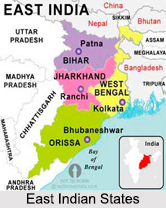
East Indian States
East Indian States comprises of Bihar, Jharkhand, West Bengal, Odisha and also the Union Territory of Andaman and Nicobar Islands. It defines the cult...
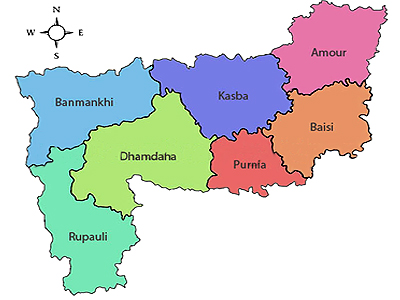
Purnia District in Bihar
Purnia District is located in Bihar and extends from River Ganga to Nepal. The district has a rich Hindu history and glorious past.
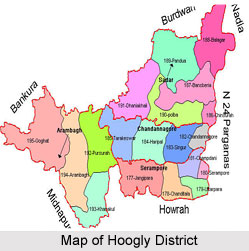
Hooghly district
Hooghly District along the bank of the river Hooghly is one of the principal trading ports of West Bengal.
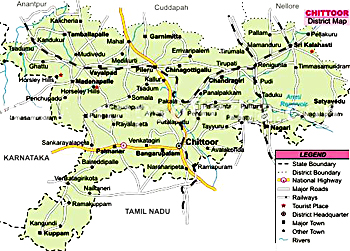
Geography Of Chittoor District
Geography of Chittoor district is spread along the topography of the land which is divided into two natural divisions; Chittoor has a dry and healthy...
Districts of West Bihar
Districts of West Bihar is comprised of medieval monuments that were built by the different governors of Mughal era.