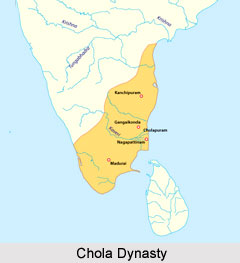
 One of the most remembered period in the history of south India is the period leading to and following the ascent of Nandivarman Pallavamalla to the throne of the imperial Pallavas of Kanchipuram. King Parameshwaravarma II Pallava, who ruled only for a short time before his death in a battle in 731 A.D., left behind his minor son Chitramaya. After his death the entire Pallava kingdom was in a state of chaos and anarchy and the ministers and important men of the realm took the decision of bringing to Kanchipuram, Hiranyavarman Maharaja, a distant royal member of the Pallava dynasty ruling a kingdom far away, to ascend the Pallava throne.
The ministers went to the court of Hiranyavaraman who turned down their request. But, his son Parameshwara, a young boy twelve years of age, decided to go to Kanchi and accompanied this delegation back to the capital city of the Pallavas, where he was coronated as Nandivarman. Since he was the second Nandivarman of the lineage of the Pallavas and since he bore the title Pallavamalla he is known to historians and archaeologists as Nandivarman II Pallavamalla.
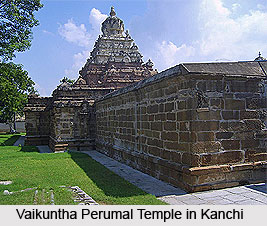
Nandivarman II Pallavamalla enjoyed a very long reign of sixty-five years and fought many battles, of which he won some and also lost a few. The ongoing struggle with the Chalukyas of the Karnataka area continued during his times and the Chalukyan ruler Vikramaditya II invaded Kanchi and defeated Nandivarman. The wars with the Pandyas of Madurai also persisted during this time and it is believed that the Madurai monarchs supported the cause of Chitramaya, son of Parameshwaravarman who had been an infant when his father died. The Pallava general, Udayachandra helped his master win this war and Chitramaya was killed. This king, an ardent Vaishnavite was responsible for the construction of the Vaikuntha Perumal temple in Kanchi, which was originally called Parameshwara Vishnugriham after his name, Parameshwara. He was a contemporary of the Vaishnava saint, trumangai Alvar, who has composed hymns in praise of the deities enshrined in the temple.