Lord Brahma is one of three major Gods in late Vedic Hinduism. He is four-faced as depicted in pictures and sculptures with a crown on each of them. The four Vedas are said to have proceeded from his four heads. He is seated on a lotus and rides on a swan. With the rise of sectarian worship, he was gradually eclipsed by Lord Vishnu and Lord Shiva. Brahma is regarded as the "Father of Dharma". Lord Brahma is to be found to live more in scriptures than in homes and temples.
Origin of Lord Brahma
According to Mythology, Lord Brahma is the son of God, and often referred to as Prajapati. The Shatapatha Brahman says that Brahma was born from the Ultimate Being Brahman and the female energy known as "Maya". According to legends, Lord Brahman first created the water, in which he placed his seed. This seed converted into a golden egg, from which Brahma appeared. For this reason, Lord Brahma is also known as "Hiranyagarbha". According to another myth, Brahma is self-born out of a lotus flower which grew from the navel of Lord Vishnu.
 Iconography of Lord Brahma
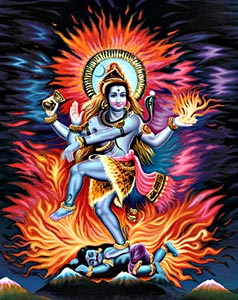
In Mythology, Lord Brahma at first had 5 heads. One of them was cut down by Lord Shiva in his anger. Now, Brahma"s icon has 4 heads (Chatur Mukha Brahma). They stand for the four Vedas (Rig, Yajur, Sama, Atharva), the four Yugas (Satya, Treta, Dwapara, Kali) and the four Varnas (Brahmana, Kshatriya, Vaisya, Sudra). The faces have beards with eyes closed in meditation. There are four arms holding up diverse objects:
•Akshamala (rosary)
•Kurcha (kusha grass)
•Sruk (ladle)
•Sruva (spoon)
•Kamandala (water pot)
•Pustaka (book)
 Akshamala represents time; Kamandala represents waters of all formation. The Pustaka (books) represents the religious and secular knowledge. Hand postures (mudras) are abhaya (protector) and varada (giver of boons). The icon may be in standing posture on a lotus or in sitting posture on a hamsa (swan). Hamsa stands for wisdom and prejudice. Brahma is also shown riding a chariot drawn by seven swans, representing the seven worlds.
Lord Brahma and his Creation
According to Mythology, Lord Brahma created the four types: Gods, demons, ancestors and men. Brahma then made all living creatures upon the earth. The demons were born from Brahma"s thigh and so he deserted his own body which became the Night then. After Brahma created Gods, he abandoned his body again, which then became Day. Therefore, demons gain the power at night and Gods rule in day. Lord Brahma then created ancestors and men, each time again abandoning his body. This development of formation repeats itself in every era. Brahma then appointed Shiva to rule over humanity.
In the legend told in the Mahabharata, Lord Brahma created women. Gods feared that men could become so controlling that they might challenge their control, so they asked Lord Brahma to stop this. Brahma"s response was to create women. In another myth, Brahma"s first female was also Death, the evil force which brings the stability to the universe. The figure of Death is appealingly described in the Mahabharata as a dark woman.
 Myths for not Worshipping Lord Brahma
According to legends, Lord Brahma created a woman in order to help him in his creation named "Shatarupa". She was so beautiful that Lord Brahma became obsessed with her, and watched her wherever she went. This caused her extreme humiliation. Wherever she moved, Lord Brahma developed a head until he had created four. Finally, Shatarupa grew so frustrated that she jumped to avoid his gaze. Brahma, in his fascination, developed the fifth head on top of all. Shatarupa kept changing her form as she had the power to attain 100 forms. She became every creature on the earth to avoid Lord Brahma. Lord Shiva rebuked Brahma for signifying behaviour of an incestuous nature and chopped off his fifth head for "unholy" deeds. Since Brahma had diverted his mind from the soul, Shiva"s curse was that people should not worship Lord Brahma. As a form of shame, it is believed that Brahma has been repeatedly reciting the four Vedas since this instance.
Another myth says that there was a war between Brahma and Vishnu to prove who is greater between them, and who should be worshipped former. In order to win that competition, Lord Brahma spoke a lie and tried to trap Lord Vishnu. On seeing this, Lord Shiva appeared and chopped his fifth head Brahma and cursed him not be worshipped.
Temples of Lord Brahma
Very few temples in India are principally dedicated to Lord Brahma and his devotion. The most famous temple for Lord Brahma is the Brahma Temple in Pushkar. Other temples of Lord Brahma in India are Kheteshwar Brahmadham Tirtha in Rajasthan, Thripaya Trimurti Temple, Mithrananthapuram Trimurti Temple, Brahmapureeswarar Temple, Brahma Temple at Bengaluru, Brahma Kuti Temple in Kanpur, etc.