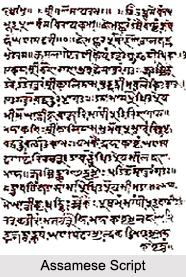
 Assamese literature, just like the umpteen other Indian literatures of every region, possesses its own distinct way of differences in every genre. For instance, early Assamese literature was yet to flower from its aboriginal influence of ancient Indian languages. However, inscriptions were the ones that had been lent foremost importance. Then again, Middle Assamese literature began to egress forth the slow betterment of literature in its umpteen genres, also including domains of education and subjects of scientific knowledge.
Influences on Assamese Literature
Assamese literature had been incredibly fortunate to constant patronage and backing of the ruling kings and dynasties of the erstwhile Assam state. Each reigning sovereign were forever eager to take interest in literature in every kind, beginning from prose and perhaps ending in other forms of writing. The excavated evidences of such etchings still bear gloriousness to modern Assamese literature. However, administrational policies during the colonial rule under the domineering Britishers, had rested its profound influence, for once creating an almost vacuum in the literary scenario. In this context, the Middle Assamese literature had likewise, been swayed by the legendary Bhakti Movement, and its consequent overflow of Vaishnavism. Assamese literature also had significantly borrowed from Bengali language, believed to be a separate fraction of one and the same language structure.
History of Assamese Literature
History of Assamese literature can largely be classified into three periods, including: Early Assamese period, Middle Assamese period and Modern Assamese period.
Ancient Era (950-1300 AD): While visiting Kamrupa in seventh century, Xuanzang noted that the language of the region was slightly different from the language of Middle India (Magadha). He was able to identify the phonetic differences evident in the region. Even though systematic errors in the Sanskrit of Kamarupa inscriptions betray an underlying Pakrit in the pre-12th century period, scarce examples of the language exist. The Charyapadas, the Buddhist ballads of 8th-10th century some of whose composers were from Kamarupa and the language of which bear strong affitinities with Assamese (besides Bengali, Maithili and Oriya), are considered the first examples of Assamese literature.
The spirit of the Charyapadas are found in later-day Deh-Bicaror Geet and other aphorisms; and some of the ragas found their way to the 15th-16th century Borgeets. In the 12th-14th century period the works of Ramai Pandit (Sunya Puran), Boru Chandidas (Krishna Kirtan), Sukur Mamud (Gopichandrar Gan), Durllava Mullik (Gobindachandrar Git) and Bhavani Das (Mainamatir Gan) bear strong grammatical relationship to Assamese; and their expressions and their use of adi-rasa are found in the later Panchali works of Mankar and Pitambar.
Medieval Era (1300-1826 AD): The Pre-Shankari literature in medieval era of Assamese literature saw the flourishing of two kinds of literary activity: translations and adaptations, and choral songs. The earliest known Assamese writer of this period was Hema Saraswati, whose well known works include Prahlad Charita and Hara Gauri Samvada. Kaviratna Saravati`s Jayadratha-vadha; Rudra Kandali`s Satyaki-pravesa are prominent works of this era. Harivara Vipra, a court poet of Kamata Kingdom composed Vavruvahanar Yuddha (based on the Mahabharata), Lava-Kusha Yuddha (based on the Ramayana) and Tamradwajar Yudha. Though translated works, they contain local descriptions and embellishments, a feature that describes all translated work of this period. His Vavruvahanar Yuddha, for instance makes references to articles of the Ahom kingdom. The major work from this period that left a lasting impression is Saptakanda Ramayana, composed by Madhava Kandali in verse, and recited in the court of a 14th-century Barahi-Kachari king Mahamanikya (Mahamanikpha) who ruled either in the Nagaon or the Golaghat region.
 In chronology, among vernacular translations of the original Sanskrit, Kandali`s Ramayana comes after Kamban`s (Tamil, 12th century), and ahead of Kirttivas` (Bengali, 15th century), Tulsidas` (Awadhi, 16th century), Balaram Das` (Oriya) etc. In the pre-shankari era, a renowned mathematician, Bakul Kayastha from Kamarupa Kingdom, compiled Kitabat Manjari(1434), which was a translation of the Lilavati by Bhaskara II into Assamese. Kitabat Manjari is a poetical treatise on Arithmetic, Surveying and Bookkeeping. Choral songs composed for a popular form of narration-performances called Oja-Pali, a precursor to theater and theatrical performances, came to be known as Panchali works. The Oja-palis follow two different traditions: biyah-gowa which tells stories from the Mahabharata and Maroi, which tells stories on the snake goddess Manasa. The poets, Pitambar, Durgabar, Mankar and Sukavi Narayan are well known for the compositions.
In the Post-Shankari literature the tradition of composing works based on Sanskrit scriptures still continued. Raghunath Mahanta was one of the most important figures of this period whose well known works include Katha-Ramayana, Adbhut Ramayana and Satrunjoy- all of them are based on the Ramayana. Kabiraj Chakravarti`s translation of Brahma Vaivarta Purana and Shakuntala, Kavichandra Dwija`s Dharma Purana, Bishnu Dev Goswami`s Padma Purana, Putala Charitra by Borruchi, Ramchadra Borpatra`s Hoigrib-Madhva Kahini, Acharya Dwija`s Ananda-Lahari, and Ruchinath Kandali`s translation of Chandi Aakhyana are important works of this period.
Modern Era (1826 AD – present): This is a period of the prose chronicles (Buranji) of the Ahom court. The Ahoms had brought with them an instinct for historical writings. In the Ahom court, historical chronicles were at first composed in their original Tai-Kadai language, but when the Ahom rulers adopted Assamese as the court language, historical chronicles began to be written in Assamese. From the beginning of the 17th century onwards, court chronicles were written in large numbers. These chronicles or buranjis, as they were called by the Ahoms, broke away from the style of the religious writers. The language is essentially modern except for slight alterations in grammar and spelling.
The modern Assamese period began with the publication of the Bible in Assamese prose by the American Baptist missionaries in 1819. The currently prevalent standard Asamiya has its roots in the Sibsagar dialect of Eastern Assam. As mentioned in Bani Kanta Kakati`s "Assamese, its Formation and Development" (1941) – "The Missionaries made Sibsagar in Eastern Assam the centre of their activities and used the dialect of Sibsagar for their literary purposes". The American Baptist Missionaries were the first to use this dialect in translating the Bible in 1813. In 1846 they started a monthly periodical called Arunodoi, and in 1848, Nathan Brown published the first book on Assamese grammar.
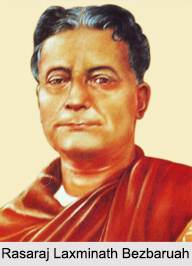
The period of modern literature began with the publication of the Assamese journal Jonaki (1889), which introduced the short story form first by Lakshminath Bezbaroa. Thus began the Jonaki period of Assamese literature. In 1894 Rajanikanta Bordoloi published the first Assamese novel Mirijiyori. The modern Assamese literature has been enriched by the works of Jyoti Prasad Agarwala, Birinchi Kumar Barua, Hem Barua, Atul Chandra Hazarika, Mafizuddin Ahmed Hazarika, Nalini Bala Devi, Navakanta Barua, Syed Abdul Malik, Mamoni Raisom Goswami, Bhabendra Nath Saikia, Homen Borgohain, Birendra Kumar Bhattacharya, D. K. Barooah, Nirupama Borgohain, Kanchan Baruah, Saurabh Kumar Chaliha, Raihan Shah and others.
Authors of Assamese Literature
Assamese literature is the entire corpus of poetry, novels, short stories, documents and other writings in the Assamese language. It also includes popular ballads in the older forms of the language during its evolution to the contemporary form. The literary heritage of the Assamese language can be traced back to the c. 9-10th century in the Charyapada, where the earliest elements of the language can be discerned. Famous authors of Assamese Literature are Ambikagiri Raichoudhury, Ananda Chandra Agarwala, Ananda Chandra Barua, Anandaram Dhekial Phukan, Banikanta Kakati, Benudhar Sharma, Bhabendra Nath Saikia, Bhubanmohan Baruah, Binanda Chandra Barua, Birinchi Kumar Barua, Bishnuprasad Rabha, Bishnuram Medhi, Brajanath Sarma, Chandra Kumar Agarwala, Chakreshwar Bhattacharyya, Ganesh Chandra Gogoi, Gopinath Bordoloi, Gunabhiram Barua, Hem Barua, Hiren Gohain, Indira Goswami, Jyotiprasad Agarwalla, Kamalakanta Bhattacharyya, Kanaklata Baruah, Lakshminath Bezbaroa etc.
Assamese literature is currently booming in Assamese-speaking world, with readership of Assamese books gradually increasing over the last decades. A huge success can be seen in North East book fair and Nagaon book fair, when selling of Assamese books increased compared to English books.