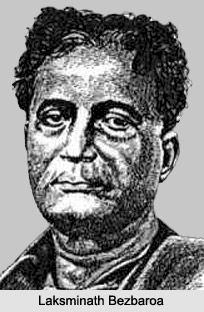
 Laksminath Bezbaroa (1868-1938) is a multifaceted luminary; at one hand a novelist, dramatist, poet, short-story writer while on the other hand folklorist, hagiologist and a writer of Philosophical essays. He is the universally acknowledged to be the greatest figure in modern Assamese literature. He was one of those who introduced Western humanistic culture into Assamese literature. In the History of Assamese Society, Bezbaroa is the esteemed exponent and expositor of the Vaishnava faith and philosophy of Srimanta Sankardeva.
He was an excellent poet, a gifted essayist, and a distinguished journalist. Assamese poetry in the hands of Lakshminath broke all its traditional fetters. He not only struck new notes and opened new vistas of thought but introduced fresh forms and diction. He wrote outstanding love-lyrics, nature-poems, narrative verse and ballads. He is thoroughly imbued with the romantic spirit, and visualises two poles for the world of poetic consciousness - the sweetness of the saddest thought and the beauty of colour and sound pervading the whole world.
Historically modern Assamese literature began its journey towards the later part of the 19th century with the advent of English education when the Assamese mind came into contact with English literature and Western humanist ideas. In this context one recalls an apparently small but vastly significant incident- that of establishing an organization called Asamiya Bhasar Unnati Sadhini Sabha in Calcutta on 25 August, 1888, by a batch of Assamese students and their subsequent publication of a literary magazine, Jonaki.
The romantic wave that touched the Assam corners towards the end of the 19th century continued to expand till the beginning of the forties. In poetry, Chandra Kumar Agarwalla proved to be not only the precursor of the deepest aspirations of Assamese romantic poetry- its love of beauty, of life in nature, its sense of sadness at the transience of beauty and at the sufferings of human life, its glorification of human life, its patriotic fervour; but he also proved to be the creator of some of the finest and deepest specimens of Assamese lyrics. His informal essays are written in pickwickian manner. His Malati and Pharing premikar jui reveal romantic possibilities of poems composed which are in a simple and unsophisticated style. His other works include Dhanbar aru Ratani. He is one of the romantic trios, the others being Hem Chandra Goswami and Agarwalla. Considered as one of the patriotic poets, even he was the messiah who freed Assamese literature from conventions. His Vin aru varagi is a poem that has a rousing patriotic appeal. In fact he created an anthem for the people of Assam.
He has to his credit a number of lyrics, nature poems, ballads and patriotic songs. He was constantly revisiting imaginatively the hills, dales and rivers of his birth place. In Dhanbar am Ratani one can find that his imagination was based on simple folk-tunes and ballad-music. Bezbaroa`s Priyatamar saundajya is written on the physical loveliness of the beloved and it is one of the finest sensuous love-poems in Assamese Literature. Bezbaroa is a poet of joy who refused to believe that the universe is an illusion.
In his patriotic songs and poems, as in Amar Janma Bhumi, Mor Deis, Asam-sangit, and Bin Baragi, Lakshminath sets forth the glories and the greatness of Assamese culture and history with glowing love and admiration. He looks with wondering eyes upon the past history of the country and bursts into splendid paeans of praise for the faded grandeur and the forgotten national heritage. Romantic idealization of the past stimulated Bezbaroa`s nationalistic sentiments. Needless to say, Lakshminath`s patriotic poetry shed lustre on and lent courage, faith, confidence and strength to the downtrodden and oppressed people of the country during their last freedom fight. His song, O My Own Land, O My Beautiful Land, is justly regarded as the national anthem of Assam.
Her folk-literature has always exercised a weird fascination over the minds of all lovers of letters. Lakshminath not only collected ancient lays in Assamese and conserved the other literary treasures of the country but also distilled their wealth of passion, imagination and expression into his own compositions. He skillfully recreated in his poems the body and soul of many an old ballad and many a mediaeval pastoral song. He was endowed with the eye of a painter and the ear of a musician. His Nimati Kanya (Dumb Bride) is a picture in words. Dkanbar am Ratani, a ballad about a rustic youth and a maiden, is a unique piece of literary creation. Kiyano Anili Mane ai Badan Tai, a sombre pastoral poem which deal with the catastrophic treason of Badan Barphukan, the Assamese Minister at whose invitation the Burmese invaded Assam in 1816, is full of melancholy, sadness and despair. Padmanath Gohain Barua also composed some lyrics, and his Phular Caneki (Sample of Flowers) is an anthology of descriptive nature poems. The poet is attracted by the silent profundity of Nature. Gerald Manley Hopkins observed that the world is charged with God`s grandeur which shines forth everywhere as from shook foil`. Gohain Barua subscribes to the same view and affirms that all Nature points to God. The sun, the trees and creepers "sing the hymns of God". From this point of view, his poem Kartavya (Duty) is note worthy. In the poem, Usa (Dawn), the poet speaks of the birth of new life as a result of the union of Dawn and Nature. Gohain Barua`s vocabulary is racy of the soil, he being extremely loyal to orthodox and meticulous Assamese. Lila is a long autobiographical poem in blank verse, describing domestic felicity. The poem glows with charming descriptions of the natural beauties of Assam.
However, his literary works has its own limitations. His poetic achievements are frivolous resulting from his intellectual maturity. He drew his inspiration from English literature trying to preserve the deft craftsmanship. His collection of poems is called Kadamkali (1913). His Gojpuria in Chakardhvaj Singha is modelled after Shakespeare`s Falstaff. The mob scene in Julius Caesar finds its reverberation in Indreswar Barthakur`s Srivatsa Chinta (1923). Bezbaroa`s Litikai (1890 is a light comedy of revenge. His three other comedies are farces of an inferior quality. He tries to sport with "human follies" and "not with crimes." Through his light comedies and farces, he has pointed out the faults of human character. He was known as `The King of Humour` for his satirical writings.
He resorted to Ahom chronicles for his serious dramas. His historical dramas are Chakradhvaj Singha, Joymati Konwari and Belimar. His Joymati Konwari is a marked improvement.