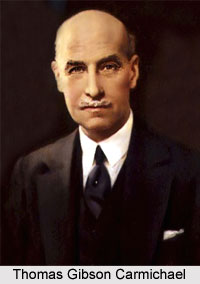
 Thomas Gibson Carmichael was one of the most well known Governors of Bengal Presidency from the year 1912 to 1917. He also acted as the Governor of Madras Presidency from 1911 to 1912. Carmichael was also a Scottish Liberal politician and a well known British colonial governor in the former undivided India under the rule of the British East India Company. Thomas Gibson Carmichael was formally known as Sir Thomas David Gibson Carmichael, 1st Baron Carmichael GCSI, GCIE, KCMG, DL.
Early Life of Thomas Gibson Carmichael
Thomas Gibson Carmichael was born on 18 March 1859 at Edinburgh in Scotland, United Kingdom. He was born to the parents Reverend Sir William Henry Gibson Carmichael, 10th Baronet, and Eleanora Carmichael, the daughter of David Anderson. He successfully completed his studies from St John`s College in Cambridge. After the death of his father in the year 1891, Thomas Gibson Carmichael succeeded as 11th Baronet.
Career of Thomas Gibson Carmichael
Thomas Gibson Carmichael was initially employed as the Private Secretary to George Trevelyan and Lord Dalhousie. Later in 1892, he ineffectively contested Peebles and Selkirk. However in 1895, Carmichael was successfully returned as Liberal Member of Parliament for Midlothian. He was preceded by William Ewart Gladstone. Carmichael continued to represent the constituency until the general election held in the year 1900. Sir Thomas David Gibson Carmichael, 1st Baron Carmichael GCSI, GCIE, KCMG, DL was assigned as the Governor of Victoria in the year 1908. He served in office from 27 July 1908 to 19 May 1911. Carmichael, as governor, allowed Victoria Premier Sir Thomas Bent to dissolve the assembly and request fresh elections. Eventually John Murray was appointed as the governor.
Thomas Gibson Carmichael was appointed as the Governor of Madras Presidency on 3 November 1911. He was preceded by Arthur Lawley, 6th Baron Wenlock, GCIE, KCMG. The Madras Presidency, which was also known as the Presidency of Fort St. George and Madras Province, was an administrative sub division of British India. The region comprised much of southern India, such as the modern states of Tamil Nadu, the Coastal Andhra and Rayalaseema regions of Andhra Pradesh, Lakshadweep Islands, the Malabar region of North Kerala, Koraput, Malkangiri, Nabarangapur and Gajapati districts of southern Orissa and the Bellary, Ganjam, Dakshina Kannada, Rayagada and Udupi districts of Karnataka. He served in office till 30 March 1912 and was succeeded by Sir Murray Love Hammick KCSI CIE as the Acting Governor of Madras Presidency.
Later Carmichael was appointed as the Governor of Bengal Province on 1 April 1912 and was preceded by Sir Frederick William Duke, who retired from the post in the year 1912. The Bengal Presidency originally comprised east and west Bengal and was a colonial region of the British Empire in India. The region included the territories of undivided Bengal like West Bengal, Tripura, Orissa, Meghalaya, Bihar, Assam and modern Bangladesh. He held the position until 26 March 1917 and was succeeded by Laurence John Lumley Dundas, 2nd Marquess of Zetland KG, GCSI, GCIE, PC, DL, JP, who took office on 26 March 1917 and served as his replacement.
Thomas Gibson Carmichael later served as Chairman of the Scottish Board of Lunacy from the year 1894 to 1897. He became a Trustee of the National Portrait Gallery in 1904 and served in the position till 1908. He also served as the National Gallery from the year 1906 to 1908. From 1920 to 1926, Carmichael served as Lord Lieutenant of Peeblesshire.
Personal Life of Thomas Gibson Carmichael
In the year 1886, Thomas Gibson Carmichael was married to Hon. Mary Helen Elizabeth, who was the daughter of Baron Albert Nugent. The couple had no issue. Carmichael died on 16 January 1926 at the age 66 years at Portman Street in London, England. After his death, the barony became extinct on his death.
Honours of Thomas Gibson Carmichael
Thomas Gibson Carmichael was appointed a Knight Commander of The Order of St Michael and St George (KCMG) in 1911. Later in the year 1911, he was knighted with Knight Grand Commander of The Most Eminent Order of the Indian Empire (GCIE) and with Knight Grand Commander of The Most Exalted Order of the Star of India (GCSI) in 1917. Carmichael was also raised to the peerage as Baron Carmichael of Skirling in the County of Peebles in 1912.